
How Amenities Impact Student Housing ROI
Amenities can make or break your student housing investment. Here's why:
Rent Premiums: High-quality features like fitness centers or social spaces allow properties to charge more. For example, a $50 rent increase per bed in a 500-bed property could justify a $3,000 per bed investment for a 20% return.
Occupancy Rates: Properties with modern amenities like fast internet or wellness spaces lease faster and maintain higher occupancy. Older buildings without updates often struggle.
Lease Renewals: Amenities like study lounges and coffee bars create convenience that encourages tenants to stay, saving up to $4,000 per unit in turnover costs.
Key takeaway: Thoughtful investments in internet, wellness, and social spaces directly improve rent, retention, and profitability. Data-driven tools like CoreCast help investors analyze which features drive the best returns.
Amenities That Increase Student Housing ROI
High-Speed Internet and Connectivity
In today's student housing market, reliable, high-speed internet isn't just a perk - it's an absolute must. Take The Urban in Columbus, Ohio, for example. Managed by The Prime Company, this multifamily development faced major Wi-Fi complaints during the 2024–2025 academic year. To fix the issue, they teamed up with Allbridge to install a gigabit wireless network. The result? Internet speeds improved tenfold, delivering a whopping 590% ROI in just one year[6].
"Since switching to Allbridge, our internet experience has tremendously improved. We now have a reliable connection with consistently great speeds." - Jared Turner, General Manager, The Urban [6]
A seamless internet connection isn't just about convenience - it directly impacts resident satisfaction and retention. Poor connectivity can lead to unhappy tenants and even vacancies. But let's move on to another key feature: study lounges and wellness spaces.
Study Lounges and Wellness Spaces
Gone are the days when student housing study spaces were just basic computer labs. Today’s designs are all about versatility and comfort. For instance, The Marshall in Minneapolis, MN, located near the University of Minnesota, underwent a stunning transformation by BKV Group. A previously underused lobby was reimagined as a dynamic hub featuring a coffee bar, communal worktables with built-in lighting, diner-style booths, and glass-enclosed study rooms[2].
"At the end of the day, what matters most are a trifecta of spaces that help improve students' ability to socialize, study and stay well mentally and physically." - Kelly Naylor, Vice President of Interior Design, BKV Group [2]
Wellness spaces are also evolving. Beyond the typical gym setup, properties are introducing sensory rooms with customizable lighting and sound, fitness areas that connect to outdoor spaces, and even wellness-focused designs aimed at supporting mental health. These thoughtful touches not only promote well-being but also encourage lease renewals and justify higher rents [2][4]. And speaking of well-being, let’s talk about fitness centers.
Fitness Centers and Health Amenities
Fitness amenities in student housing have come a long way. Today, they focus on a holistic approach to health, offering more than just treadmills and weight machines. Many properties now feature virtual reality rooms for sports like golf and tennis, meditation spaces, and outdoor fitness areas [2].
One standout example is UnionWest Student Living in Orlando, FL, designed by Baker Barrios Architects. This 600-bed property integrates student housing with academic spaces, including incubation labs for digital media students to test gaming and software projects using dedicated media infrastructure. This innovative design fosters creativity while catering to both academic and personal growth [2].
Modern fitness amenities don’t just improve tenant satisfaction - they also help reduce turnover, ultimately boosting ROI [5].
Student Housing Unlocked: When Does Data Come Into Play
How Social Spaces Affect Financial Returns
Social spaces are more than just a nice-to-have - they're a key factor in making properties attractive and profitable. These areas directly impact tenant retention, which in turn reduces the high costs associated with turnover. Tenant turnover can rack up expenses of around $4,000, including marketing, repairs, and vacancy losses [5].
The goal is to create spaces that encourage real community connections. Features like coffee bars, communal kitchens, and flexible lounges give students opportunities for daily interactions, which boosts positive word-of-mouth - a critical driver of traffic for student housing [2]. This sense of community naturally leads to financial gains.
As KrisAnn Kizer, Vice President of Marketing and Leasing at Pierce Education Properties, explains:
"Students want to be with friends who share similar interests. They often come to buildings because of a positive word of mouth. For this reason, social media offers a huge benefit." [2]
Students also gravitate toward spaces that look great and are social media-worthy. Visually appealing areas, like rooftop pools, fire pits, or stylish lounges, not only enhance the living experience but also serve as organic marketing tools when students share photos online [2].
Social Space ROI Examples
Real-world examples show how investing in social spaces can directly boost rents and occupancy rates. Take The Scion Group's 2014 renovation of the Village of Blacksburg near Virginia Tech. By upgrading interiors and adding social amenities, they achieved a 14% rent increase and hit 100% occupancy by March of that year [7]. Similarly, Homestead U invested $1.2 million in renovating the River Park property at Ohio University. The project included a resort-style pool, pool house, and barbecue area, all designed to enhance returns [7]. These examples highlight the financial advantages of well-designed social spaces.
Flexibility is key to maximizing these returns. Fixed-purpose rooms, like movie theaters, can quickly become outdated as student preferences shift. Instead, multipurpose spaces - like lounges with movable furniture, co-working areas, and outdoor spots with fire pits and grills - are gaining popularity for their ability to adapt to changing trends [2].
When students feel connected and safe in these spaces, they tend to bring their friends along. This creates a ripple effect, where retaining one group often leads to retaining their entire social circle [2].
Transform Your Real Estate Strategy
Access expert financial analysis, custom models, and tailored insights to drive your commercial real estate success. Simplify decision-making with our flexible, scalable solutions.
Amenity Performance Data and ROI Metrics
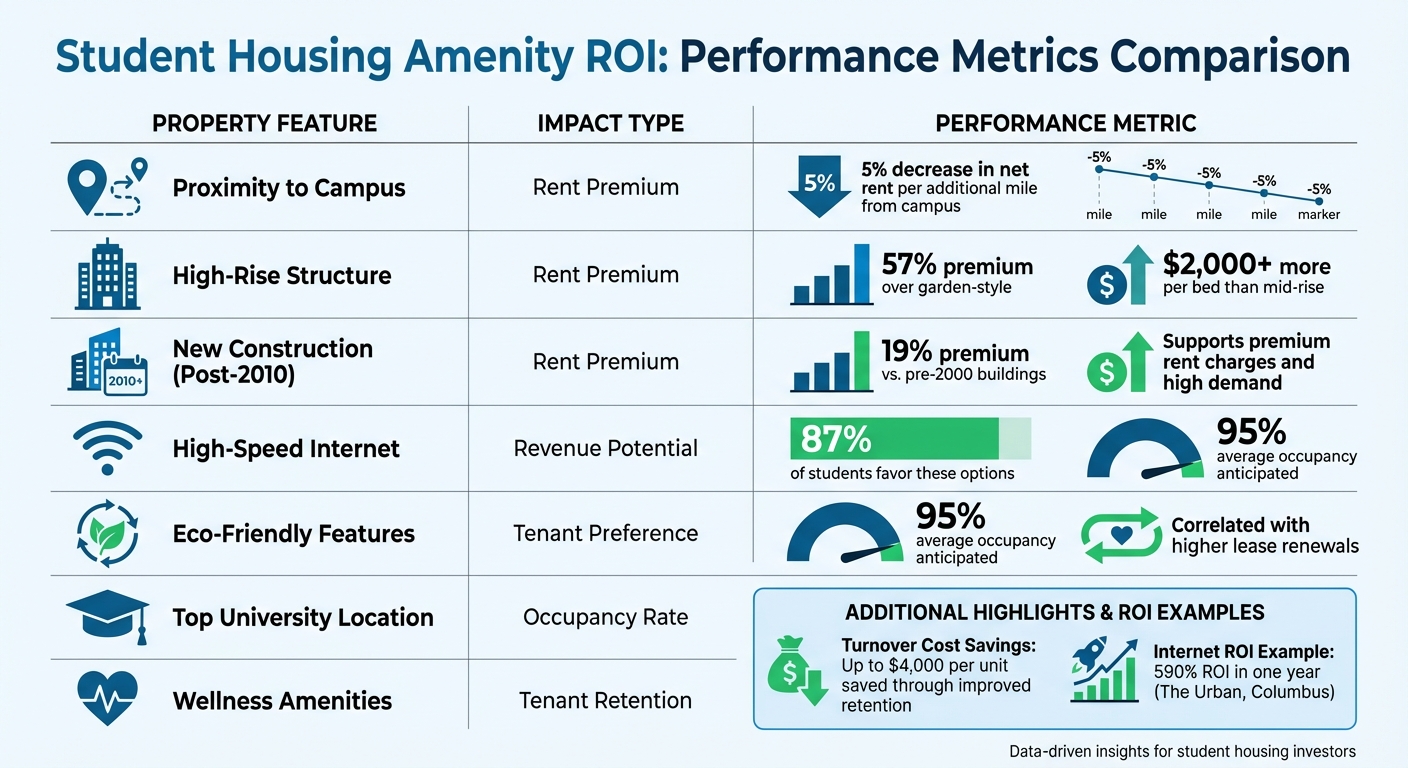
Student Housing Amenity ROI Comparison: Key Performance Metrics
Figuring out which amenities deliver the best financial returns comes down to analyzing the numbers - rent premiums, occupancy rates, and tenant retention all paint a clear picture of what drives success in student housing.
Proximity to campus is a major factor in revenue. Properties lose about 5% in net rent per bed for every additional mile they are from campus [8]. For example, a property three miles away could see a 15% dip in rental income compared to one located right next to campus.
Building type also plays a big role. High-rise buildings bring in a 57% rental premium over garden-style apartments, with median rental income exceeding $2,000 more per bed than mid-rise buildings [8]. While garden-style apartments tend to have lower per-bed operating costs, they often face higher vacancy rates [8].
Property age matters as well. Buildings constructed after 2010 earn a 19% net rental premium compared to those built before 2000 - a jump from 15% in earlier years [8]. Additionally, wellness-focused amenities, such as meditation rooms and outdoor fitness spaces, have been linked to higher lease renewals, although the exact impact varies by location [4].
Conclusion
When it comes to student housing, the return on investment (ROI) heavily depends on offering amenities that align with student lifestyles. Features like high-speed internet, adaptable study areas, and state-of-the-art fitness centers not only attract higher rents but also help maintain strong occupancy rates. Recent data shows that both students and parents are willing to pay more for properties that provide genuine value [3].
Today's students are more focused on practicality than flashy extras. As Teddy Abdelmalek, Senior Vice President at HH Redstone, explains:
"The student of today has matured. They see through marketing gimmicks. The emphasis has shifted from spectacle to substance" [10].
This shift highlights the growing importance of amenities that directly support academic achievement and overall wellness.
Making smart, data-backed decisions is what sets successful investments apart. For instance, if a rent increase is limited to $50 per bed in a 500-bed property, the maximum allowable investment to achieve a 20% return would be $3,000 per bed [1]. Insights like these are essential for effective investment analysis.
Tools like CoreCast simplify this process by bringing together deal underwriting, pipeline tracking, and portfolio benchmarking. With CoreCast, investors can compare amenities across their portfolio, create professional reports for stakeholders, and assess how specific amenities impact occupancy rates. It turns amenity planning into a streamlined, data-focused strategy.
In short, carefully chosen and consistently evaluated amenities are the key to boosting both occupancy and net operating income in student housing. Data-driven tools ensure these investments deliver measurable results.
FAQs
-
Amenities can have a noticeable impact on rental prices. For instance, offering garage parking can bump up rent by about 8%, while having in-unit washers and dryers adds roughly 6%. The effect of these features can vary based on location - cities like New York tend to see even greater increases. Other sought-after amenities, such as fitness centers and yards, typically boost rent by around 5% each on a national level. These additions are highly appealing to tenants and can play a big role in maximizing rental income.
-
Amenities play a key role in cutting turnover costs by improving tenant satisfaction and retention. Features such as study lounges and fitness centers make living spaces more appealing, encouraging tenants to renew their leases. By minimizing vacancies and re-leasing efforts, these amenities help reduce overall turnover expenses.
-
CoreCast evaluates the return on investment (ROI) for amenities by analyzing data on their costs and benefits - think study lounges, fitness centers, and similar features. By factoring in market trends and tenant preferences, it estimates how these amenities influence property income and overall valuation. This data-focused method equips investors with the insights they need to determine which amenities are likely to deliver the highest ROI.