
Top Tools for Regulatory Change Management

Managing regulatory changes is tough, especially for construction and real estate professionals dealing with complex rules and steep penalties. In 2024, over 90,000 pages of new regulations were issued, making manual tracking nearly impossible. Penalties for non-compliance surged by 417% in early 2025, with the SEC collecting $8.2 billion in fines that year. Automated tools are now essential to stay compliant, cut costs, and avoid project delays.
Key features to look for in these tools include:
- Automated monitoring of regulations at federal, state, and local levels.
- AI-powered analysis to filter relevant updates and assess their impact.
- Integration with existing systems like project management and ERP software.
- Mobile access for real-time updates at job sites.
CoreCast is one such platform tailored for construction and real estate teams. It tracks regulatory changes, provides visual impact analysis, and integrates compliance updates into workflows. Pricing starts at $50/user/month during beta, with higher tiers available post-launch.
To implement these tools effectively:
- Align stakeholders early.
- Start with high-risk agencies.
- Set clear response workflows and integrate with existing systems.
Shifting from manual processes to automated tools not only reduces compliance costs by up to 90% but also helps teams respond 60% faster to new regulations. These tools transform compliance from a burden into a streamlined part of daily operations.
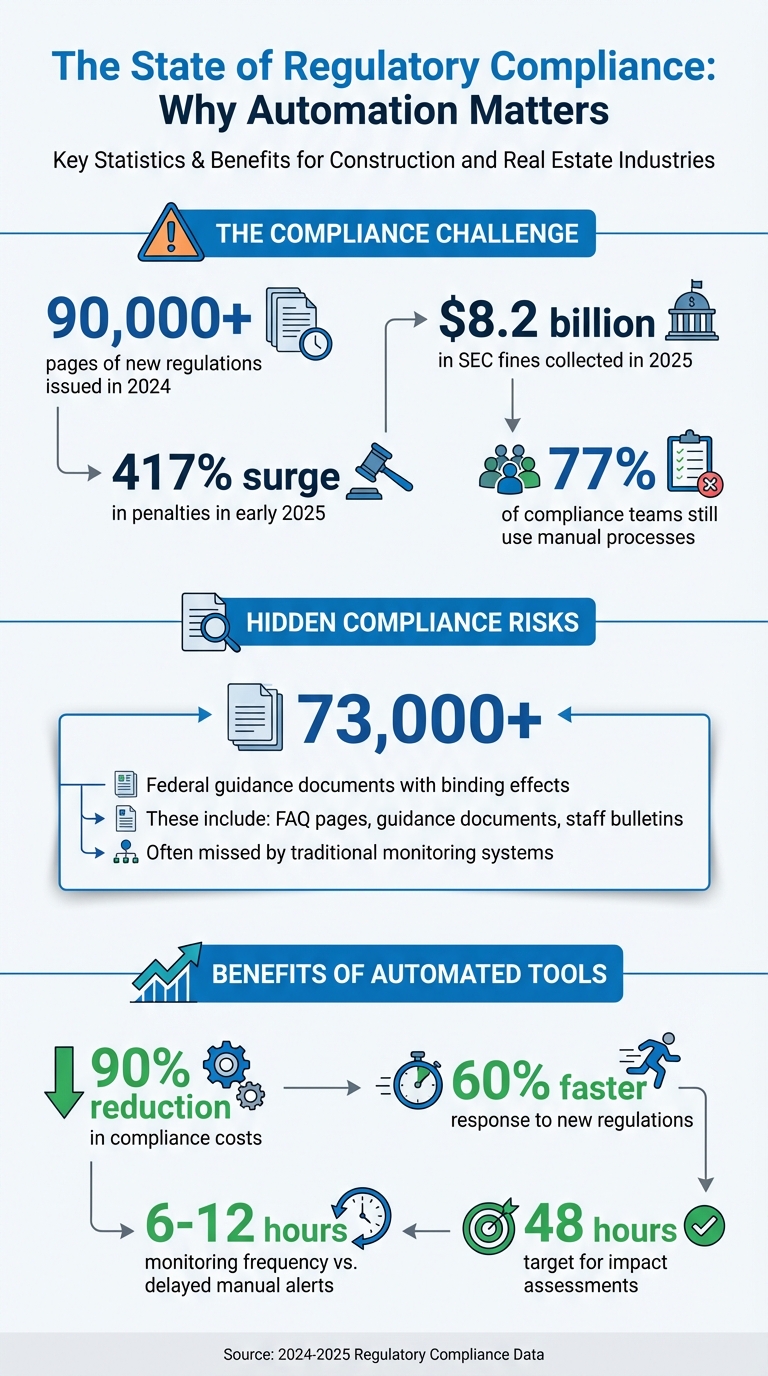
Regulatory Compliance Statistics and Cost Savings 2024-2025
7 Best Compliance Automation Tools
sbb-itb-99d029f
What to Look for in Regulatory Change Management Tools
When it comes to handling compliance challenges, the best regulatory change management tools go beyond basic alerts - they offer advanced features that truly make a difference.
One of the key features to look for is automated regulatory intelligence. The tool should actively monitor federal, state, and local agency websites, not just the Federal Register. As the Changeflow team highlights:
"The biggest compliance risks aren't in the Federal Register. They're in guidance documents, FAQ pages, and staff bulletins that most monitoring systems completely miss" [3].
This is a critical point, considering federal agencies maintain over 73,000 guidance documents that, while not formally published through rulemaking, still have binding effects [3]. To stay ahead, your system must track these primary sources directly, checking critical pages every 6–12 hours instead of relying on delayed alerts.
Another must-have is AI-powered filtering and impact analysis. This feature helps cut through the noise, ensuring your team isn’t overwhelmed by irrelevant updates. Using natural language processing, modern tools can analyze complex regulatory language, automatically extract obligations and deadlines, and send only relevant alerts based on your industry, location, and operations [4]. For example, in construction, this could mean instantly identifying which job sites are affected by a new OSHA safety rule and determining what documentation updates are necessary. The tool should also link new requirements to your existing policies, revealing any gaps before they lead to compliance issues.
Integration capabilities are equally important. A good tool should fit seamlessly into your existing workflow rather than creating new data silos. For construction firms, this means integrating with project management software, ERP systems, and document management platforms. This kind of connectivity allows real-time cost tracking, ensuring regulatory changes are automatically reflected in budgeting tools and preventing unexpected expenses. This integration also facilitates scenario analysis for real estate portfolios to model the financial impact of potential regulatory shifts. CMiC Global underscores this benefit:
"Real-time reporting eliminates data duplication: Centralized databases record changes once and reflect system-wide, reducing risks common in legacy systems" [5].
Lastly, mobile access is vital. Field personnel need immediate access to regulatory updates and safety protocols, especially when working at remote job sites [5][6]. These features together shift regulatory management from being a reactive chore to a proactive, strategic advantage.
Top Tools for Regulatory Change Management
CoreCast is reshaping how construction and real estate teams handle regulatory compliance. It simplifies the complex regulatory environment by providing a precise and efficient solution. With its comprehensive features, CoreCast delivers a one-stop platform for managing all aspects of regulatory requirements.
CoreCast
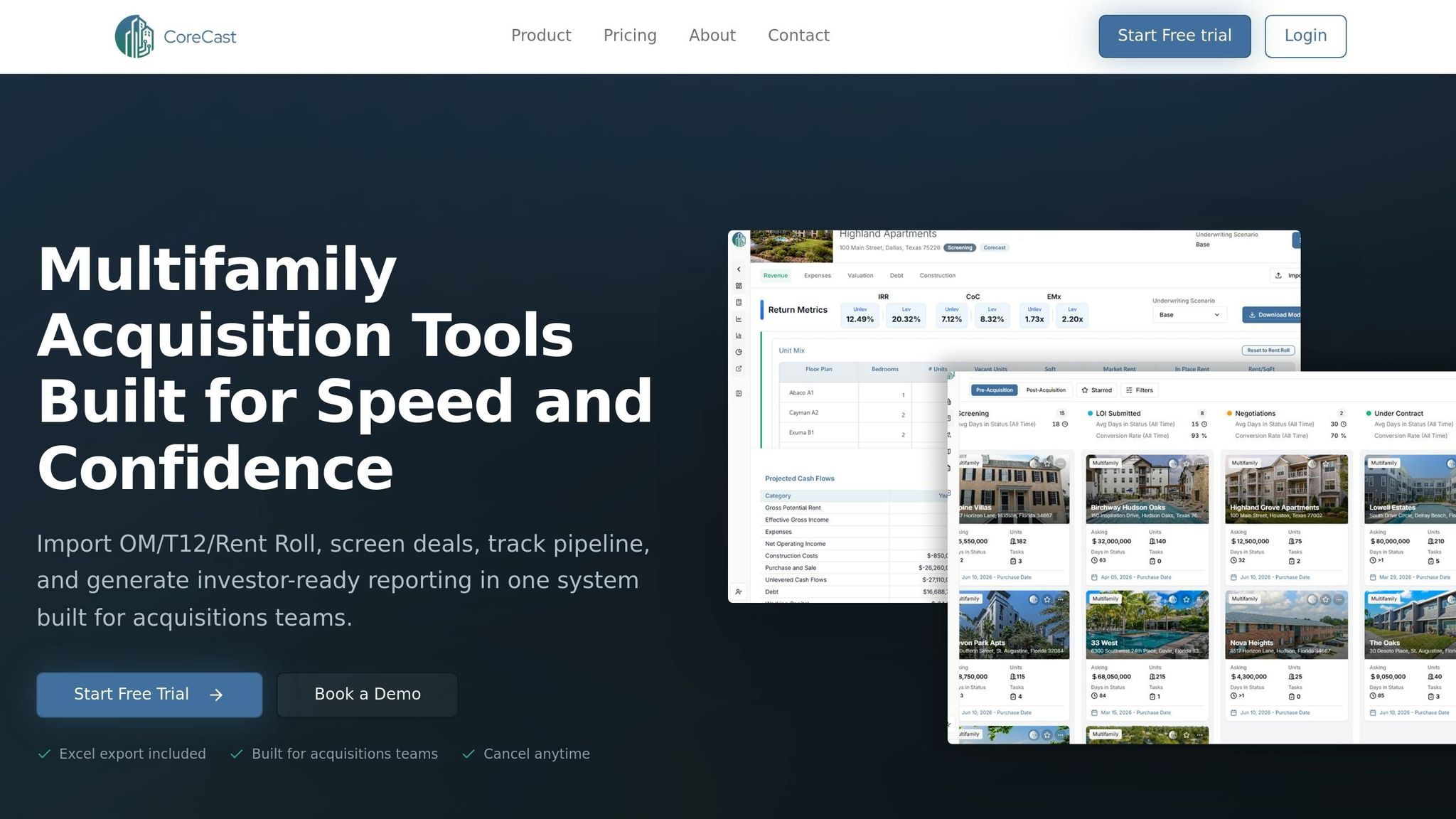
CoreCast is a versatile real estate intelligence tool that brings together deal management, portfolio analysis, and regulatory tracking into a single, cohesive workspace. Here's what it offers:
- The ability to underwrite any asset class and monitor deal progress through various stages.
- An integrated mapping feature that helps users visualize properties and assess their competitive landscape, making it easier to pinpoint sites impacted by new construction regulations.
- A stakeholder center that enhances communication through customizable, branded reports, which include essential compliance updates.
Currently in its beta phase, CoreCast is priced at $50 per user per month. Once fully launched, it will offer additional pricing tiers: Essentials at $75 per user per month and Pro at $100 per user per month. Looking ahead, CoreCast plans to introduce expanded construction management tools, further simplifying regulatory change management for projects.
Feature Comparison of Regulatory Change Management Tools
CoreCast Feature Overview
When selecting a regulatory change management tool, it’s crucial to align it with your team’s unique needs, budget, and workflows. CoreCast delivers a focused solution, offering real-time insights and compliance management specifically designed for professionals in construction and real estate.
| Tool | Automated Monitoring | Impact Assessment | Workflow Automation | Reporting Capabilities | Pricing |
|---|---|---|---|---|---|
| CoreCast | Comprehensive regulatory monitoring with integrated property mapping | Visual impact analysis via integrated maps | Stakeholder-branded report automation | Customizable, branded reporting | $50/user/month (beta); $75–$100/user/month (post-launch) |
This table highlights how CoreCast addresses the complex challenges of regulatory compliance. With 77% of compliance teams still relying on manual processes [4], CoreCast simplifies the entire process by offering real-time updates and smooth integration into existing workflows. This not only reduces the costs tied to compliance but also helps teams respond faster to regulatory changes. And let’s face it, the costs of non-compliance can be staggering, making an efficient tool like CoreCast a necessity.
"A GRC platform without regulatory awareness is flying blind. An awareness tool without a response workflow leaves findings sitting in an inbox." - Changeflow Team [7]
For construction and real estate professionals juggling supply chain compliance, CoreCast goes beyond basic tracking. By integrating regulatory monitoring with deal management and portfolio analysis, it eliminates the hassle of managing multiple disconnected tools. The result? A single, comprehensive platform that simplifies regulatory change management for construction supply chains.
How to Implement Regulatory Change Management Tools
For construction and real estate teams, successfully implementing regulatory change management tools is just as important as choosing the right software. It all starts with stakeholder alignment. Bring together executive sponsors, compliance experts, legal teams, and operational staff early in the process. This ensures the tool is tailored to your organization’s needs, rather than becoming just another isolated system [4]. Getting everyone on the same page upfront creates a strong foundation for a smooth rollout.
A phased deployment approach works best. Begin by focusing on the 10–15 agencies that pose the greatest compliance risks [7]. This helps your team avoid being overwhelmed with information and allows them to gain confidence with the system before expanding its use. For example, construction supply chains might start by tracking OSHA safety updates and environmental regulations, then later incorporate state-level building codes.
Establish clear response workflows to keep things running efficiently. Assign reviewers, prioritize findings, and aim to complete impact assessments within 48 hours. Use automated routing to ensure regulatory updates are sent to the right subject matter expert immediately, reducing the risk of compliance gaps.
Integration is key. Connect your regulatory change management platform with existing tools like project management software, document management systems, and communication platforms such as Slack or email. This ensures that updates - like a new environmental regulation - are seamlessly incorporated into active project workflows instead of getting buried in someone’s inbox. Be cautious about over-customizing the system; opt for configurable tools that are easier to maintain over time [4][7].
Once workflows are in place and integrations are set up, rigorous testing is the next step. Conduct unit, integration, and user acceptance testing before launching the system to ensure staff can follow the new procedures effectively [8]. Considering that 77% of compliance teams are still relying on manual processes [4], thorough testing is essential to prevent users from falling back into old habits after the system goes live.
Conclusion
Choosing the right regulatory change management tool depends on real-time visibility, AI-driven automation, and integrations that work seamlessly - especially as enforcement penalties have skyrocketed by 417% in early 2025 [3]. Automated platforms have proven their worth, helping organizations cut compliance costs by 90% and respond to regulatory changes 60% faster [1].
The focus should be on moving away from manual processes to systems that centralize data, automate supplier interactions, and catch less obvious regulatory updates [3]. Tools that map new requirements to existing policies can pinpoint gaps before they lead to violations. This is where platforms like CoreCast shine, combining comprehensive regulatory insights with operational workflow management.
CoreCast tackles these challenges head-on by delivering real-time regulatory updates and ensuring centralized data accuracy. By integrating regulatory tracking with tools for portfolio analysis, pipeline management, and stakeholder reporting, it allows teams to weave compliance into their daily workflows rather than treating it as an isolated task.
Kristy Grant-Hart, Vice President and Head of Advisory Services at Spark Compliance, highlights the importance of this approach:
"When companies prioritize advanced compliance tools and ongoing risk assessments, they're better equipped to anticipate regulatory changes and minimize exposure to emerging risks" [2].
The right platform does more than just reduce fines - it strengthens your organization’s risk management and demonstrates solid governance to both investors and regulators.
Take stock of your regulatory obligations, focus on high-risk areas, and select a system with strong detection, automation, and audit trail capabilities. The goal is to shift your team’s focus from reactive problem-solving to proactive compliance management.
FAQs
Which regulations should we monitor first?
Organizations should focus on tracking regulations that carry the most significant risks or could heavily affect their operations. This means keeping a close eye on rules that are frequently updated, newly issued guidance documents, or enforcement actions that suggest shifts in interpretation. Areas like ESG reporting, AI governance, and mandates specific to certain industries are evolving quickly and deserve extra attention. Leveraging automated tools can simplify the process of monitoring these changes, helping ensure compliance with critical regulations like data privacy laws and environmental standards.
How do we connect regulatory alerts to project workflows?
To link regulatory alerts with project workflows effectively, leverage tools that automate the process of monitoring, assessing, and integrating regulatory updates. Key features such as impact analysis, automated notifications, and workflow tracking help ensure that updates prompt the necessary actions. This process includes setting up alerts, identifying affected areas, and embedding relevant insights directly into workflows. By doing so, you can simplify compliance efforts and minimize potential risks.
What should we test before rolling out CoreCast?
Before launching CoreCast, it’s crucial to test how well it can detect, evaluate, and respond to regulatory changes. Confirm that it can accurately identify relevant updates, assess their impact on your operations, and facilitate timely actions - like updating policies or initiating training programs. Make sure it integrates seamlessly with your existing data and workflows to maintain proactive compliance management. These steps will help ensure CoreCast supports your regulatory change management processes effectively before it’s fully deployed.