
Portfolio Insights from Tenant Behavior Analytics

Tenant behavior analytics is transforming how commercial real estate portfolios are managed. By focusing on tenant satisfaction alongside traditional financial metrics, property owners can improve lease renewals, reduce turnover, and increase revenue. Here's why it matters:
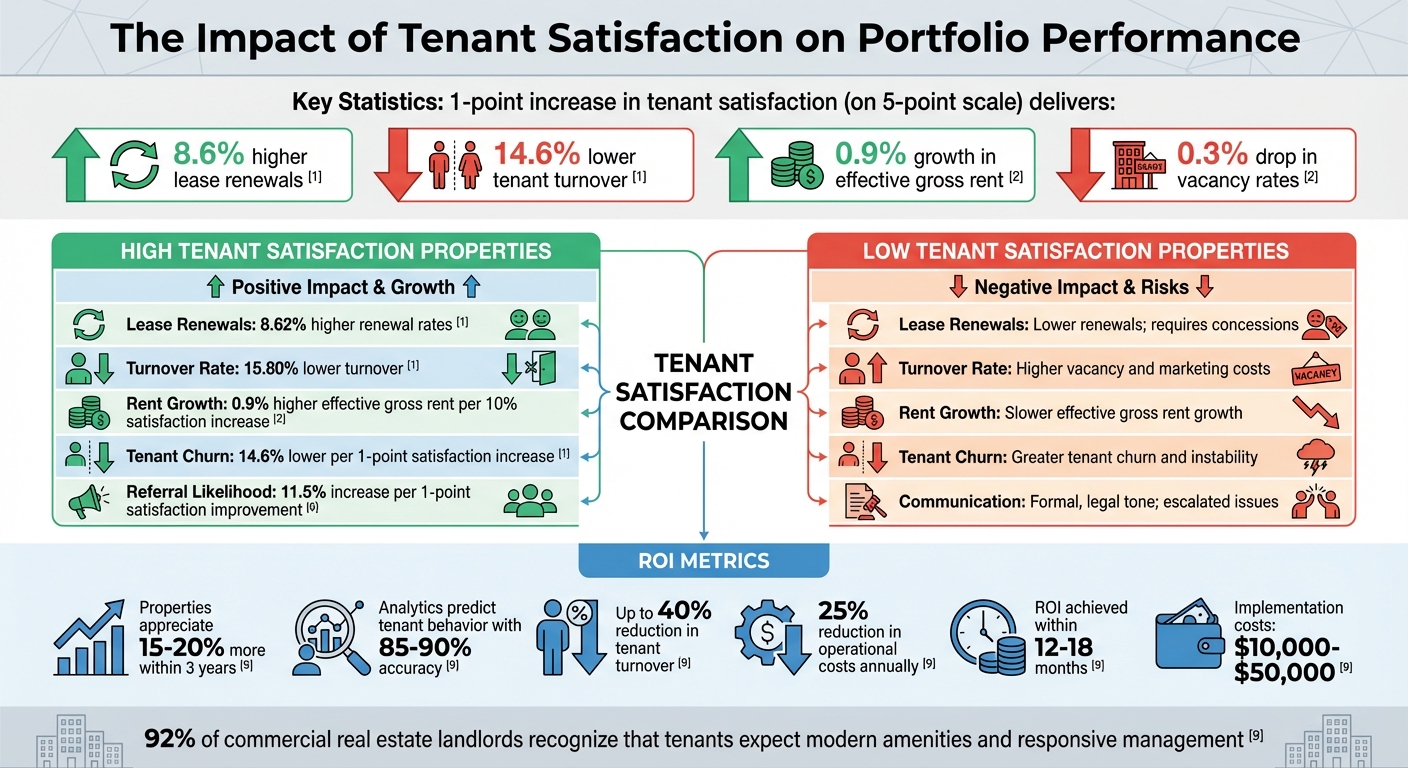
- 1-point tenant satisfaction increase (on a 5-point scale) leads to:
- 8.6% higher lease renewals
- 14.6% lower tenant turnover
- 0.9% growth in effective gross rent
- 0.3% drop in vacancy rates
- Properties with satisfied tenants experience 8.62% higher renewals and 15.80% lower turnover rates compared to those with dissatisfied tenants.
- Dissatisfied tenants often signal issues early through late payments, reduced engagement, or escalated communication.
Tools like CoreCast help property managers track these metrics in real time, allowing for smarter decisions and better portfolio performance. By leveraging tenant behavior data, you can reduce operational costs and stabilize cash flow while addressing tenant needs effectively.
Impact of Tenant Satisfaction on Commercial Real Estate Performance
1. Properties with High Tenant Satisfaction
Tenant Retention
When tenants are happy, property owners can avoid the expensive churn of tenant turnover. Turnover brings costs like marketing expenses, broker fees, tenant improvement allowances, and the loss of rental income during vacancies. Here’s a key stat: improving tenant satisfaction by just 1 point on a 5-point scale lowers the likelihood of a tenant leaving by 14.6% [2]. This means fewer vacancies, steadier cash flow, and a more stable property portfolio.
Operational Efficiency
Tenant satisfaction doesn’t just help with retention - it also boosts operational performance. For example, a 10% increase in tenant satisfaction translates to a 0.9% rise in effective gross rent and a 0.3% drop in vacancy rates [2]. Plus, satisfied tenants are more likely to recommend the property. In fact, a 1-point improvement in satisfaction increases the chance of tenant referrals by 11.5% [2]. These referrals act as free marketing, making it easier and cheaper to fill vacancies with tenants who already have positive impressions. These operational improvements directly contribute to better financial outcomes.
Financial Performance
The ripple effects of tenant satisfaction go beyond day-to-day operations - they significantly impact financial performance. Properties with high satisfaction levels consistently excel in revenue generation and cost control. Lower turnover means reduced spending on renovations, leasing commissions, and the revenue gaps caused by vacant units. For portfolio managers, tracking tenant satisfaction scores provides a clear benchmark for success, showing how aligning property operations with tenant needs can drive measurable returns.
Using tools like CoreCast, an integrated real estate intelligence platform, property managers can combine tenant behavior data with broader portfolio insights. This approach enables smarter decisions and supports long-term asset growth.
sbb-itb-99d029f
2. Properties with Low Tenant Satisfaction
Tenant Retention
When tenant satisfaction dips, the signs often show up long before any formal notice of non-renewal. For instance, dissatisfied tenants might bypass standard property management channels, opting instead to contact ownership directly or even escalate matters to legal counsel [3]. You might also notice a shift in communication style - from friendly, long-term planning discussions to a more transactional or even legal tone [3]. Another clue? Monthly payments starting to arrive later, even if they’re still within the grace period. This could indicate financial strain or a lack of commitment to the property [3]. These subtle changes often hint at deeper operational challenges ahead.
Operational Efficiency
Tenant dissatisfaction doesn’t just affect relationships - it can also disrupt operations. For example, unhappy tenants may stop reporting minor maintenance issues, like a flickering light or a stained floor tile. Over time, this neglect can lead to costly deferred maintenance [3]. Other engagement metrics might also drop - such as fewer survey responses, lower attendance at community events, or reduced use of amenities. These declines, often observed over a six-month period, usually come before tenants decide not to renew [3]. Communication becomes more formal too, with tenants addressing their requests impersonally to “Property Management” and even including legal counsel in routine correspondence [3].
Financial Performance
In today’s market, 92% of commercial real estate landlords recognize that tenants expect modern amenities and sustainability features [1]. Properties that fail to deliver on these expectations risk losing tenants and seeing occupancy rates drop. By keeping an eye on these trends, portfolio managers can adjust their strategies to protect net operating income. Tools like CoreCast’s real estate intelligence platform make it possible to monitor trends in real time, enabling property managers to take proactive, data-driven steps to stabilize performance.
The impact of tenant behavior on the built environment with Julie Whelan, SVP at CBRE
Pros and Cons
Examining tenant retention and operational efficiency reveals a clear divide between properties with high and low tenant satisfaction. Properties with satisfied tenants enjoy 8.62% higher lease renewal rates and 15.80% lower turnover rates [1]. These benefits directly translate into shorter vacancy periods, reduced marketing costs, and more consistent cash flow timing. On the flip side, properties with lower tenant satisfaction face higher vacancy costs, the need for concessions to attract tenants, and ongoing turnover-related expenses.
Interestingly, a 10% boost in tenant satisfaction at the building level correlates with a 0.9% increase in effective gross rent growth. Additionally, for every 1-point rise in tenant satisfaction (on a 1–5 scale), the likelihood of a tenant moving out drops by 14.6% [2].
| Metric | High Tenant Satisfaction Properties | Low Tenant Satisfaction Properties |
|---|---|---|
| Lease Renewals | 8.62% higher renewal rates [1] | Lower renewals; often requires concessions [1] |
| Turnover Rate | 15.80% lower turnover [1] | Higher vacancy and marketing costs |
| Rent Growth | 0.9% higher effective gross rent per 10% satisfaction increase [2] | Slower effective gross rent growth [2] |
| Tenant Churn | 14.6% lower per 1-point satisfaction increase [2] | Greater tenant churn and instability |
With tools like CoreCast enabling real-time tracking of these metrics, portfolio managers can make smarter, data-driven decisions. Low tenant satisfaction not only creates operational challenges but can also negatively impact an entire portfolio. Given that 92% of commercial real estate landlords recognize modern amenities and responsive management as tenant priorities [1], addressing these gaps is key to maintaining profitability and identifying underperforming assets before they cause financial strain.
Conclusion
Tenant behavior analytics offers a powerful way to identify portfolio gaps before they affect financial performance. For example, properties with higher tenant satisfaction see an 8.62% boost in lease renewals and 15.80% lower turnover rates [1]. Over time, this satisfaction translates into properties appreciating 15–20% more within three years [4].
Analytics platforms take this a step further by predicting tenant behavior with 85–90% accuracy, using data like payment history, maintenance requests, and amenity usage patterns [4]. These insights can cut tenant turnover by up to 40% and reduce operational costs by 25% annually [4][6]. Many property managers report seeing a return on investment within 12–18 months, as vacancy rates drop and operational efficiency improves [4].
CoreCast simplifies this process by consolidating these analytics into a single platform. It allows users to monitor portfolio-wide trends, dive into property-specific data, and create custom-branded reports for stakeholders. Instead of managing multiple spreadsheets or systems, CoreCast provides real-time insights that help you focus on properties needing attention and allocate resources strategically. Starting with key metrics like payment history and maintenance requests can deliver quick results, while more advanced analyses can follow as your confidence in the data grows.
The adoption of AI-driven analytics for real-time CRE analytics for KPI tracking is already reshaping the industry [5]. With implementation costs ranging from $10,000 to $50,000, depending on portfolio size [4], the investment often pays for itself through better retention, optimized pricing, and fewer surprises. The real challenge is how quickly you can put these tools to work. Platforms like CoreCast give you the ability to act swiftly, ensuring stable cash flow and strong performance in a rapidly evolving market.
FAQs
What tenant behaviors predict a non-renewal?
Tenant behaviors that could signal a higher likelihood of non-renewal include consistently late rent payments, frequent maintenance requests, and negative satisfaction feedback. These patterns often correlate with higher tenant turnover rates.
Which tenant data points should I start tracking first?
Tracking core metrics such as occupancy rates, lease expirations, tenant satisfaction, rent payment trends, and lease renewal rates is a smart way to understand tenant behavior and boost portfolio performance. For instance, keeping an eye on lease expirations allows you to take proactive steps toward renewals, minimizing vacancies. Tenant satisfaction scores can serve as a strong indicator of retention likelihood, while analyzing rent payment patterns and conversion rates sheds light on tenant reliability and leasing effectiveness. These insights empower you to make informed decisions and fine-tune your portfolio strategy.
How does CoreCast turn tenant data into portfolio actions?
CoreCast leverages advanced analytics and automation to turn tenant data into practical portfolio strategies. It brings together real-time insights on tenant profiles, occupancy rates, lease expirations, and behavior, making it easier to monitor key performance indicators. By diving into this data, users can spot potential risks, predict trends, and apply strategies like diversification or retention. The result? Improved portfolio performance, reduced risks, and stronger long-term returns.