
5 Steps to Custom IoT Integration for Smart Buildings
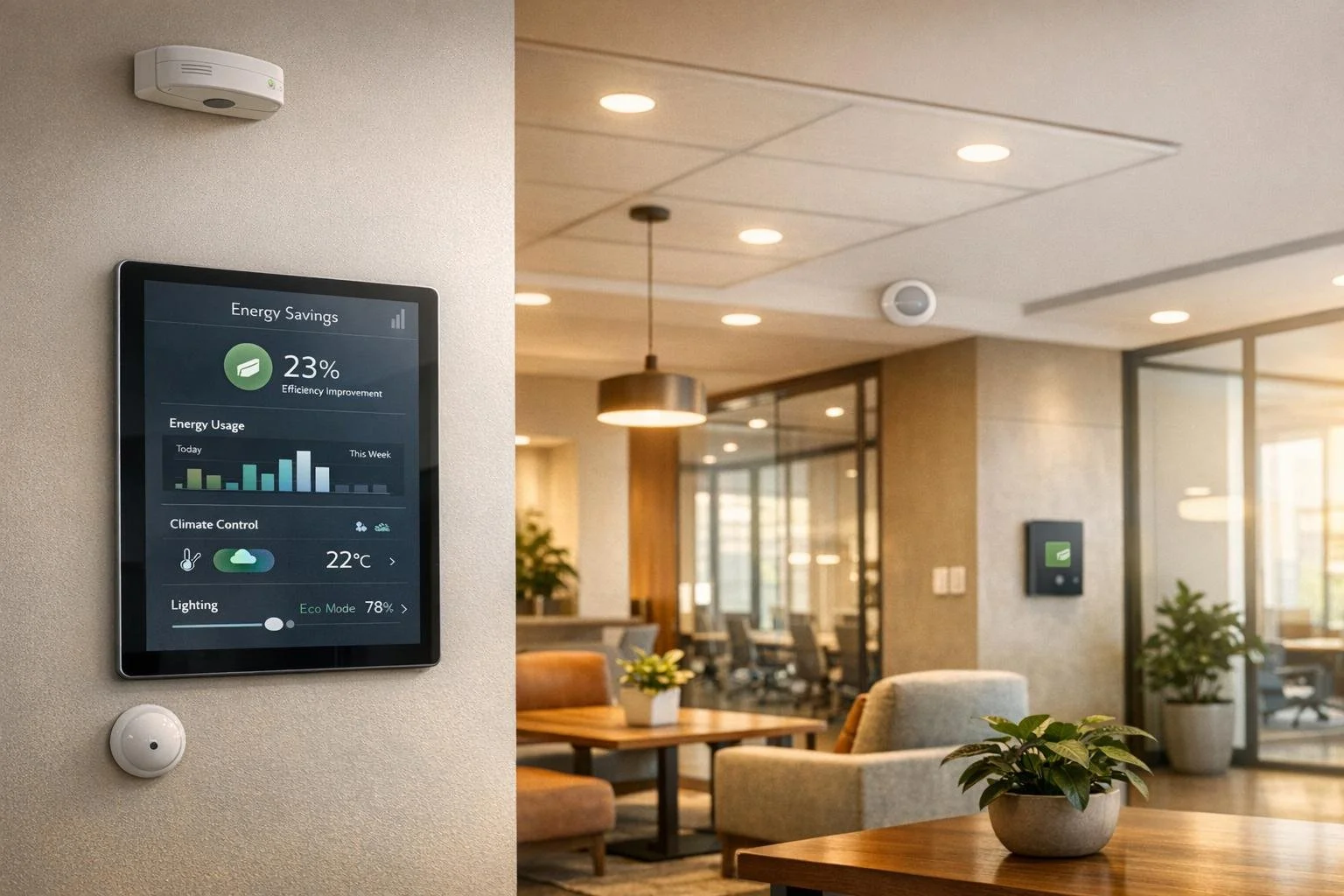
Smart buildings are the future of real estate, and IoT integration is the key to unlocking their potential. By connecting HVAC, lighting, security, and water systems into a single network, IoT enables real-time decision-making, reduces energy costs, and improves tenant experiences. With buildings contributing 40% of global CO₂ emissions, this shift is not just practical - it’s necessary.
Here’s how you can implement IoT in your buildings:
- Define Requirements: Identify stakeholders, assess current systems, and set measurable goals like a 15-20% energy cost reduction.
- Design Architecture: Choose the right connectivity (e.g., BACnet/IP, LoRaWAN) and establish a centralized data platform for analytics.
- Deploy Systems: Start with pilot projects, test infrastructure readiness, and integrate devices with existing systems.
- Secure Systems: Use encryption, authentication, and network segmentation to safeguard devices and data.
- Optimize and Scale: Track KPIs, standardize processes, and expand IoT deployment across properties to maximize financial returns.
These steps help reduce costs, improve efficiency, and meet sustainability goals while delivering a better experience for tenants. Start small with a pilot, measure results, and scale strategically.
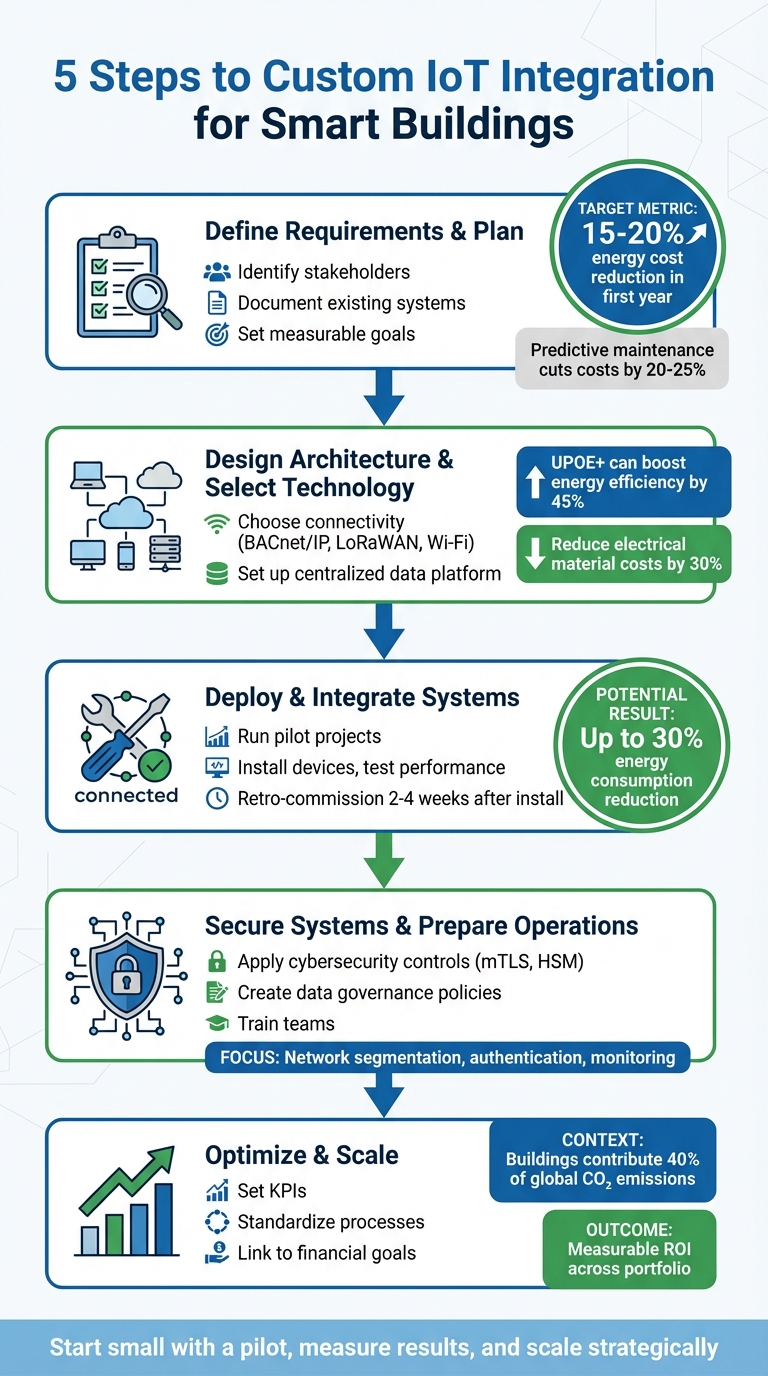
5-Step IoT Integration Process for Smart Buildings
1. Define Your Requirements and Plan
Identify Stakeholders and Use Cases
Integrating IoT into your building starts with bringing the right people to the table. Asset managers, IT teams, facility staff, and tenants each have their own priorities. For example, property managers care about improving efficiency and meeting maintenance goals, IT teams focus on network security and managing data, and tenants prioritize comfort and air quality. Regular consultations with these groups can help uncover challenges, address concerns, and build a unified approach.
Some of the most impactful use cases include reducing energy consumption - potentially by as much as 30% [11] - tracking space utilization for flexible work environments, implementing smart access controls, and using predictive maintenance to cut costs by 20–25% [11].
Document Existing Systems and Set Targets
Start by reviewing your building’s existing mechanical, electrical, and plumbing (MEP) systems, as well as lighting and HVAC documentation. Verify this information with a physical walk-through to ensure accuracy. Additionally, analyze current utility expenses - covering electricity, water, and gas - by location and climate zone. This creates a baseline to measure future improvements.
"The key to a successful implementation depends on identifying the primary key tasks, deliverables, and process steps, which include developing a baseline for current building performance."
Set clear, measurable goals. For instance, instead of vaguely aiming to lower energy costs, aim for a 15–20% reduction in the first year [11]. Define key performance indicators (KPIs) for equipment reliability, such as increasing the mean time between failures. Use "not to exceed" (NTE) thresholds to decide when to repair versus replace equipment. To prioritize upgrades, consider using a 0–10 rating scale that evaluates each piece of equipment based on its importance and technological readiness.
Plan for Budget, Regulations, and Data Needs
Plan for both the upfront costs - like hardware and installation - and the ongoing expenses, such as data storage, connectivity, and security updates. For older buildings, you may need specialized gateways or infrastructure upgrades to address limitations like 100-meter cable restrictions [9].
Ensure regulatory compliance by aligning with ASHRAE guidelines, local building codes, and certifications like LEED or BREEAM. Early in the process, define your data requirements. Decide on sensor types, communication protocols (e.g., BACnet, Modbus, MQTT), and strategies to secure data both at rest and in transit. Establish clear policies for device authentication and access control before purchasing any equipment.
Once your requirements and goals are clearly outlined, you’ll be ready to design your IoT architecture and choose the best technologies for your needs.
2. Design Your Architecture and Select Technology
Choose Your Architecture and Connectivity
When designing your IoT architecture, you’ll need to balance local processing with cloud analytics. Local edge computing handles time-sensitive tasks, like adjusting HVAC settings or dimming lights, to minimize delays [3][8]. Meanwhile, the cloud takes care of storing historical data and running more complex analyses [3][8]. A common setup includes two data paths: a "cold" path for long-term batch analysis and a "warm" path for real-time alerts and device control [3].
Your choice of connectivity depends on your building's requirements and use case. For example, BACnet/IP is a solid option for integrating with existing building management systems, though you’ll need protocol translation software to convert legacy data into modern formats like MQTT before sending it to the cloud [3][12]. Low-power radio networks like LoRaWAN are perfect for extending coverage - spanning 0.6 to 3.1 miles - without needing SIM cards, making them ideal for large campuses or remote sensors [1]. For real-time applications and user-facing features, Wi-Fi is a reliable go-to. Additionally, buildings using 90W Universal Power over Ethernet Plus (UPOE+) can see up to a 45% boost in energy efficiency by eliminating AC-to-DC conversion losses, while also cutting electrical material costs by 30% [8].
Set Up Data Platforms and Analytics
A centralized data platform is key to managing information from various systems - like HVAC, lighting, and access control - and transforming it into a unified format [10]. This is especially important since many building systems rely on fragmented standards such as BACnet, OPC UA, and Modbus [3][12]. By normalizing this data, you can enable analytics that span across multiple properties [3][12].
Tools like CoreCast (https://corecastre.com) can take IoT data streams and integrate them into a larger real estate intelligence framework. This allows you to connect operational metrics - like energy savings or predictive maintenance - directly to financial outcomes, such as NOI improvements and asset valuations. By eliminating data silos, this approach ties operational efficiencies to investment performance.
For scalability, serverless technologies like AWS Lambda or containerized solutions like Azure IoT Edge are worth considering. These options automatically adjust capacity based on data flow, reducing the need for manual intervention [7][12].
Once your centralized data platform is established, the focus should shift to securing devices and ensuring compatibility.
Secure Your Devices and Ensure Compatibility
Device security forms the foundation of a reliable IoT system. Start by using Hardware Security Modules (HSM) or Secure Elements to generate and store private keys locally, keeping them safe from external threats [13]. Implement mutual authentication using mTLS to verify both device and backend identities [13]. Additionally, adopt least-privilege access policies through Identity and Access Management (IAM) to limit permissions for devices and operators to only what’s necessary [7].
Encryption is a must - secure data in transit with TLS/HTTPS and at rest with tools like AWS KMS [13][7]. Plan for automated certificate rotation and Over-the-Air (OTA) firmware updates to patch vulnerabilities without needing physical device access [13][14]. To avoid being locked into a single vendor, choose devices that support open protocols like MQTT, HTTP, or AMQP. An orchestration layer can further simplify component replacement as your technology evolves [10][3].
| Device Category | Connectivity Method | Relevant Protocols |
|---|---|---|
| Cloud-connected | Cloud-connected | HTTP, MQTT, AMQP |
| Edge-connected | Edge-connected | MQTT v3.1.1, MQTT v5 |
| Protocol-specific | Through edge connector | OPC UA, ONVIF, BACnet |
3. Deploy and Integrate Your IoT Systems
Run Pilot Projects and Check Readiness
Start with a pilot project to test your IoT strategy. Pilots are a low-risk way to pinpoint hardware issues, fine-tune installation processes, and gather user feedback without committing your entire budget [1][10]. As Ed Carney, Sr. Sales Manager at Carrier, explains:
"Ensure scope of work for pilot involves sufficient number and diverse quality of locations to enable the accurate assessment and effective statistical analysis" [4].
This means you should test across various building types, climate zones, or tenant setups. Doing so can help uncover site-specific challenges like connectivity gaps or infrastructure limitations.
During this phase, assess the building’s physical infrastructure. Confirm that Main Distribution Frames (MDF) and Intermediate Distribution Frames (IDF) have enough power and cooling capacity. Older buildings often lack the infrastructure to handle modern equipment, which can lead to overheating or device failures [9]. Check that cabling paths - both horizontal and vertical - meet your connectivity needs. For example, Category 5e or 6 cables have a maximum range of 328 feet (100 meters) [9]. If physical cabling isn’t practical, explore wireless options like Wi-Fi or private 5G networks. Pre-commissioning devices during this phase ensures a smoother rollout [4].
Once you’ve gathered insights from the pilot, you can move forward with system installation and integration.
Install Devices and Connect Systems
With a successful pilot under your belt, it’s time for full-scale deployment. Install and calibrate sensors according to your architecture plan. In buildings with older systems, specialized gateways may be necessary to connect proprietary Operational Technology (OT) systems to standard Ethernet or Wi-Fi networks [9].
Integration with existing systems, such as Building Management Systems (BMS) and utility meters, is a critical step. Review as-built documentation for MEP (Mechanical, Electrical, Plumbing) and HVAC controls to identify existing data points and potential connection issues before conducting a physical walk-through [6]. For instance, a financial services headquarters in the Midwest encountered a problem when they planned to monitor elevator power consumption. The elevators, specified without confirming data-sharing compatibility, couldn’t integrate with their intelligent building platform. As a result, a major power consumer went unmonitored [6].
Platforms like CoreCast (https://corecastre.com) can simplify this process by consolidating IoT data streams into a single real estate intelligence platform. By linking operational metrics - such as energy usage and equipment performance - with financial outcomes like NOI improvements and asset valuation, you can clearly demonstrate the return on your IoT investment across your portfolio.
Test and Validate Performance
Once installation is complete, test all devices to ensure they’re communicating properly with your central platform and CMMS [4]. Begin with an initial commissioning, then schedule a retro-commissioning phase 2–4 weeks later to confirm devices are still functioning accurately in a live environment [4]. As Ed Carney emphasizes:
"Properly commission all IoT devices, the retro commission again 2-4 weeks after install" [4].
Validate the data by comparing IoT-generated energy readings with actual utility bills for electricity and water. This helps confirm accuracy and establishes a baseline for tracking financial performance [4]. Test failover scenarios to ensure your system remains operational during network disruptions or device failures. Use centralized logging to monitor metrics and set alarms for anomalies, such as sensors reporting out-of-range values or communication issues [7]. Lastly, test the user interface to ensure dashboards and reporting tools work seamlessly for all stakeholders [4].
4. Secure Your Systems and Prepare Operations
Apply Cybersecurity Controls
After installing and validating your devices, the next step is protecting them from cyber threats. A good starting point is to separate IoT devices into specific network segments, like HVAC controllers, cameras, and printers. This method, called micro-segmentation, limits an attacker’s ability to move through your network if one device is compromised [16][17].
Authentication is key, so use X.509 certificates and store private keys securely in Hardware Security Modules (HSM) or Secure Elements (SE) [13][15]. Implement mutual TLS (mTLS) to ensure both the device and your backend verify each other's identity during every connection [13]. While reestablishing a TLS connection adds a small data overhead, it significantly strengthens security [17].
Restrict access permissions using Identity and Access Management (IAM) principles [15][17]. Incorporate non-intrusive monitoring tools to discover assets and detect threats in real time [17]. For older systems that lack modern encryption capabilities, "guardian modules" can provide a secure connection layer [17].
Securing devices is just the first step. From there, a strong data governance strategy ensures consistent protection across your organization.
Create Data Governance and Privacy Policies
Once your devices are secure, it’s time to focus on managing data access and privacy. Clearly define who owns, accesses, and manages your IoT data. Establish a Data Governance Committee with representatives from facilities, IT, and leadership to align policies with business objectives and address interdepartmental conflicts [18]. Appoint a Chief Data Officer (CDO) to lead the program, while Data Stewards ensure data quality and compliance within their areas [18].
Organize your IoT data into two categories: "cold" paths for historical analysis and long-term storage, and "warm" paths for real-time operations and alerts. Apply appropriate governance measures to each [3]. Use IAM principles to enforce least-privilege access for all users and systems [7]. To manage access policies and versioning, store server and device certificates in central repositories like AWS Secret Manager or HashiCorp Vault [13].
Start small by piloting your governance framework with a specific dataset to prove its value before scaling across your entire operation [18]. Align your policies with established standards like COBIT or ISO/IEC 38500 to meet U.S. privacy regulations [18].
Train Teams and Monitor Reliability
Securing devices and data is only part of the equation - the people managing these systems play a critical role. Build a Smart Environment Team that includes representatives from Facilities (infrastructure and electrical), IT (network security), Security (physical and cyber), and HR (employee safety and experience) [10]. Provide thorough training during the final implementation phase so team members can navigate dashboards, interpret alerts, and respond effectively [4].
Ongoing monitoring is essential. A dedicated team should use proactive tools, like network assurance engines, to predict outages and track performance metrics before issues arise [8][19]. Cisco emphasizes:
"A smart building's network must also provide end-to-end threat-centric security... Establishing a proactive defense that searches for threats or issues before they take hold prevents downtime and loss of services" [19].
Leverage security network analytics to spot unusual traffic patterns, which could signal a compromised device [16]. Integrate your IoT platform with a Computerized Maintenance Management System (CMMS) to automate work orders based on real-time data [4]. Use a "Red/Yellow/Green" status report format during weekly meetings to quickly highlight delayed tasks, risks, and security concerns [4].
Finally, align IoT security with your business continuity plans. Ensure critical building systems - like fire alarms, electrical, and mechanical functions - have manual override options in case of certificate failures or connectivity issues [17].
sbb-itb-99d029f
5. Optimize Performance and Scale Across Properties
Set KPIs and Optimize Continuously
Start by establishing a baseline using utility data and Energy Utilization Index (EUI) metrics [4]. Organize your key performance indicators (KPIs) into four main categories: Financial (energy and labor savings), Operational (equipment failure rates and uptime), Social (greenhouse gas emissions and regulatory compliance), and Cultural (occupant comfort and indoor air quality). Using cluster analysis, group properties with similar performance levels to streamline decision-making. As Ed Carney, Sr. Sales Manager at Carrier, advises:
"Establish a baseline against which project performance outcomes and success criteria will be measured" [4].
Focus on predictive maintenance by identifying locations with higher maintenance costs and tracking mean time between equipment failures (MTBF). Integrate IoT data with your Computerized Maintenance Management System (CMMS) to monitor and improve equipment reliability [4] [20].
Once KPIs are in place, standardize processes across all properties to ensure consistent and effective implementation.
Standardize and Scale Your IoT Program
After a successful pilot program, expand IoT deployment by standardizing key elements like bills of materials (BOMs), graphical user interface (GUI) settings, and communication protocols [4]. Use edge computing to normalize legacy protocols into standard formats like MQTT. Implement an orchestration layer for unified API access and maintain a centralized device registry that includes metadata such as building location, floor, vendor, and equipment type [3] [10]. Adam Daniel, VP of Enterprise Solutions at Losant, highlights the importance of starting small:
"Through a PoC we were able to show immediate value. We started small with one focused goal and have been able to expand that to solve multiple issues rather quickly" [10].
Leverage solutions like CoreCast to prioritize IoT investments by linking sensor deployment to asset performance data and capital plans. This approach helps identify properties with higher energy consumption or maintenance costs, enabling targeted IoT deployments that maximize financial impact.
Once systems are standardized, connect performance metrics directly to financial outcomes for a clearer understanding of ROI.
Link IoT Benefits to Financial Goals
Tie IoT improvements - tracked through both historical (cold) and real-time (warm) data streams - to measurable savings in energy, maintenance, and labor [1] [3]. Integrate environmental, social, and governance (ESG) metrics, such as reductions in greenhouse gas emissions, into your financial reports. Remember, buildings are responsible for about 40% of global carbon dioxide emissions when construction is factored in [1].
“AI & IoT Trends in Smart Buildings | Future of BMS Automation 2025”
Conclusion
Custom IoT integration brings together disconnected systems into a responsive, interconnected network [6]. By following these five steps, you can create a practical roadmap that aligns IoT investments with goals like reducing carbon footprints and enhancing tenant comfort [6][2]. This approach not only helps save energy but also lays the groundwork for better operational performance across your portfolio.
IoT integration changes the way buildings function by making them more efficient and responsive to real-time conditions. Data-driven platforms act as the central hub, consolidating information from various sources into unified APIs [10]. This enables predictive maintenance and ties operational improvements directly to financial outcomes.
For portfolio managers, tools like CoreCast take IoT data a step further by integrating it into strategic decision-making processes. By linking building performance metrics with asset underwriting, pipeline tracking, and portfolio analysis, CoreCast helps focus investments on properties with higher energy usage or maintenance costs - delivering measurable financial returns.
As Deloitte aptly puts it:
"The journey to Smart Buildings is not always about adding more systems, it's about doing more with what you have and harnessing your existing data to drive value" [5].
Start with a targeted pilot program, prove its ROI, and then scale it systematically across your portfolio. This step-by-step approach ensures both operational improvements and financial gains.
FAQs
What are the main advantages of using IoT in smart buildings?
Integrating IoT into smart buildings brings a host of advantages, particularly in cutting energy use, boosting operational efficiency, and improving the experience for those inside. With smart sensors and automated systems, buildings can continuously monitor and fine-tune how resources like electricity, water, and HVAC systems are used. This can translate to savings of 15%–30% on utility bills, a win for both the budget and the environment. Plus, these systems help shrink carbon footprints, aligning with sustainability priorities that matter more and more to investors.
IoT also transforms how buildings are managed by delivering real-time data and predictive insights. This means facilities teams can catch equipment issues early, preventing costly breakdowns and reducing downtime. On top of that, integrated security features - like cameras and access controls - add another layer of safety by sending instant alerts directly to mobile devices. With IoT in the mix, smart buildings become not just efficient and secure, but also more attractive to both tenants and investors.
How can I improve the security of IoT devices in my smart building?
To keep IoT devices in your smart building secure, it's essential to adopt a layered security approach. Start by isolating IoT devices on their own dedicated networks or VLANs. This limits access and helps reduce potential risks. Make sure to implement strong authentication methods, like certificate-based authentication, and confirm that all devices, gateways, and cloud endpoints use the latest version of TLS for encryption.
Stay proactive by regularly updating device firmware, enabling secure boot, and disabling any unused ports or services that could be exploited. Synchronize device clocks using NTP to maintain accurate logging and certificate validation, and opt for a secure DNS service for name resolution. To strengthen access control, use role-based access control to restrict permissions and encrypt data stored on devices. Regular security audits or penetration tests can help uncover vulnerabilities before they become issues.
Lastly, having a well-prepared incident response plan specifically designed for IoT environments is crucial. These measures work together to establish a secure and dependable IoT ecosystem for your building.
What should I consider when selecting IoT connectivity for a smart building?
Choosing the best IoT connectivity for a smart building involves weighing several crucial factors. Start with coverage and reliability - will the signal effectively reach every corner of the building, including challenging areas like basements or outdoor zones? Options like cellular networks or LoRaWAN provide broader coverage, while Wi-Fi might need extra access points to fill in gaps.
Next, consider the data rate and latency requirements of your devices. Applications like video streaming or real-time HVAC management demand faster connections. On the flip side, low-power protocols such as NB-IoT or LoRaWAN are ideal for sensors that transmit small amounts of data. Power consumption is another key point: battery-powered devices work best with energy-efficient options, whereas devices plugged into a power source can handle higher energy needs, such as those of Wi-Fi.
Don’t overlook security, cost, and scalability. The connectivity solution should align with your current network setup while leaving room for future growth. For critical systems, it’s wise to include redundancies to ensure reliability, even during unexpected outages.