
AI in Rental Demand Forecasting for Multifamily Properties

AI is transforming how rental demand is forecasted for multifamily properties by improving accuracy, speed, and market responsiveness. Here's the bottom line:
- Accuracy: AI models analyze 50–100 submarket-specific variables, outperforming conventional flat-rate methods by 30–45%.
- Speed: AI tools can generate detailed forecasts in minutes, while manual processes take hours or days.
- Market Responsiveness: AI updates forecasts in near real-time, adapting to shifting conditions faster than manual methods.
- Data Integration: AI automates data collection from platforms like Zillow and property management systems, reducing errors and saving time.
- Impact: A 2% shift in rent growth assumptions can lead to an $8–$10 million valuation difference for a 200-unit property over five years.
While AI offers precision and efficiency, it requires high-quality data and human oversight. For smaller portfolios, conventional methods may suffice, but larger, dynamic portfolios benefit significantly from AI's capabilities. A hybrid approach - using AI alongside manual checks - can balance accuracy and control.
1. AI-Powered Forecasting
Data Collection
AI-powered forecasting tools gather data from a variety of sources all at once, providing a detailed picture of rental demand. By connecting directly to property management platforms like AppFolio or Buildium through APIs, these systems eliminate the need for manual data input and reduce the chance of errors. They also use web scrapers to track competitor listings on sites like Zillow and Apartments.com, analyzing pricing, vacancy rates, and new inventory. This automation saves significant time - manual competitor tracking can take 10–15 hours per week and is often error-prone. Meanwhile, AI delivers real-time updates continuously, creating a solid and reliable data foundation for better forecasting.
Forecasting Accuracy
AI doesn't just rely on historical data; it combines internal, external, IoT, and alternative data to predict the best rental rates for the upcoming month. It evaluates factors like market trends and new competing listings while considering portfolio-specific goals and the effects of simultaneous vacancies. Unlike traditional property management systems that only record past rental rates, AI provides a more dynamic and tailored approach, leading to better-informed decisions [3].
Market Responsiveness
AI's ability to respond quickly to market changes is another key advantage over traditional methods. While conventional approaches may take weeks to adapt, AI systems can adjust forecasts in just days - or even hours - when market conditions shift. Automated data pipelines ensure that pricing strategies are updated promptly. Additionally, some operators are turning to custom-built Python-based forecasting engines. These solutions offer enhanced data privacy and lower costs, avoiding ongoing per-unit SaaS fees. For instance, platforms like CoreCast demonstrate how advanced AI-driven tools can provide real-time insights and predictive analytics for multifamily properties, helping real estate professionals make smarter rental pricing decisions while keeping monthly hosting fees under $50 [3].
sbb-itb-99d029f
2. Conventional Forecasting Methods
Data Collection
Traditional forecasting methods often depend on manual data entry and scattered spreadsheets, creating barriers to comprehensive data analysis. Property managers typically store rent rolls, maintenance logs, and financial records in separate, unconnected systems. This fragmented approach makes it hard to get a full, clear view of operations. For example, a manager handling a 300-unit portfolio might manually track data from 20 competitor buildings in a spreadsheet - a time-consuming process prone to human error [3]. Without real-time integration, these methods rely on periodic updates, meaning decisions are often based on outdated information by the time analysis is completed.
Forecasting Accuracy
Conventional underwriting models frequently use a flat annual rent growth assumption of 2% to 3% for the entire investment hold period [1]. This one-size-fits-all approach fails to consider critical differences, such as submarket trends, property classes, or broader economic cycles. For instance, it treats a downtown urban market the same as a suburban workforce submarket, leading to valuation mistakes. In comparison, AI-driven forecasting models are 30% to 45% more accurate [1] because they analyze 50 to 100 submarket-specific factors, rather than relying on a few static variables. The rigidity of these traditional methods also limits their ability to respond effectively to market changes.
Market Responsiveness
Unlike AI, which can adapt in real time, traditional methods are slow to react to shifting market conditions. With manual processes and periodic reporting, property managers often base decisions on outdated information and intuition instead of current market insights [3]. Statistical models like ARIMA, which assume consistent patterns, struggle to account for the volatility and unpredictability of real estate markets [4]. This lack of adaptability forces managers to address problems only after they arise, rather than preventing them. Additionally, poor data quality contributes to 62% of forecasting errors [4], demonstrating how manual tracking and inconsistent data standards can severely impact decision-making accuracy.
Strengths and Weaknesses
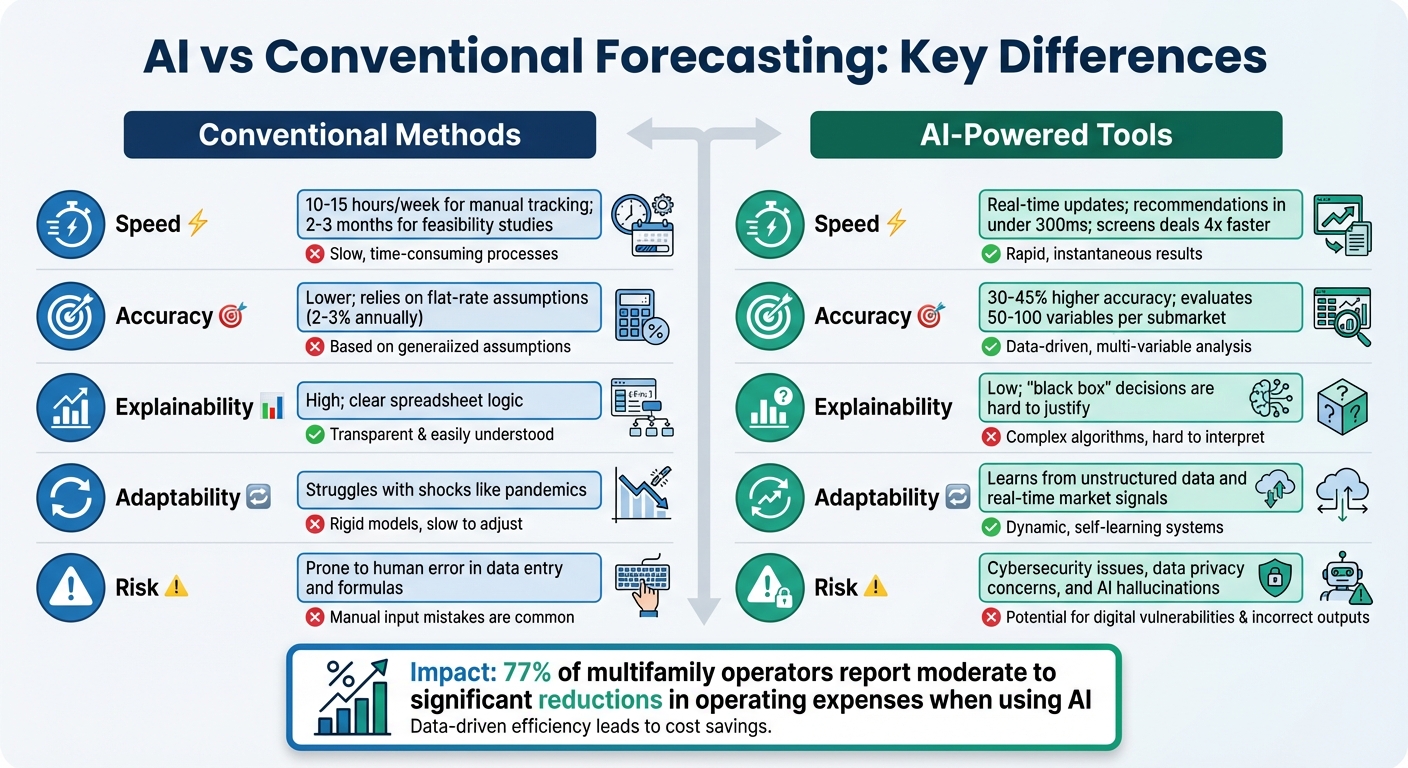
AI vs Conventional Rental Demand Forecasting: Speed, Accuracy & Cost Comparison
When comparing forecasting methods, it's crucial to weigh accuracy against practical usability. Both AI-powered tools and traditional methods bring their own strengths and challenges to the table, and property managers need to understand these nuances before deciding on an approach. AI shines in unpredictable markets where traditional models like ARIMA often fall short. It can detect subtle pricing drivers, such as premiums tied to specific unit features or location-based amenities, that basic spreadsheet models might miss. However, AI's "black box" nature can make its decision-making process hard to understand, which raises concerns about trust and accountability. As Team Reapit points out:
"If you cannot explain how AI made a decision, how can you trust it with your agency?" [7]
On the other hand, traditional methods rely on clear, auditable spreadsheet logic, making them easier to understand and justify. While AI can cut feasibility study time by up to 75% [5], and 83% of developers believe it improves accuracy by minimizing manual errors [5], its complexity requires careful oversight.
Here's a quick comparison of the two approaches:
| Feature | Conventional Methods | AI-Powered Tools |
|---|---|---|
| Speed | 10–15 hours/week for manual tracking; 2–3 months for feasibility studies [5] | Real-time updates; recommendations in under 300ms; screens deals 4x faster [2] |
| Accuracy | Lower; relies on flat-rate assumptions (2–3% annually) [1] | 30–45% higher accuracy; evaluates 50–100 variables per submarket [1] |
| Explainability | High; clear spreadsheet logic [5] | Low; "black box" decisions are hard to justify [7] |
| Adaptability | Struggles with shocks like pandemics | Learns from unstructured data and real-time market signals |
| Risk | Prone to human error in data entry and formulas [5] | Risks include cybersecurity issues, data privacy concerns, and AI hallucinations [6][7] |
AI tools can occasionally produce flawed results, such as inventing non-existent amenities or schools in property descriptions [7]. This highlights the importance of human oversight to catch such errors before they impact critical decisions. Despite these risks, 77% of multifamily operators report moderate to significant reductions in operating expenses when using AI [6]. For many, the efficiency gains outweigh the challenges - provided the technology is used responsibly.
Choosing the right forecasting method depends largely on the complexity of your portfolio and your risk tolerance. Smaller, stable portfolios might do fine with traditional methods, but larger, more dynamic portfolios can benefit from AI's ability to process 50–100 variables per submarket and deliver one-year forecast accuracies within 0.5% to 1.5% [1]. The key lies in using AI as a tool to enhance, not replace, human expertise. For those looking to implement this, learning how to build an AI agent can help automate routine data collection.
Platforms like CoreCast aim to bridge the gap by combining AI-driven forecasting with transparent analytics. By offering clear reporting and audit trails, they address explainability concerns while helping real estate professionals manage market volatility with confidence and accountability.
Conclusion
AI-driven forecasting has shown it can boost accuracy by an impressive 30% to 45%, thanks to its ability to analyze complex variables effectively[1]. For multifamily operators, even a small shift - like a 2% change in rent growth assumptions - can translate into a massive swing of $8 million to $10 million in property valuations for a 200-unit asset over a five-year period[1]. Beyond accuracy, AI also delivers unmatched speed, providing real-time updates and recommendations in under 300 milliseconds[3].
That said, AI isn’t without its hurdles. High-quality data and technical expertise are non-negotiable for optimal performance, making it less of a plug-and-play solution. For smaller portfolios in stable markets, traditional spreadsheet methods may still suffice. However, larger or more dynamic portfolios stand to gain significantly from AI’s ability to uncover subtle pricing drivers and respond to market shifts.
A hybrid approach often works best. AI can shine in complex, data-intensive scenarios, such as acquisitions or navigating competitive submarkets, while simpler forecasts might still benefit from AI vs. traditional methods. A good starting point? Test AI on a few properties before committing to a broader rollout. Integrating AI tools directly into existing property management systems can also help streamline workflows and minimize disruptions[3].
CoreCast bridges the gap between AI’s advanced capabilities and traditional forecasting methods. With features like transparent reporting and audit trails, CoreCast offers AI-powered forecasting tailored for multifamily operators. Currently in beta, it’s priced at $50 per user per month, with plans for tiered pricing. This tool makes sophisticated forecasting accessible without requiring a dedicated data science team. The real value lies in using AI as a support system - enhancing scenario planning and validating outputs with real-world market insights.
FAQs
What data is needed for reliable AI rent forecasts?
To produce reliable AI rent forecasts, it's essential to pull from a wide range of data sources. These include:
- Market trends: Factors like employment rates, migration patterns, and affordability levels.
- Property-level metrics: Details such as lease terms and trade-out rates.
- Regional data: Information on construction starts and absorption rates.
- Historical performance: Past data that helps establish patterns and benchmarks.
- Economic indicators: Broader economic signals that influence housing demand and pricing.
By combining all of these elements, forecasts become more accurate and better aligned with real-world conditions.
How do I validate AI forecasts and avoid “black box” mistakes?
To ensure AI forecasts are accurate and avoid the pitfalls of "black box" errors, it's crucial to take a hands-on approach. Start by backtesting models to see how they would have performed with historical data. Then, monitor their performance over time to identify any discrepancies or patterns. Scenario testing is another key step - run the models under different market conditions to understand how they react.
Additionally, make it a habit to compare predictions with actual outcomes and keep an eye on errors. Use domain-specific checks to confirm that forecasts align with real-world trends, such as rent growth, occupancy rates, and cap rates. To refine accuracy and build trust in your models, rely on validation techniques like k-fold cross-validation or rolling-origin validation. These methods can help ensure your forecasts are both reliable and grounded in reality.
When is a hybrid AI + spreadsheet approach better than AI alone?
When it comes to tasks like validation, scenario testing, or aligning with market conditions, a hybrid approach combining AI and spreadsheets is often the most effective. This method strikes a balance by pairing AI-generated insights with the ability to manually review and adjust data. The result? Fewer errors and forecasts that are more reliable and grounded in real-world considerations.