
AI in Portfolio Rebalancing for Real Estate

AI is transforming how real estate portfolios are managed. Instead of relying on slow, manual processes and periodic reviews, AI offers real-time data analysis and decision-making tools that save time, reduce risks, and improve portfolio performance.
Key Takeaways:
- Time Savings: AI reduces financial analysis time by up to 90%, enabling faster decisions.
- Continuous Monitoring: Tracks metrics like net operating income (NOI) and portfolio drift in real-time, flagging issues before they escalate.
- Improved Accuracy: Predictive analytics identify risks like tenant defaults and demographic shifts months in advance.
- Automation: AI executes rebalancing actions automatically, minimizing emotional biases and transaction costs.
- Proven Results: Companies like JLL and KeyBank report productivity boosts of 30x and significant cost savings.
AI tools like CoreCast integrate data from multiple systems, turning complex, unstructured information into actionable insights. This shift allows asset managers to focus on strategy while AI handles repetitive tasks. The result? Smarter, data-driven decisions that align portfolios with market dynamics and investment goals.
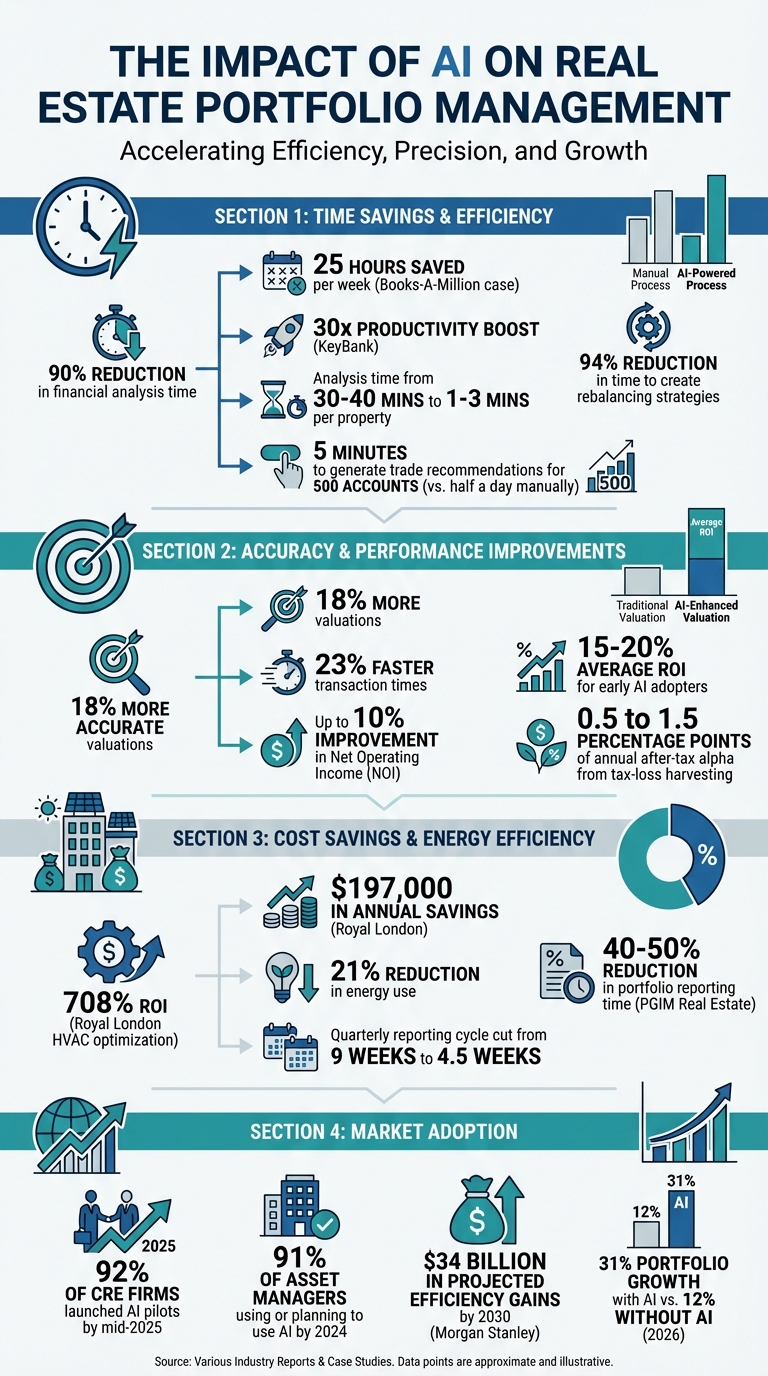
AI Impact on Real Estate Portfolio Management: Key Statistics and ROI
AI and the Future of How Real Estate Firms Work
sbb-itb-99d029f
How AI Improves Portfolio Rebalancing in Commercial Real Estate
AI transforms portfolio rebalancing into a continuous process, pulling data from work management systems, computerized maintenance management systems, ERPs, and lease administration platforms. This constant flow of insights allows for precise monitoring and quicker responses [4][2].
The benefits are clear. For example, Books-A-Million's real estate team saved 25 hours per week by streamlining their data workflows with an AI platform, enabling them to rescore their portfolio based on current market conditions [3]. Similarly, Royal London implemented an AI-powered HVAC optimization system at its 135,000-square-foot Birmingham property in 2025, achieving a 708% ROI, $197,000 in annual savings, and a 21% reduction in energy use [6].
Real-Time Portfolio Monitoring and Drift Detection
Traditionally, portfolio rebalancing happens on a fixed schedule - quarterly or annually - without accounting for market fluctuations. AI changes this by enabling threshold-based rebalancing, where adjustments are triggered when allocations exceed specific percentage bands, such as 200 basis points [1]. This approach captures opportunities that rigid, calendar-based reviews often miss.
AI continuously tracks key metrics like net operating income, debt service coverage ratios (DSCR), loan-to-value (LTV) ratios, and portfolio drift [2]. When thresholds are crossed, automated alerts notify managers immediately. But AI doesn’t stop at lagging indicators - it also monitors leading indicators like foot traffic trends, demographic shifts, competitor activity, and development pipelines to predict issues before they appear on financial statements [3].
"It may not be so much about opening the winning one as it is eliminating the losers. If you can just increase your batting average by not opening bad stores, that's super important." - Kevin Hawk, VP of Expansion, TNT Fireworks [3]
Platforms like CoreCast integrate these capabilities, providing real-time insights and historical data to help managers detect drift patterns early and act before returns are impacted.
| Leading Indicator | What It Signals | Monitoring Frequency |
|---|---|---|
| Foot traffic trend | Site-specific decline vs. chain average | Monthly |
| Demographic shift | Changes in population or income affecting customers | Annual |
| Competitive entry | New competitors or loss of complementary businesses | Quarterly |
| Development pipeline | Construction or road changes impacting accessibility | Quarterly |
| Customer origin shift | Shifts in customer base toward competitors | Quarterly/Semi-annual |
Automated Rebalancing Execution
AI doesn’t just identify when rebalancing is needed - it can also execute the changes. This eliminates delays from manual processes and removes emotional biases from decision-making. Research shows that threshold-based rebalancing reduces transaction costs and improves risk-adjusted outcomes compared to monthly rebalancing [1].
The time savings are impressive. AI can generate trade recommendations for 500 accounts in just 5 minutes, a task that would take half a day manually [7]. Multi-agent AI systems have reduced the time needed to create rebalancing strategies by 94% [5]. This speed means teams can act on opportunities before market conditions shift.
Agentic AI takes it further by managing multi-step workflows with AI agents. Beyond flagging issues, these systems can draft detailed action plans for each site, route items for approval, and coordinate tasks across teams [4]. They can even simulate complex scenarios, like evaluating whether closing an underperforming property might lead to revenue losses or whether the remaining portfolio can absorb the impact [3]. This automation not only accelerates decision-making but also sharpens asset allocation.
Data Analysis for Better Asset Allocation
AI turns unstructured data - like satellite images, Street View data, news feeds, and social media - into actionable insights [6][8]. This allows for more precise decisions, factoring in elements that traditional analyses might overlook.
For instance, companies using AI in real estate report 18% more accurate valuations and 23% faster transaction times [6]. Organizations leveraging machine learning have improved Net Operating Income (NOI) by up to 10% [8]. Early adopters of AI technology in commercial real estate have seen an average ROI of 15-20% on their investments [8].
"We can now take data from documents, we can generate data from Street View or satellite images and create really clear structured data sets - which was very difficult to do in the past." - Phoebe Holtzman, Global Director of Data Science Innovation, JLL [6]
AI systems combine high-frequency data - like neighborhood mobility trends and macroeconomic changes - to forecast asset performance and identify emerging submarkets before they appear in traditional reports [8]. They also perform year-round tax-loss harvesting, systematically selling securities at a loss to offset gains while maintaining market exposure. This strategy can add 0.5 to 1.5 percentage points of annual after-tax alpha [1]. Managing this level of optimization manually across large portfolios would be nearly impossible.
Case Studies: AI in CRE Portfolio Rebalancing
Case Study 1: Reducing Costs Through Automation
AI has become a game-changer in cutting costs for portfolio rebalancing. Back in February 2026, KeyBank introduced AI-driven financial modeling tools that slashed the time needed for preparing financial models by up to 40%. Even more impressive, these tools boosted productivity by 30x, reducing the time spent analyzing individual property statements from 30–40 minutes to just 1–3 minutes. For portfolio managers juggling hundreds of properties, this meant they could evaluate up to 10 times more deals without the need to expand their teams[2]. By freeing up time, managers could focus more on risk analysis and strategic decision-making.
Case Study 2: Reducing Risk with Predictive Analytics
AI also plays a critical role in mitigating risks. In 2026, Alliance Laundry Systems avoided a costly acquisition mistake thanks to an AI-powered zoning overlay tool. During their due diligence, the tool flagged a zoning misclassification: the property was incorrectly labeled as Office/Institutional (OI) instead of the required Commercial (C2) designation. This quick insight saved the company from making an expensive error[3].
On a broader scale, AI systems now assess over 1 billion signals across 120 million properties to predict tenant default risks. By analyzing payment patterns and industry trends, these tools proactively identify financial warning signs and flag key thresholds. This capability enables organizations to address potential risks before they escalate, leading to faster and more informed decision-making[2].
Case Study 3: Faster and More Accurate Decisions
The ability of AI to streamline decision-making is reshaping how CRE portfolios are managed. For example, in 2026, Books-A-Million managed to save 25 hours per week by using a single AI-powered platform for portfolio reviews. This tool eliminated the need for manual tasks like automated data collection from multiple systems, cleaning up unstructured PDFs, and building comparison models. With this streamlined process, the team could rescore their entire portfolio against current market conditions much faster, allowing them to flag underperforming locations well in advance of lease renewals.
AI also aids in making strategic decisions about property closures. For instance, AI-powered cannibalization modeling helps managers understand whether shutting down an underperforming store might negatively affect the rest of the portfolio. As Kevin Hawk, VP of Expansion at TNT Fireworks, put it:
"If you can just increase your batting average by not opening bad stores, that's super important"[3].
What used to take weeks of analysis can now be done in minutes, highlighting how automation and AI are driving smarter, faster decisions in CRE portfolio management. These advancements are not just about saving time - they’re setting the stage for better risk management and improved overall performance.
Combining AI Automation with Human Judgment
Integrating human judgment with AI's efficiency ensures decisions are grounded in strategic oversight and context.
Understanding How AI Makes Recommendations
AI thrives on transparency, especially when its recommendations are directly linked to source documents like lease clauses, T12 statements, or offering memoranda. Without this link, verifying recommendations or spotting errors becomes far more difficult.
Modern CRE AI tools now address "reconciliation intelligence" issues. For instance, if an offering memorandum contradicts a T12 statement, the system flags the discrepancy instead of arbitrarily choosing one source over the other[9]. To ensure accuracy, test AI tools with a verified dataset of completed deals[4].
The Role of Human Oversight in Rebalancing
While AI handles data-heavy tasks with ease, human expertise is essential for adding context and making strategic decisions. Embedding AI into expert-led processes strengthens oversight and ensures results are aligned with broader goals[6].
The "30% rule" offers a helpful framework: allow AI to manage about 70% of repetitive, data-intensive tasks, leaving humans to focus on the remaining 30% - tasks requiring judgment, ethics, and strategic thinking[10]. This balance prevents over-reliance on algorithms, especially when dealing with physical limitations, local regulations, or long-term objectives. For example, AI might recommend upgrading a property, but only a human expert can determine whether the structure of a historic building can support new HVAC equipment or how local energy laws might influence the decision[6].
| Task Category | AI Responsibility | Human Responsibility |
|---|---|---|
| Document Processing | Extracting rent rolls/T12s, flagging missing data | Assessing data quality, managing broker relationships |
| Underwriting | Populating Excel models, reconciling numbers | Setting assumptions, crafting market strategies |
| Portfolio Monitoring | Stress-testing DSCR, flagging covenant breaches | Determining asset strategies, capex plans, and timing disposals |
| Rebalancing | Real-time drift detection, drafting trade orders | Approving final decisions, addressing physical or local constraints |
How AI Reduces Emotional Bias in Investment Decisions
One of AI's standout benefits is its ability to counteract the emotional biases that often skew investment decisions.
"AI doesn't replace the advisor's judgment. It refines it." - Russell Hughey, Strategic Account Executive at First Rate[11]
Studies reveal that the average investor underperforms market indices by 2–3% annually due to emotional decision-making[1]. AI helps mitigate biases like the "sunk cost fallacy", where managers cling to underperforming assets based on past investments rather than current performance[5]. By mid-2025, 92% of commercial real estate firms had launched AI pilots, with early adopters reporting 23% faster transaction times and 18% more accurate valuations[6]. In essence, AI acts as a "sophisticated calculator", testing hypotheses grounded in factual data while leaving ultimate accountability for high-stakes decisions to human professionals[6]. This partnership minimizes emotional interference, particularly in portfolio rebalancing, ensuring allocation decisions are based on logic and data.
The combination of AI's precision with human insight creates a robust framework for AI-driven portfolio management and decision-making processes.
How to Implement AI-Driven Portfolio Rebalancing
Bringing AI into portfolio rebalancing means seamlessly integrating it with your current systems to enable real-time, data-driven decisions. The challenge lies in adding this technology without disrupting operations while ensuring confidence in its outputs.
Data Integration and System Setup
The first step is to digitize lease documents, clean up master data (like site IDs, cost centers, and vendor information), and standardize property details. A major hurdle here is creating a canonical data schema - a unified framework that aligns data from various sources like Yardi, MRI, ARGUS, and even PDF appraisals into consistent categories [12].
AI tools need to connect with your core systems, including property management platforms, financial systems, and valuation tools. For example, in 2026, PGIM Real Estate cut its portfolio reporting time by 40–50% after implementing an AI platform that automated data collection and normalization [12]. Similarly, a mid-sized REIT slashed its quarterly reporting cycle from nine weeks to four and a half weeks by automating data ingestion from Yardi and MRI systems [12].
Manual data entry is not only time-consuming but also prone to errors, with typical error rates ranging from 1–3%. For institutional owners managing over $1 billion in assets, this can translate to 400–800 hours spent on a single quarterly portfolio report [12]. Tools like CoreCast can centralize real-time insights and eliminate manual data transfers and version-control issues.
Once your data integration is complete, the next step is rigorous testing to validate the AI system.
Testing and Monitoring AI Performance
Before fully implementing AI-driven rebalancing, run parallel testing alongside your existing manual processes for at least one complete cycle. This helps validate the AI’s accuracy and builds trust in its recommendations [12]. Test the system using a "golden dataset" of verified deals and leases, and include challenging scenarios with incomplete or conflicting data to assess its reliability [4].
After going live, continuous performance monitoring is crucial. Focus on metrics like slippage versus the model (the difference between recommended and executed prices), tax alpha captured (the value of harvested losses), and drift duration (how long the portfolio remains off-target) [7]. Configure alerts to flag data points that exceed a 5% budget variance or deviate by more than two standard deviations from peer group norms [12].
"The safest agents don't eliminate humans; they raise the quality of human decisions by bringing the right information together." - StackAI [4]
Use confidence scoring to evaluate AI data. Flag low-confidence items for manual review, allowing your team to focus on strategic analysis instead of routine tasks [12]. By 2024, 91% of asset managers were either using or planning to use AI for asset-class research and portfolio construction [1].
Once the AI system proves reliable, it’s time to adjust your workflows to maximize its potential.
Adapting Workflows for AI Tools
Begin by applying AI to high-volume, low-risk tasks like monthly reporting, lease abstraction, or data reconciliation [4]. Take a phased approach: start by defining workflows and success metrics, then run a 4–8 week pilot to train users and develop playbooks, and finally, expand the process across more regions and asset types on a quarterly basis [4].
Update your Standard Operating Procedures (SOPs) to clarify when staff should rely on AI outputs, how to review them, and what escalation steps to take for exceptions [4]. Clearly document roles and responsibilities to avoid over-reliance on automation. This ensures that your team remains in control while benefiting from the efficiencies AI can provide.
Conclusion: What's Next for AI in CRE Portfolio Rebalancing
AI is reshaping how commercial real estate (CRE) portfolios are managed. Instead of sticking to rigid, calendar-based reviews, AI introduces continuous, threshold-driven monitoring. This means actions are triggered only when allocations exceed predefined limits, cutting out the need for scheduled quarterly reviews and reducing unnecessary transaction costs [1]. The result? Better risk-adjusted outcomes and greater efficiency.
Morgan Stanley projects that AI could bring $34 billion in efficiency gains to the real estate sector by 2030 [13]. By 2026, portfolios managed with AI saw an average growth of 31%, compared to just 12% for those without AI [13].
"AI adoption has quietly shifted from a question of willingness to one of readiness." - Commercial Observer [14]
The industry is already moving toward more advanced AI systems. Beyond basic tools like chatbots, the focus is shifting to "Agentic AI" - intelligent systems designed to plan tasks, pull data from siloed sources, and manage workflows across teams [4]. These AI agents act as "always-on" command centers, monitoring everything from occupancy rates to expenses and market trends around the clock. This shift enables real estate operations to move from being reactive to predictive [4].
The potential for AI in CRE portfolio management is enormous. Tools like CoreCast are leading the charge by offering comprehensive real estate intelligence. CoreCast integrates underwriting, pipeline tracking, portfolio analysis, and stakeholder reporting into one platform. This eliminates the need for fragmented systems - those "10-tool stacks" that create data silos - and allows AI to operate as a fully functional production system rather than just a pilot project [3][4].
However, the industry still faces a key challenge: the lack of centralized, clean data. Much like the early hurdles in AI implementation, overcoming this "readiness gap" will be critical in the coming years. Firms that prioritize building strong, clean data foundations today will be better positioned to unlock the full potential of AI-driven portfolio management in the future.
FAQs
What data do I need before using AI to rebalance a CRE portfolio?
To make the most of AI in rebalancing a commercial real estate (CRE) portfolio, you'll need access to several key data points. Start with details on current asset allocations, property performance metrics, and market conditions. Add in risk factors and the specifics of your portfolio holdings. Don't forget historical data - it’s crucial for spotting trends and understanding correlations over time. With this information, AI tools can deliver precise insights and actionable recommendations to help fine-tune your portfolio.
How are rebalancing thresholds set and adjusted over time?
Rebalancing thresholds rely on predefined drift bands, which determine how far an asset allocation can stray before rebalancing kicks in. These thresholds are tailored to fit the investor's risk tolerance, financial goals, and the current market environment. Over time, adjustments are made based on how the portfolio performs, shifts in market trends, or changes in the overall investment strategy. AI tools make this process even more efficient by keeping a close eye on asset drift in real-time and using predictive analytics to fine-tune thresholds dynamically.
What controls keep AI-driven rebalancing accurate and compliant?
AI-powered rebalancing ensures precision and adherence to rules by using advanced controls. Algorithms continuously monitor portfolio data, comparing it to target allocations, and make adjustments only when necessary. These systems also incorporate regulatory requirements, automating processes like tax-loss harvesting and compliance with legal standards. With features like audit trails and detailed reporting, managers can review and validate decisions, aligning portfolios with investment objectives while reducing the chances of errors or rule violations.