
Best Practices for Using Investor Portals in Real Estate

Investor portals are transforming how real estate firms manage investments by centralizing data, automating tasks, and improving investor communication. These platforms simplify processes like document management, performance tracking, and capital calls, saving time and reducing errors. For example, ROCO Management cut its reporting timeline from 14 days to just 3–4 days using automation, saving 80 labor hours annually.
Here’s what you need to know:
- Key Features: Real-time metrics (IRR and NAV), mobile access, document automation, and integration with tools like Yardi and CRM systems.
- Customization & Security: White-label branding, personalized dashboards, and SOC 2 Type II compliance ensure a professional and secure experience.
- Best Practices: Use portals to streamline communication, automate workflows, and engage investors with intuitive interfaces and self-service tools.
- Analytics: Monitor investor activity, identify bottlenecks, and gather feedback to improve user experience.
Investor portals are no longer optional - they’re essential for building trust, improving efficiency, and meeting investor expectations for real-time data access.
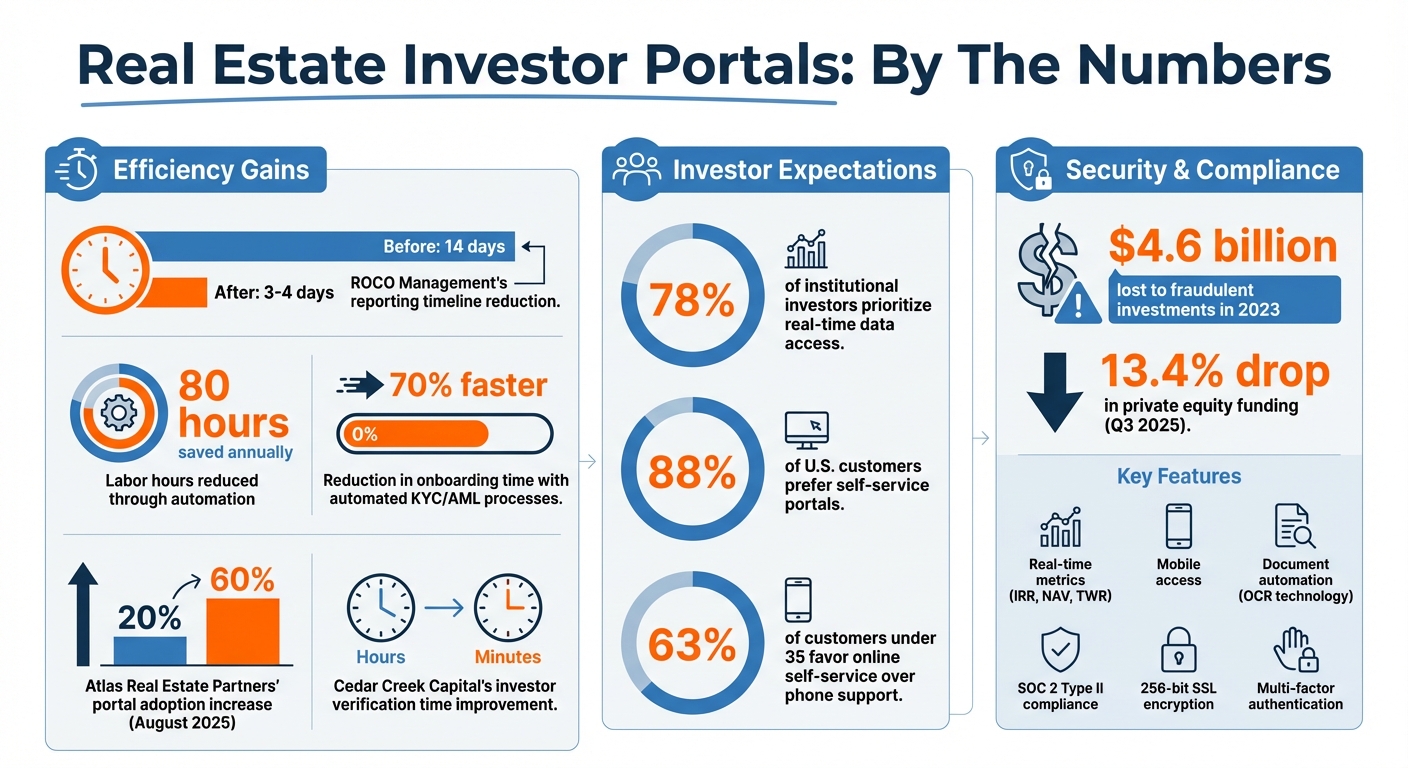
Real Estate Investor Portal Benefits: Key Statistics and ROI Metrics
Core Features of Real Estate Investor Portals
The right investor portal does more than just store documents - it reshapes how you manage relationships and allocate capital. Knowing which features truly matter helps distinguish what’s essential from unnecessary extras.
Data Management and Analytics
Modern investor portals simplify data management with interactive dashboards that deliver real-time metrics like IRR (Internal Rate of Return), equity multiples, NAV (Net Asset Value), and TWR (Time-Weighted Return). These features eliminate the need for tedious manual spreadsheet updates, saving both time and effort.
Document management has also evolved. Advanced portals use OCR (Optical Character Recognition) technology to automatically sort and assign tax documents - such as K-1s, 1099s, and Schedule D forms - to the right investor profiles. This automation removes the hassle of manually organizing files during tax season.
Mobile accessibility is now a must-have. Investors expect to check portfolio performance, sign documents, and track distributions directly from their smartphones. Optimized mobile interfaces streamline these tasks, allowing investors to make decisions faster and with less friction.
On top of analytics, seamless integration with existing systems takes portal efficiency to the next level.
Integration with Existing Systems
Disconnected tools lead to inefficiencies, often requiring manual reconciliation. The best portals integrate seamlessly with accounting software like Yardi Voyager and Breeze Premier, creating a unified system that reduces duplicate data entry and minimizes errors.
CRM integration is another key feature. By syncing with email tools, portals automatically log every investor interaction, making it easy to track conversations and avoid redundant outreach. This ensures teams stay coordinated and investors feel valued.
Built-in ACH and wire transfer capabilities speed up the funding process. Investors can move from expressing interest to completing their investments in minutes. These integrations don’t just centralize data - they also improve operational workflows and elevate the overall investor experience.
For firms managing complex deals, portals that connect with third-party data sources like Preqin, PitchBook, and S&P Global provide a competitive edge. Combining in-house data with external market insights enables smarter strategies for raising capital.
While integrations improve backend operations, the user interface plays a critical role in creating a smooth investor experience.
User Interface and Customization Options
A well-designed portal isn’t just functional - it reflects the firm’s brand identity. White-labeling options allow firms to customize everything from domains and logos to color schemes and typography, ensuring a polished, professional look across all investor-facing touchpoints.
Customizable dashboards further enhance usability. Different stakeholders can focus on the metrics that matter most to them. For instance, Limited Partners might prioritize details like capital account balances and historical distributions, while co-sponsors may need insights into project-level IRR and equity multiples. This personalization reduces support requests and improves communication with investors.
Static PDF presentations are becoming obsolete, replaced by digital deal rooms that bring offerings to life. These spaces combine images, videos, and interactive performance metrics, creating a dynamic experience. Features like progress indicators guide investors through subscription steps, and conditional logic in forms ensures they only see relevant questions. This streamlined process feels more like an e-commerce checkout, reducing friction during commitments.
Lastly, robust security is non-negotiable. Platforms with SOC 2 Type II certification, multi-factor authentication (MFA), and 256-bit SSL encryption offer institutional-grade protection for sensitive financial data. These measures give investors confidence in the platform’s ability to safeguard their information.
sbb-itb-99d029f
Best Practices for Portal Efficiency
Having the right features in an investor portal is just the starting point. The real difference lies in how well you implement and maintain it. A well-optimized portal can transform into a powerful asset rather than just another tool collecting dust. The firms that see the most success focus on three key areas: communication, security, and engagement.
Improving Stakeholder Communication
Relying on scattered emails and spreadsheets can quickly erode investor confidence. A well-managed portal solves this by acting as a centralized hub for all investor interactions. No more digging through inboxes to find capital call notices or distribution updates - everything investors need is housed in one secure, easy-to-access location.
Automation is another game-changer. Tasks like distributing K-1s, sending alerts for distributions, or notifying investors about new documents can be handled automatically, saving time and reducing manual errors.
Transparency is also a major trust-builder. When investors can independently check metrics using portfolio analytics tools with custom reporting for IRR, equity multiples, or property-level performance on their schedule, it reduces the need for constant back-and-forth. In fact, 88% of U.S. customers prefer using self-service portals for a smoother experience, and 63% of customers under 35 specifically favor online self-service over phone support [6].
Modern portals also offer two-way communication tools. Built-in messaging systems that integrate with CRM platforms ensure every conversation is tracked and accessible to the entire team. This helps avoid duplicate outreach and reassures investors that their concerns are being heard.
While clear communication builds trust, maintaining that trust requires a strong focus on security.
Maintaining Data Security and Compliance
Security is the bedrock of investor trust. To protect sensitive data, prioritize features like multi-factor authentication (MFA), 256-bit SSL encryption, and compliance with certifications such as SOC 2 Type II and ISO/IEC 27001 [5][4][3]. Before committing to a portal, always verify these certifications directly with the vendor.
"A robust investor portal should have robust security features, including secure login protocols, multi-factor authentication, end-to-end encryption and compliance with international security standards to protect sensitive data." – Timea Iancu, Writer, Yardi Investment Suite [2]
Compliance workflows should also be seamlessly integrated into your portal. Automating KYC (Know Your Customer) and AML (Anti-Money Laundering) processes allows investors to upload accreditation documents or self-attest directly within the portal. This approach can cut onboarding time by up to 70%, all while ensuring regulatory requirements are met [6].
Additionally, features like access controls and audit trails add another layer of security. Detailed logs showing who accessed specific documents - and when - help maintain accountability. Permission settings ensure that investors only see information tied to their specific investments. For highly sensitive deal rooms, requiring digital NDA signatures before granting access can further protect proprietary data [3].
Once your portal is secure, the next step is keeping investors actively engaged.
Increasing Investor Engagement
Even the most advanced portal won’t deliver results if investors don’t use it. Digital onboarding is a crucial first step to ensure adoption. Replace cumbersome paper forms with smart digital workflows that use conditional logic - forms that only ask relevant questions based on previous answers. This simplifies the process and reduces friction.
Educational resources also play a big role in boosting engagement. Short video tutorials on tasks like downloading tax documents, navigating performance dashboards, or updating contact details can empower investors to use the portal effectively while minimizing support requests.
Customizable features further enhance engagement. Let investors tailor their notification preferences, choosing how often and what types of updates they receive. With 78% of institutional investors prioritizing real-time data access when evaluating fund managers [2], meeting these expectations can help build long-term loyalty.
Using Analytics to Improve Portal Performance
Analytics can turn your portal into a dynamic tool by measuring engagement and pinpointing areas for improvement.
Monitoring Investor Activity and Behavior
Portal data provides a clear picture of investor engagement. Metrics like login frequency, document downloads, and deal room views can highlight which investors are actively involved and which might need a nudge. For example, multiple views of offering materials can signal strong interest and suggest it's time for a follow-up [3].
Audit trails add another layer by tracking file access. These details not only support compliance but also help you send targeted reminders instead of generic bulk emails [3][7].
Subscription workflow analytics can uncover bottlenecks in the onboarding process. For instance, if data shows investors frequently drop off at the accreditation upload stage, it may indicate the need for clearer instructions or better guidance. A great example comes from Atlas Real Estate Partners, who saw portal adoption jump from 20% to 60% in August 2025 after introducing enhanced self-service features based on user behavior. Their Controller noted that custom reporting now take "just a couple hours, not days" to complete [6].
Gathering and Implementing Investor Feedback
While numbers tell part of the story, direct investor feedback provides the context needed to understand what’s working and what isn’t. Embedding surveys and feedback forms directly into the portal allows investors to share their thoughts while their experience is still fresh.
Behavioral patterns can also reveal dissatisfaction. For example, if investors keep requesting data via email despite having portal access, it could be a sign that your interface needs improvement [8]. Feedback like this is invaluable for refining the portal and making it more user-friendly.
Conclusion
Investor portals have become essential tools for real estate firms, streamlining capital deployment and strengthening investor relationships.
Take ROCO Management, for example - they slashed their quarterly reporting process from two weeks to just 3–4 days, saving 80 hours annually [2]. Similarly, Cedar Creek Capital transformed investor verification, cutting the process from weeks to mere minutes with advanced onboarding tools [1]. These results are achieved by leveraging automation, security, and engagement best practices.
Real-time data access is now a must-have, with 78% of institutional investors demanding it [2]. Meeting this expectation not only improves transparency but also deepens investor trust and engagement.
Security remains the backbone of these advancements. With over $4.6 billion lost to fraudulent investments in 2023 [1], robust measures - like SOC 2 Type II certification and integrated KYC/AML checks - are critical. As Andrew Berg from InvestNext puts it:
"A resilient security system forms the foundation for all portal features, and allows them to market their operational standards as a competitive differentiator from other investment managers" [3].
In a challenging fundraising climate, where private equity funding dropped 13.4% in Q3 2025 [4], firms that offer secure and seamless digital experiences stand out. By applying the strategies in this guide, you can transform your investor portal into a powerful tool that drives capital growth while cutting down on administrative burdens.
FAQs
Which portal features matter most for my firm?
The best investor portals focus on making things clear, efficient, and trustworthy for users. Some standout features include secure document management, customizable deal rooms, automated workflows, integrated communication tools, and real-time reporting.
It's also crucial to have a user-friendly interface, a branded experience that reflects your company, and robust security measures to safeguard sensitive information. Together, these elements help improve efficiency, keep investors engaged, and support long-term success in real estate capital management.
How do I get investors to actually use the portal?
To attract investors to your portal, focus on transparency, usability, and efficiency. Start with a seamless onboarding process that makes it easy for users to get started. Include features such as customizable deal rooms, secure commitment flows, and real-time portfolio updates to enhance their experience.
Make sure investment reports are easily accessible, and design a user-friendly interface that encourages trust and regular interaction. Reducing any points of friction while offering clear, detailed insights into investments will help build confidence and encourage long-term engagement.
What security and compliance checks should I require?
To align with SEC regulations, it's crucial to establish thorough investor verification procedures. These procedures should ensure compliance with applicable securities laws while safeguarding sensitive information. Implementing secure data management systems is equally important - this not only protects investor data but also helps maintain transparency and trust.
Additionally, maintaining detailed documentation and audit trails is essential. Proper records can significantly reduce the risk of fraud and demonstrate adherence to regulatory standards, offering both legal protection and operational clarity.