
How Real-Time Updates Improve Investor Relations
Real-time updates are transforming investor relations by offering instant access to critical data like occupancy rates, lease comparisons, and portfolio performance. This shift eliminates the delays of traditional reports, builds trust through transparency, and empowers smarter decision-making.
Key insights:
- 63% of investors prioritize transparency when allocating capital.
- Only 38% of firms provide weekly updates, creating a competitive opportunity.
- Companies using data-driven strategies are 19x more likely to achieve profitability.
- Tools like real-time dashboards and automated alerts streamline reporting, saving time and reducing errors.
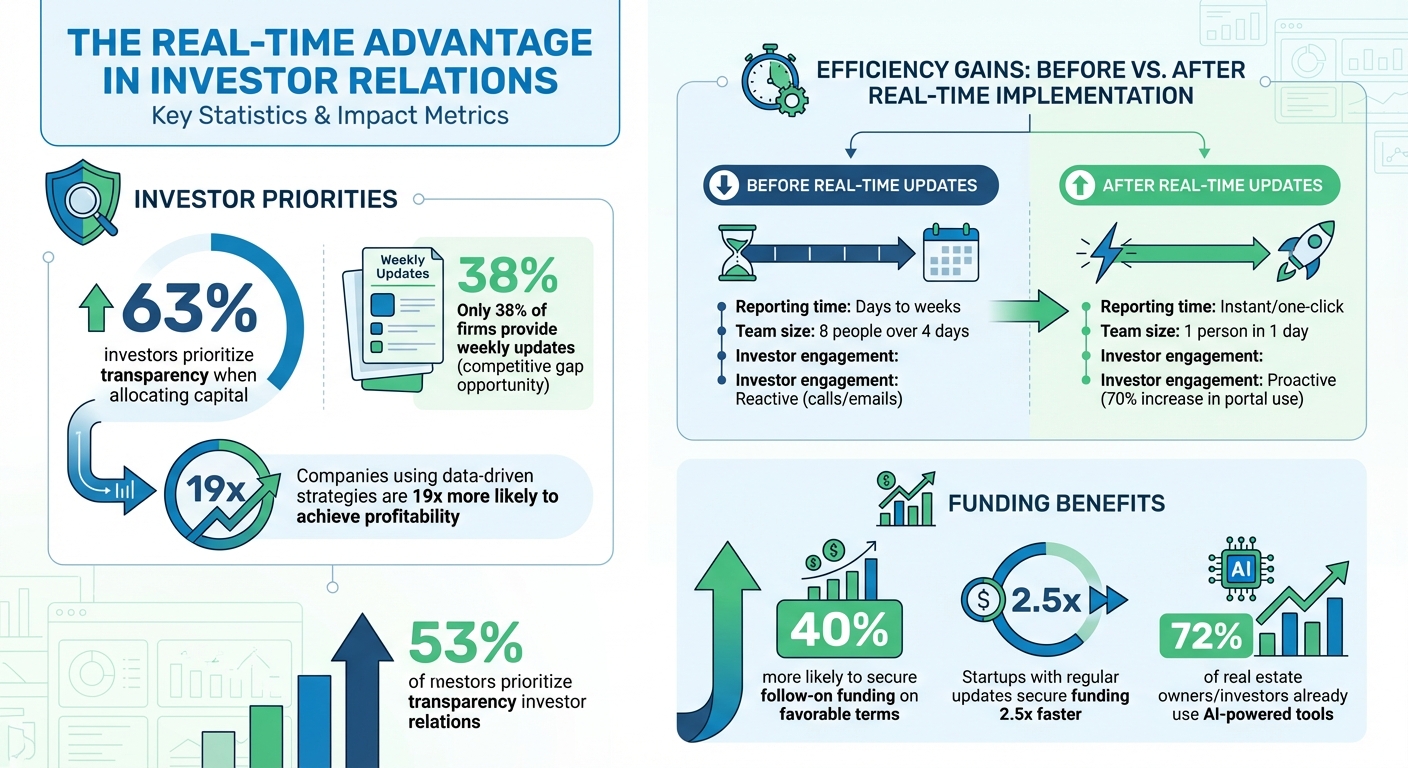
Real-Time Updates Impact on Investor Relations: Key Statistics and Benefits
The Strategic Power of Investor Relations | Mostly Classics
sbb-itb-99d029f
How Real-Time Dashboards Support Portfolio Management
Real-time dashboards allow portfolio managers to monitor their investments instantly, bypassing the delays of traditional end-of-month reports. Instead of juggling data from multiple sources, managers can access all performance metrics through a single, continuously updated platform. Tools like CoreCast simplify this process by consolidating diverse data streams into one actionable view.
The shift from static reports to dynamic dashboards is transforming how organizations handle data [5]. Monthly slide decks are being replaced by systems that offer automated alerts and immediate access to critical metrics. This change allows managers to quickly identify issues, such as a sudden drop in occupancy or an unexpected rise in maintenance costs. These instant insights enable faster responses and better decision-making, powered by automated data connections and clear visual representations of key metrics.
Take Jain Global, for instance. As the largest hedge fund launch since 2018, with $5 billion in assets, it adopted an integrated dashboard from the start. This approach allowed the firm to oversee seven distinct business lines across global operations without needing separate systems [3]. While this example comes from the hedge fund space, the principle applies across industries, especially real estate: consolidating data into a single view eliminates blind spots and accelerates decision-making.
Connecting Data Sources for Automatic Updates
To make integrated dashboards effective, they need continuous and automatic data updates. This is achieved through automated connections between various data sources. Technologies like WebSockets enable low-latency streaming of market data, while REST APIs pull live pricing and historical context from platforms such as Polygon and Yahoo Finance [4][6]. This setup ensures dashboards refresh automatically, eliminating the need for manual data entry or uploads.
Before connecting data sources, it's crucial to verify their accuracy [8]. Check the reliability of your accounting software, CRM systems, and IoT sensors that track physical assets. Feeding inaccurate data into a dashboard can lead to flawed insights and misplaced confidence. Once verified, automated workflows can clean and enrich the data, significantly reducing errors and potential risks [3][5].
The benefits are clear. In June 2024, Northland Investment Corporation automated its investor package preparation process. What used to take eight team members four days was reduced to a single person completing the task in just one day [1]. This not only improved efficiency but also freed up valuable staff time for strategic analysis and decision-making.
Presenting Key Metrics in Clear Visual Formats
With data flowing automatically, the next challenge is presenting it in a way that stakeholders can easily understand and use. Different audiences require tailored views. For example:
- Investors need metrics like ROI, IRR, total portfolio value, cap rates, and equity multiples to assess risk-adjusted returns.
- Operators focus on operational details such as occupancy rates, maintenance costs, and rent collection.
A clear visual hierarchy is essential. Place high-level KPIs like total portfolio value, ROI, and cap rates at the top for executives. Below that, include layers for performance and risk metrics, such as occupancy rates and lease expirations. Finally, provide detailed project data for team members who need a granular view [5].
| Metric Category | Key KPIs to Include | Purpose |
|---|---|---|
| Financial | ROI, IRR, Cap Rates, Equity Multiples | Evaluate investment performance and value |
| Operational | Occupancy, Maintenance Costs, Downtime | Track daily efficiency and expenses |
| Market | Rental Trends, Absorption Rates, Benchmarking | Compare against market performance |
Set up automated alerts to flag unusual changes in KPIs [7][9]. For instance, if occupancy falls below a certain threshold or maintenance costs exceed the budget, the dashboard can immediately notify the relevant team. For IoT-enabled assets, data often refreshes every two minutes [9], offering near-instant updates on performance.
The aim isn't to display every possible metric but to focus on the ones that matter most to each decision-maker. Before building the dashboard, define your objectives to avoid overwhelming users with too much data [7][8]. Think about the specific decisions the data will support, and design visuals - like heatmaps, gauges, or interactive maps - that make patterns easy to spot. This approach not only streamlines portfolio management but also improves communication with investors, building confidence and trust.
Automating Investor Communication
Relying on manual updates can slow down communication and lead to errors, but automation ensures timely, tailored updates for investors. By building on the advantages of real-time dashboards, automated communication takes transparency a step further, delivering critical updates directly to investors. The key is to create systems that notify investors only when meaningful changes occur. Automated alerts can monitor property value changes, market trends and cap rates, and other vital performance indicators [1]. This approach respects investors' time while keeping them informed about what truly matters. Companies that maintain consistent, high-quality communication with investors are 40% more likely to secure follow-on funding on favorable terms [12], and startups offering regular updates secure subsequent funding rounds 2.5 times faster [12].
"Technology has played a huge role in shortening the time it takes to both market and sell a property, and that technology has allowed investors to transact across ever-increasing distances." – Bob White, Founder and President, Real Capital Analytics [1]
Platforms like CoreCast simplify this process by integrating investor relations tools with portfolio management systems. Instead of juggling multiple platforms, real estate professionals can use one system to ensure updates are always based on the most current data. Next, let’s explore how targeted alerts and customized updates can further enhance investor engagement.
Setting Up Alerts for Important Metrics
For effective investor communication, link alerts to key performance thresholds like cash-on-cash returns or occupancy rates. Identify the metrics that matter most to your investors - such as IRR, cap rates, or cash distributions - and set thresholds to trigger alerts when significant deviations occur. For example, if you projected a 12% IRR but actual performance drops to 9.5%, the system should flag this gap and prompt you to include an explanation [1]. Dynamic templates with auto-filled fields can streamline this process, ensuring alerts are sent within minutes of major changes [10].
While these alerts keep investors informed of critical shifts, personalized reporting ensures each investor receives updates tailored to their specific needs.
Customizing Updates for Individual Investors
Not every investor requires the same level of detail or frequency of updates. Institutional investors often expect in-depth financial reports and detailed risk analyses, while retail investors may prefer concise summaries with clear visuals [1]. Automation allows you to provide this customization at scale without adding to your workload.
Start by segmenting your investor base into meaningful categories. Group them by type (institutional, retail, lender, private equity), investment strategy, or level of engagement [11][12]. This segmentation helps you align communication workflows with each group’s preferences. For instance, active institutional investors might receive monthly detailed reports with comprehensive financials, while passive retail investors could get quarterly summaries focusing on distributions and high-level performance.
Using investor CRM tools, you can track individual preferences, investment amounts, past conversations, and areas of interest [11][12]. This ensures every interaction feels personalized. If an investor has shown interest in a specific asset class or market, automated updates can prioritize information relevant to those interests.
Set up automated triggers based on timelines or engagement patterns [12]. For example, if an investor hasn’t logged into your portal in 60 days, the system can send a re-engagement email highlighting recent performance. Similarly, if someone frequently checks data for a particular property, they might receive more detailed updates for that asset.
Prepare key materials - like financial statements, pitch decks, and KPIs - in advance to respond quickly to customized requests [12]. By automating routine updates, your team can focus on delivering thoughtful responses to specific questions.
"To get the most out of your investors, it's a good idea to have a shoutout section in your investor updates. We're competitive nerds and will definitely go the extra mile to consistently make it on the list." – Arianna Simpson, General Partner, Andreessen Horowitz [13]
Pair scheduled, automated updates with a self-service investor portal where stakeholders can access detailed data and documents whenever they want [10][14]. This approach gives investors control over how they consume information, whether they prefer diving into granular details on their own or relying on curated summaries delivered to their inbox. It also reduces the volume of on-demand requests, striking a balance between convenience and thoroughness.
Using Real-Time Analytics to Build Stronger Investor Relationships
Real-time analytics transform investor relations from a reactive approach to a proactive one. By tracking how investors engage with your communications, you can adjust your strategy on the fly. Understanding their behavior through live data becomes a key factor in maintaining trust and ensuring future funding opportunities.
The days of static quarterly PDFs are fading, replaced by self-service portals that cater to modern investor expectations. Analytics reveal how investors consume information, showing which metrics they check most often and how they respond to various communication formats. This data lets you fine-tune your strategy to meet their preferences rather than relying on guesswork. It’s a smarter way to craft targeted engagement strategies.
Monitoring Investor Engagement and Feedback
Real-time insights don’t just stop at understanding behavior - they also help refine communication strategies. For example, tracking login frequency to your investor portal can highlight which stakeholders are actively engaged and which might need extra attention [15][16]. Similarly, email click-through rates on updates and notices provide clear feedback on whether your messages are resonating [1].
But it’s not just about passive tracking. Embedding feedback tools within your digital platforms allows investors to ask questions or share comments directly through the portal. This two-way dialogue can help you address concerns before they grow into bigger issues [2]. Keeping a detailed record of all interactions - whether through meetings, calls, or emails - in your CRM system ensures no detail is overlooked [2][16].
By streamlining these processes, you free up more time to focus on meaningful conversations and relationship-building with your investors.
Creating Dynamic Reports with Current Data
Dynamic, auto-updating reports eliminate delays between performance changes and investor updates. These reports can refresh metrics like occupancy rates, rental income, and distribution yields in real time, keeping investors informed as changes happen. This aligns with the 72% of real estate owners and investors already using AI-powered tools to optimize their operations [1].
Tailoring these reports to different investor needs is essential. Institutional investors often require detailed analyses, such as cash flow breakdowns, NPV calculations, and sensitivity models, presented in formal, data-heavy formats [1]. On the other hand, retail investors typically prefer simplified summaries focusing on key figures like NOI, ROI, and distribution yields, often delivered through visually engaging slide decks [1].
Platforms like CoreCast make this level of customization possible. By consolidating portfolio analysis, stakeholder management, and branded reporting into a single system, they allow for automated, audience-specific templates. These templates pull in current data and adjust presentation styles based on the recipient’s profile. This automation ensures consistency while addressing the unique needs of each investor group, fostering stronger relationships through timely and relevant communication.
Measuring the Impact of Real-Time Updates
Introducing real-time updates is a crucial step, but the real game-changer lies in assessing their influence on investor engagement and operational efficiency. Without tracking the right metrics, it's impossible to gauge the return on your technology investment.
Real-time systems are designed to provide investors with the clarity they need. However, their broader impact becomes evident when you measure how they enhance engagement and streamline operations. These metrics shed light on how investors interact with your portal, highlight the most impactful reports, and reduce the time spent on repetitive tasks.
Monitoring Engagement Metrics
Start by analyzing how investors interact with your real-time portals. Metrics like login frequency reveal which stakeholders are actively monitoring their investments, while document download rates help identify the reports and data that resonate most with your audience. For instance, when Metonic Real Estate Solutions launched their investor portal in 2024, they saw a 70% increase in investor engagement [17]. This growth underscores the increased involvement of investors in monitoring their portfolios.
Another key indicator is the decline in support calls, which suggests that investors are successfully using the portal for self-service. This frees up your team to focus on strengthening relationships rather than handling routine inquiries. By understanding these usage patterns, you can establish a clear comparison between pre- and post-implementation performance.
Comparing Results Before and After Implementation
To fully understand the impact, compare baseline metrics with the results after implementing real-time updates. Pay attention to key areas like staff hours required for reporting, error rates in calculations, and the time it takes to deliver data to investors.
For example, Northland Investment Corporation transformed its reporting process dramatically. What once required eight team members working over four days was reduced to one person completing the task in a single day [1]. This shift highlights how real-time updates can completely overhaul operational workflows.
| Metric | Before Real-Time Updates | After Real-Time Updates |
|---|---|---|
| Reporting Speed | Days or weeks of manual compilation | Instant or one-click generation |
| Investor Engagement | Reactive (calls/emails for information) | Proactive (70% increase in portal use) [17] |
| Staffing Requirements | Large teams (e.g., 8 people) [1] | Minimal staffing (e.g., 1 person) [1] |
In addition to these metrics, gather direct feedback from investors through surveys or one-on-one conversations. Focus on their perceptions of transparency, ease of accessing data, and the frequency of communication. Combining hard data with investor feedback creates a comprehensive picture of the benefits real-time updates bring, reinforcing their role in fostering stronger, more transparent relationships.
Best Practices for Real-Time Investor Relations
Rolling out real-time updates is just the beginning. To ensure long-term success, it's crucial to focus on data security, system maintenance, and strategic planning. The real estate industry is increasingly embracing technology - 72% of real estate owners and investors now use AI-powered tools [1]. However, the most successful firms treat these systems as dynamic platforms that need continuous oversight and refinement.
To make the most of real-time updates, a phased approach works best. Start small by testing workflows with a single portfolio or fund. This helps confirm that everything operates smoothly before scaling up. Next, map out your data sources and APIs to understand the flow of information - from lease agreements to ledgers to investor dashboards - before expanding across your entire operation [15].
Data accuracy requires constant attention. Regularly audit your data sources to catch inconsistencies or gaps before they reach investors. Standardization is key: use consistent date formats (MM/DD/YYYY), currency symbols, and naming conventions. Cross-check property details with reliable sources like MLS listings or county records to ensure accuracy.
Security must be a top priority. Implement multi-layered safeguards such as two-factor authentication, encryption, and role-based access controls. Conduct frequent system access audits to stay compliant with evolving privacy regulations. Blockchain technology can also be a valuable tool, providing immutable, time-stamped transaction records for additional verification and auditability [15].
Platforms like CoreCast simplify the process by integrating critical functions - underwriting, pipeline tracking, portfolio analysis, and investor relations - into a single ecosystem. This allows firms to manage all aspects of their operations in one place. Plus, with branded reports sent directly to stakeholders via a dedicated center, communication remains seamless without juggling multiple tools.
Even with real-time access to data, maintaining a regular reporting schedule (such as quarterly or monthly) is essential. This consistency reinforces trust and reliability among investors [1].
Conclusion
Real-time updates have completely reshaped how investors stay informed. Gone are the days of waiting weeks for static quarterly reports. Now, stakeholders can tap into live dashboards that showcase performance metrics as they happen. This shift from reactive to proactive communication has become essential, especially since 63% of investors cite transparency as a key factor in their decision-making [1].
But the advantages go beyond just speed. Automated data workflows help eliminate manual errors, create reliable audit trails, and free up teams from repetitive data tasks. These improvements have significantly reduced the time needed for reporting [1].
This evolution paves the way for integrated platforms. For firms looking to modernize, solutions like CoreCast bring everything under one roof - combining underwriting, pipeline tracking, portfolio analysis, and branded reporting. Instead of juggling multiple tools or reconciling data across systems, firms can rely on a single source of truth. This not only ensures accuracy but also aligns with the growing trend of AI-driven transparency in the industry.
The real estate sector is at a pivotal moment, with 72% of owners and investors already leveraging AI-powered tools [1]. By embracing real-time updates now, firms can strengthen investor trust, reduce inefficiencies, and position themselves as reliable, forward-thinking partners. Acting quickly is crucial to staying ahead in this competitive landscape.
FAQs
Which investor metrics should be real-time vs. scheduled?
In real estate investment, keeping an eye on operational metrics such as occupancy rates, lease expirations, and market trends is crucial. Tracking these metrics in real-time allows for swift decision-making and better cash flow management. For instance, having up-to-date occupancy data ensures that vacancies can be addressed quickly, minimizing potential revenue loss.
On the other hand, financial metrics like Net Operating Income (NOI), Cash-on-Cash Return, and Internal Rate of Return (IRR) are generally reviewed on a set schedule - monthly or quarterly. This approach ensures the data is accurate and provides a solid foundation for strategic planning.
How do you keep real-time dashboard data accurate?
Maintaining accurate real-time dashboard data hinges on strong practices in data collection, verification, and management. Automating data collection is a smart way to minimize errors and ensure consistency. Regularly verifying the integrity of your data helps catch discrepancies early, while secure methods like encryption and role-based access protect sensitive information. Bringing together data from multiple sources adds reliability to your dashboards, and automation keeps everything up-to-date and precise. These measures ensure your dashboards deliver dependable insights for making well-informed decisions.
What security controls should an investor portal include?
An investor portal must prioritize robust security measures to safeguard sensitive financial information and establish trust with its users. Core features should include bank-grade encryption, which protects data both in transit and at rest, and enterprise-level access controls to prevent unauthorized access. Adding multi-factor authentication provides an extra layer of security, ensuring only verified users can log in.
To maintain high security standards, regular audits and adherence to data protection regulations are crucial. These steps not only protect investor data but also promote transparency, which is vital for strong investor relationships.