
How Ad Integration Enhances Real Estate Platforms

Ad integration connects real estate platforms like CRMs with social media channels, automating lead capture and streamlining marketing efforts. This approach saves time, improves lead quality, and boosts ROI by enabling precise tracking of ad performance. With 96% of homebuyers starting their search online and social media driving 52% of high-quality leads, integrating ads is essential for staying competitive in today’s market.
Key Takeaways:
- Automated Lead Management: Social media leads flow directly into CRMs for instant follow-up and retargeting.
- Efficient Campaign Tracking: Unified dashboards provide real-time insights into ad performance and ROI. Monitoring these pipeline metrics ensures every dollar spent contributes to growth.
- Top Platforms: Facebook, Instagram, LinkedIn, and YouTube offer unique benefits for targeting residential and commercial audiences.
- Improved Conversion Rates: Integration enables faster responses and smarter retargeting, increasing lead-to-sale success.
Ad integration simplifies ad management, reduces manual work, and helps agents focus on closing deals. Platforms like CoreCast centralize ad data, deal tracking, and analytics, making it easier to connect campaigns with business outcomes.
Effortlessly Generate Leads - Automated Systems for Real Estate Agents
sbb-itb-99d029f
Top Social Media Platforms for Real Estate Advertising
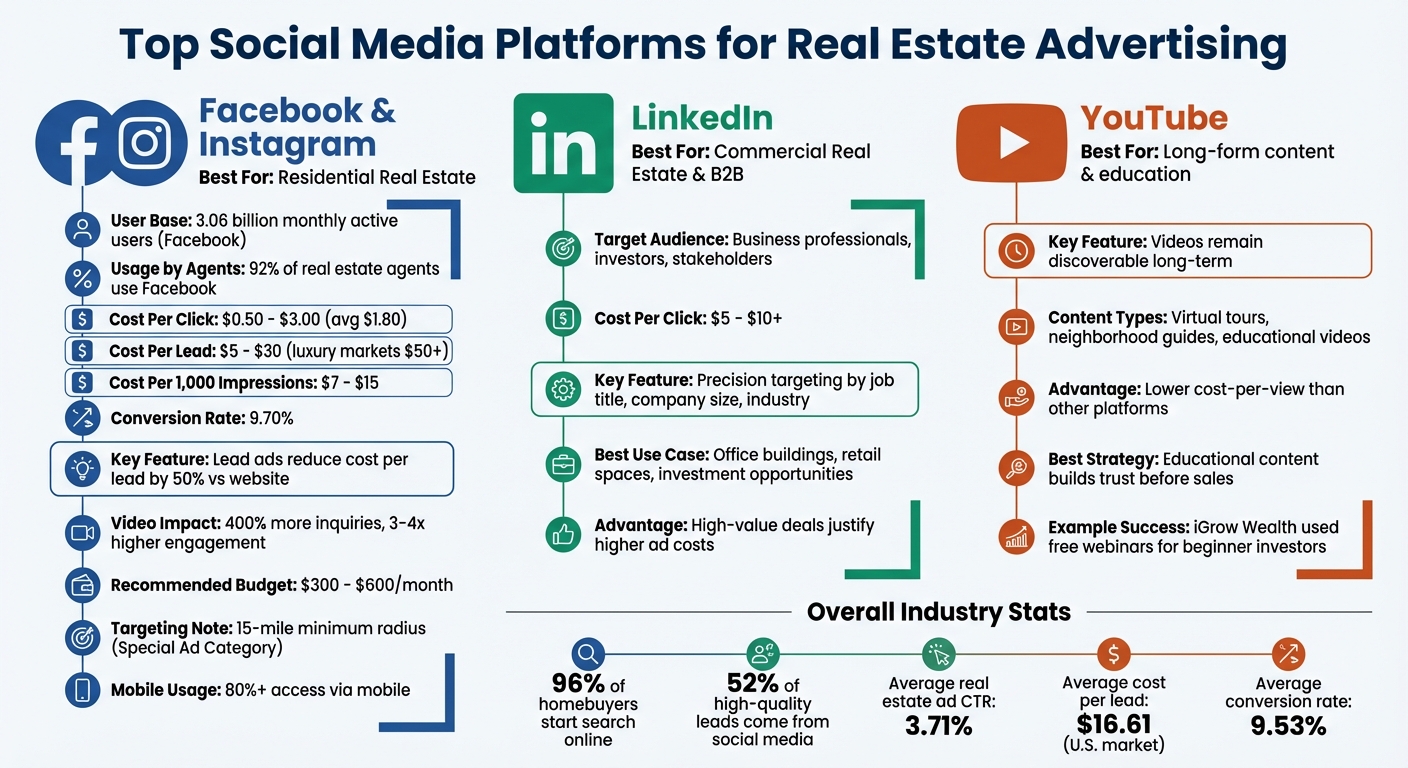
Top Social Media Platforms for Real Estate Advertising: Facebook, Instagram, LinkedIn & YouTube Comparison
Choosing the right platform for real estate advertising can make or break your efforts to connect with the right audience. While many social platforms exist, three consistently stand out for their ability to target specific audiences, tell compelling visual stories, and turn casual browsers into serious buyers. Here's a closer look at what makes these platforms effective for real estate marketing.
Facebook and Instagram
Facebook and Instagram remain dominant forces in real estate advertising, thanks to their highly visual nature and advanced ad-targeting tools. With over 3.06 billion monthly active users globally, Facebook is the third most-visited website worldwide, and 92% of real estate agents already use it for their business needs [2][4]. It's no surprise that 40% of marketers rank Facebook as one of the top platforms for driving results in real estate [4].
One standout feature of these platforms is Meta's built-in lead capture system. Facebook and Instagram Lead Ads let users submit their information without leaving the app, making the process smooth and efficient. As Matt Wheeler, CEO of Driftrock, explains:
"Facebook and Instagram lead ads and other features mean you can expect a 50% lower cost per lead than sending to a website" [4].
For context, the average cost per lead in the U.S. real estate market is about $16.61, with conversion rates hovering around 9.53% [2].
Video content reigns supreme on these platforms, driving significantly higher engagement than static images. Ads featuring videos can generate up to 400% more inquiries, with engagement rates often 3 to 4 times higher [4][5]. For example, real estate agent Zac McHardy used Facebook Live to host virtual house tours, allowing potential buyers to interact and ask questions in real-time, which not only built trust but also generated leads directly through the platform [4].
However, advertisers on these platforms must navigate compliance rules. Meta's Special Ad Category limits targeting by age, gender, or zip code, requiring a minimum 15-mile radius for geographic targeting [5]. This has led to a shift toward behavioral targeting, such as retargeting users who watch at least 50% of a listing video [3][5].
In terms of costs, expect to pay between $0.50 and $3.00 per click, with an average of $1.80. Impressions range from $7 to $15 per 1,000, and leads typically cost $5 to $30, though luxury markets can exceed $50 [5]. Many agents find success with monthly ad budgets between $300 and $600 [2].
The best-performing campaigns focus on value-driven offers rather than generic property listings. For instance, instead of promoting "free market reports", agents have seen better results with programs like "Sell-Ready Packages" (offering staging and moving assistance) or "VIP Buyer Advantage" programs. A great example comes from Alleyne Real Estate Barbados, which ran a high-urgency Facebook campaign featuring "LAST MINUTE AVAILABILITY" alongside stunning villa images and perks like private airport transfers, leading to immediate bookings [4].
To maximize results, optimize for mobile users - over 80% of Facebook users access the platform via mobile devices [4][5]. Use square or vertical video formats, take advantage of Carousel Ads to highlight multiple rooms or properties in one ad, and leverage Meta's Advantage+ catalog ads to deliver personalized property recommendations based on user behavior [5]. While Facebook and Instagram are excellent for residential real estate, LinkedIn offers unique advantages for commercial deals.
LinkedIn is the go-to platform for commercial real estate and B2B networking. Unlike Facebook and Instagram, which cater to residential buyers, LinkedIn excels at connecting with business professionals, property investors, and stakeholders in commercial real estate.
The platform's targeting tools allow you to filter audiences by job title, company size, industry, and professional interests - ideal for marketing office buildings, retail spaces, or investment opportunities. This precision targeting means you can directly reach private equity professionals or business owners looking for expansion spaces.
LinkedIn's ad formats are designed for relationship-building. Sponsored content, InMail campaigns, and thought leadership posts help establish your credibility before pitching a deal. This approach works particularly well for commercial brokers and syndicators who need to build trust before closing high-value transactions.
While LinkedIn ads are pricier - typically $5 to $10 per click or more - the higher cost often pays off when targeting high-net-worth individuals or institutional investors. A single commercial deal or investor relationship can deliver returns far exceeding the ad spend. Plus, these professional connections integrate seamlessly into your CRM or stakeholder management tools.
YouTube
YouTube stands out for its ability to showcase properties through long-form video content. While Facebook and Instagram favor short, snappy clips, YouTube supports in-depth virtual tours, neighborhood guides, and educational videos that establish you as a local expert. These longer formats give potential buyers an immersive experience, helping them envision the property before an in-person visit.
A key advantage of YouTube is its search functionality. Your videos remain discoverable long after they're posted, unlike social media posts that quickly disappear from feeds. For example, a well-optimized video titled "Homes for Sale in [Neighborhood]" or "First-Time Home Buyer Tips" can generate leads months or even years after upload.
YouTube ads offer robust targeting options, including demographic filters, interest categories, and remarketing to users who've visited your website. Ad formats include skippable in-stream ads, non-skippable 15-second spots, and discovery ads that appear in search results or related video suggestions. The platform's detailed analytics also let you track viewer behavior, such as how long they watched and which calls-to-action drove clicks.
Educational content performs especially well on YouTube. For example, iGrow Wealth successfully used the platform to promote free webinars for beginner investors, building trust early in the buying process before attempting to close sales [4]. This strategy positions you as a knowledgeable advisor rather than just another agent pushing listings.
While YouTube's costs vary based on targeting and competition, its cost-per-view rates are generally lower compared to other platforms. More importantly, consistent content can build long-term credibility, showcasing your expertise and professionalism - critical factors in high-stakes real estate transactions.
How Ad Integration Improves Real Estate Platform Performance
Ad integration is changing the game for real estate professionals by eliminating the inefficiencies of juggling multiple tools. Instead of hopping between dashboards for different platforms, integration creates a single, unified hub for managing campaigns. This shift brings three standout benefits: smoother campaign management, better-quality leads, and clearer ROI tracking. Let’s dive into how integration enhances these areas.
Managing Multi-Channel Ad Campaigns
Switching between fragmented systems is a massive time sink for multi-channel advertising. When running campaigns across various platforms, constantly toggling between tools can disrupt focus and eat up valuable hours.
Integration solves this by centralizing everything into one dashboard. From setting targeting parameters to tweaking budgets and tracking performance, you can manage it all without opening endless tabs. For example, tools like "Advantage+ for Real Estate" (Dynamic Catalog Ads) automate multi-channel retargeting, creating personalized ads based on user behavior.
Real-time data syncing eliminates manual transfers, making follow-ups faster and more strategic. With all insights housed in a single dashboard, collaboration becomes seamless. Features like in-platform commenting and change tracking make teamwork more efficient and less error-prone.
Improving Lead Generation and Conversion Rates
Integration doesn’t just increase the number of leads - it improves their quality and speeds up conversions. When ad platforms are directly linked to your CRM, leads flow in automatically, triggering instant follow-ups via text, email, or calls. Quick responses are crucial, as they significantly reduce the chances of losing a lead.
Take Jacqueline Smith from Vancouver, WA, for example. She achieved a 10.4X ROI (1037.96%) using an integrated lead program, even closing a deal just four days after a lead registered [7]. Similarly, Blair Cody from Austin, TX, signed a listing agreement within the first month of using an integrated system, with the ROI from that single deal covering the platform’s cost for an entire year [7].
AI-powered tools take lead engagement to the next level, handling follow-ups instantly and even booking appointments directly on agent calendars. Behavioral tracking further refines this process by monitoring when leads revisit your site or save a property. As Keith James noted:
"The Brivity lead gen program has allowed us to increase our lead flow... the Brivity leads are warmer which is very important in getting our clients to the closing table" [7].
The numbers back this up: real estate Facebook lead ads boast a 9.70% conversion rate, outperforming the platform average of 8.78% [6]. Vision Realty used an integrated system to generate nearly 1,000 Google leads over eight months by combining their IDX website with smart digital ad management [8]. Commercial real estate teams have also marketed properties up to four times faster using integrated platforms [9]. These gains set the stage for real-time performance tracking, as discussed next.
Tracking ROI and Campaign Performance
Real-time performance tracking is where ad integration truly shines. Traditional methods often involve manually piecing together data from various sources - a tedious process that can quickly become outdated. Integrated platforms, on the other hand, sync data automatically, offering instant insights into campaign effectiveness.
Every interaction - whether it’s a comment, like, or direct message - is automatically logged into your CRM, creating a comprehensive record of each lead’s journey. This consolidated view helps pinpoint the touchpoints driving conversions, allowing you to allocate ad spend more effectively.
Financial metrics are just as transparent. With real estate ads averaging $1.36 per click, $13.87 per lead, and click-through rates around 3.71% [6], integrated dashboards let you compare these figures against live campaign performance. Awareness campaigns typically cost $7.69 per 1,000 impressions, while conversion-focused campaigns average closer to $36 [6]. Having these metrics at your fingertips means you can quickly pause underperforming ads and reinvest in those that are delivering results.
Retargeting also becomes far more precise with integrated tracking. Instead of relying on broad demographic targeting - which is limited by Meta's Special Ad Category rules - you can retarget based on specific behaviors, like a prospect viewing a listing video or saving a property. This kind of targeted approach tends to deliver better returns, as it focuses on people who have already shown genuine interest in your offerings.
How CoreCast Supports Ad Integration
CoreCast brings together ad campaign data, deal tracking, underwriting, and portfolio analysis into one seamless platform. By centralizing this information, real estate professionals gain a single source of truth where ad-driven leads, property valuations, competitive market insights, and stakeholder communications all coexist. This streamlined approach ensures that advertising insights are directly tied to operational decisions.
Third-Party Ad Tool Integration
CoreCast works with third-party tools to pull ad performance data straight into your real estate workflow. For instance, integrating social media ad platforms allows you to monitor which campaigns are generating leads that move through critical deal stages. This makes it easier to connect advertising efforts to closed deals and overall portfolio growth. CoreCast supports all major commercial real estate asset types - Multifamily, Office, Retail, Industrial, and Single-Family [10] - so you can analyze ad-driven opportunities with property-specific metrics.
This setup lays the groundwork for more advanced workflow analytics.
Connected Workflow and Analytics
CoreCast doesn't just track ad data - it ties it to underwriting and mapping tools. Imagine capturing a lead from a Facebook or LinkedIn campaign and instantly being able to view the associated property on an integrated map. Alongside this, you can access competitive market data, simulate underwriting scenarios, and track the lead's progress through your pipeline. With CoreCast's toggle feature, you can quickly compare data and forecasts, speeding up asset evaluation [10].
Personalized Stakeholder Reporting
CoreCast also simplifies communication with stakeholders by offering custom-branded reports. These reports combine ad campaign insights with portfolio analytics, making it easy to showcase how marketing efforts directly impact pipeline value. Whether you're presenting to investors or partners, these tailored reports highlight both property performance and the role advertising plays in driving results. As Justin Britto, Principal at Maddison Communities AZ, explained:
"Having a tailored and precise model became the cornerstone of our capital-raising efforts. Their ability to simplify complex structures gave me & my investors the confidence to move forward" [10].
Steps to Implement Ad Integration on Real Estate Platforms
Setting up ad integration for real estate platforms involves careful planning to ensure a smooth data flow between social media platforms and your existing systems. This process includes verifying compatibility, mapping data fields accurately, and monitoring performance to get the most out of your investment.
Checking Platform Compatibility
Before diving in, make sure you have the necessary permissions. For Facebook Business Manager and the associated Page, you'll need full administrative access and "Leads Access" permissions [12][13]. If you're working with Facebook and Instagram, developers must create a Meta Developer App and request permissions like leads_retrieval, pages_manage_ads, and pages_show_list [13].
Next, choose an integration method. Options include native CRM integration, middleware solutions, or building a direct webhook pipeline [12][13]. If you're syncing property catalogs to Facebook, ensure your feed meets the required formats (XML, CSV, or TSV) and uses proper encoding, such as UTF-8 [11]. Additionally, you'll need a publicly accessible endpoint to handle webhook JSON payloads [13].
Once compatibility is confirmed, the next step is mapping and testing your data flows for seamless integration.
Data Mapping and Testing
Start by standardizing your data fields. For instance, break down full_name into separate firstName and lastName fields, and strip non-numeric characters from phone numbers [13]. To avoid duplicate entries, check the unique leadgen_id against existing CRM records before creating new ones - this is particularly useful for handling retries from network issues [13].
Use the Facebook Lead Ads Testing Tool to validate that data flows correctly into your CRM [12][13]. Implement detailed logging to track incoming data, transformations, and CRM API responses [13]. To ensure the data's authenticity, verify the payload signature using the X-Hub-Signature header in incoming POST requests [13]. In case your CRM API experiences downtime, set up a message queue like AWS SQS to temporarily store lead data and retry later using exponential backoff [13].
Once testing confirms accuracy, you can shift your focus to monitoring and improving campaign performance.
Monitoring and Optimizing Performance
After going live, keep a close eye on key metrics to identify underperforming campaigns. On Facebook, real estate ads typically see a click-through rate (CTR) of 0.99%, a conversion rate of 10.68%, and a Cost Per Lead (CPL) ranging from $30 to $60 [14]. Use UTM parameters with dynamic placeholders (such as {{campaign.name}}) to track which ads and placements drive specific actions in Google Analytics [14].
Regular health checks are essential to catch issues like "lead rot", which can occur due to API failures or expired authentication tokens [12][13]. Monitor ad frequency as well - showing the same ad more than 3–7 times per week can lead to audience fatigue and higher costs [14]. A/B testing is another effective strategy. Experiment with different headlines, form lengths, and calls-to-action to boost completion rates. You can also allocate more ad spend to high-performing areas or property types identified through performance dashboards [14]. For even better results, consider using the Conversions API (CAPI) alongside the Facebook Pixel, which can lower your cost per result by an average of 13% [14].
Conclusion
This guide has shown how integrating social media ad tools with real estate platforms can drive leads while improving efficiency. By connecting systems, you simplify lead management, campaign tracking, and deal closing. With social media responsible for generating most high-quality real estate leads [1], automatically funneling prospects from platforms like Facebook, Instagram, and LinkedIn into a centralized system ensures data is captured seamlessly and follow-ups happen when buyer interest is at its peak.
Tools like CoreCast bring everything together - ad performance, CRM data, and portfolio analytics - into one platform. This saves agents time and allows for precise retargeting, ensuring prospects are engaged effectively throughout the sales process. By syncing ad engagement data with deal pipeline tracking and property analytics, agents can measure true Return on Ad Spend (ROAS) instead of relying on surface-level metrics.
As Travis McClure, COO of ez Home Search, puts it: "The difference between profitable campaigns and money pits is consistent optimization based on real performance data, not gut feelings" [1]. CoreCast facilitates this data-driven approach by linking ad performance with underwriting models, pipeline tracking, and personalized reporting - all in one place. This integration not only streamlines operations but also supports the strategic, data-backed methods highlighted in this guide.
For real estate professionals juggling multiple properties and investor relationships, ad integration is no longer optional. With organic reach on social platforms dropping to around 1% [1], paid advertising paired with advanced analytics is now essential for consistent lead generation. In a world where most home buyers start their search online [1], adopting ad integration is critical to staying competitive in today’s digital marketplace.
FAQs
What should I integrate first: CRM, ads, or website tracking?
To kick things off, set up website tracking to keep tabs on visitor behavior and gather useful insights. This step helps you understand how users interact with your site, providing a solid base for decision-making.
Next, connect your CRM system. This makes managing client data easier and allows you to automate workflows, saving time and ensuring smoother operations.
Finally, incorporate ad tools, such as social media advertising platforms, to run highly targeted campaigns. With accurate and well-rounded data from the previous steps, you can create campaigns that resonate with your audience.
Following this sequence ensures you have a strong data collection and client management system in place before expanding your marketing efforts.
How do I measure true ROI from ads to closed deals?
To get a real sense of ROI, you need to follow the entire conversion journey - from how your ads perform to when deals are officially closed. Prioritize metrics that are directly linked to revenue, rather than just surface-level stats like impressions or click-through rates. Tools like CRM integrations can help you track leads as they move through the sales funnel. By using well-structured attribution models, you can tie ad campaigns to actual sales, giving you a clearer picture of what’s driving your bottom line.
How can I stay compliant with Meta’s Special Ad Category rules?
To meet Meta's Special Ad Category rules for real estate ads, make sure to classify your campaign under the "Housing" category in Facebook Ads Manager. This comes with specific restrictions, such as setting the minimum age to 18+, removing gender-based targeting, and applying at least a 15-mile radius for location targeting within the U.S. It's also important to ensure your ad content aligns with Meta’s policies by using inclusive language and avoiding interest-based targeting or exclusions. Following these guidelines helps prevent ad rejections or potential account problems.