
How Lease Compliance Integration Reduces Risk

Lease compliance integration automates the management of insurance, lease agreements, and regulatory requirements by connecting property management, accounting, and maintenance platforms. This shift eliminates manual tracking, reduces errors, and prevents costly risks like missed deadlines, uninsured incidents, and regulatory fines by reducing portfolio risk through data-driven insights. Here's why it's essential:
- Saves Time: Automating tasks like Certificate of Insurance (COI) tracking cuts compliance work by 60–80%, freeing up teams for higher-value activities.
- Reduces Errors: AI tools achieve 99% accuracy in document processing, minimizing billing mistakes and legal disputes.
- Prevents Financial Losses: Non-compliance can lead to six-figure liabilities, billing errors, or fines up to $150,000 under regulations like the Fair Housing Act.
- Improves Operational Efficiency: Automated alerts ensure deadlines are met, and compliance lapses are avoided, even for large portfolios, helping to track real estate portfolio performance more effectively.
Platforms like CoreCast simplify this process by integrating lease monitoring, portfolio analysis, and reporting into one system. With real-time alerts, data accuracy, and reduced administrative workloads, lease compliance integration helps safeguard assets and optimize operations.
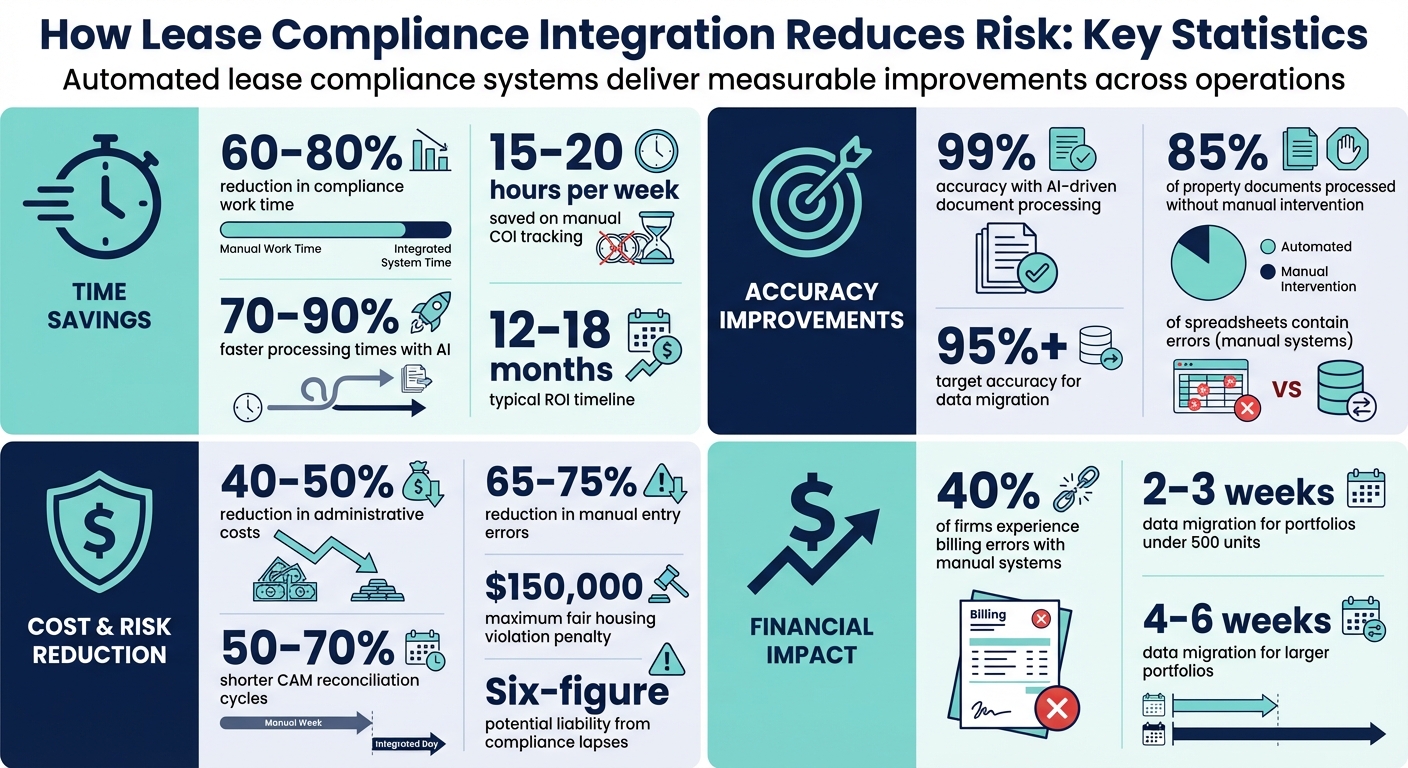
Lease Compliance Integration Benefits: Time Savings, Accuracy, and Cost Reduction Statistics
ASC 842 Webinar: How to Automate Compliance
sbb-itb-99d029f
Common Risks in Lease Compliance
While integrating automated solutions offers numerous benefits, sticking to manual processes for lease compliance can lead to significant risks, especially when managing large portfolios. These risks can quickly escalate, creating challenges that are difficult to address.
Financial Penalties and Regulatory Fines
Failing to stay compliant can result in hefty financial consequences. Logan Anderson, Director of Strategy & Growth at Re-Leased, highlights the seriousness of these lapses:
when certificates lapse or endorsements are missing, a single incident can create six-figure exposure [1].
Beyond issues like insurance gaps, manual tracking often leads to billing errors that drain revenue. Kala Halbert, Marketing Director at Prophia, shares that:
nearly 40% of firms said manual lease management had led to billing errors or missed obligations [3].
These errors can include missed expense pass-throughs or underbilled Common Area Maintenance (CAM) recoveries, directly cutting into property income. On top of that, fair housing violations can bring civil penalties of up to $150,000 under the Fair Housing Act [4]. Using inconsistent screening methods or failing to maintain proper documentation only increases the risk of running afoul of regional or federal regulations, especially when manual systems fail to standardize record-keeping [1].
Missed Deadlines and Operational Disruptions
Manual tracking makes it easy to overlook critical lease dates, which can result in unfavorable terms, missed opportunities, or uninsured vendor risks during active projects. When compliance lapses occur, teams are often forced to drop their regular responsibilities to deal with audits or investigations, pulling resources away from revenue-generating work [4].
Logan Anderson underscores how manual processes fall apart at scale:
Manual compliance breaks under portfolio scale. Spreadsheets and inboxes can't handle changing regulations, rising data privacy expectations, and vendor risk [5].
By adopting integrated platforms, teams have reported 60-80% time savings on compliance tasks, with most seeing a return on investment within 12 to 18 months [5]. Without automation, operational delays not only disrupt workflows but also create a foundation for potential legal troubles.
Legal Disputes and Documentation Errors
Inadequate record-keeping can lead to legal challenges when disputes arise over lease terms or expense calculations. Errors in enforcing lease clauses or calculating recoveries often result in costly litigation [3]. Without centralized data, these disputes become even more complicated. Spreadsheets and scattered databases make it difficult to respond quickly to regulatory inquiries, sometimes taking days instead of minutes [5]. This lack of clear audit trails leaves firms vulnerable, especially during financial reporting reviews for standards like ASC 842 and IFRS 16 [1]. Poor documentation not only increases legal exposure but also undermines the accuracy of financial data.
Data Inaccuracies and Reporting Challenges
Manual data entry is prone to errors, which can impact financial reporting and portfolio analysis. Mistakes in rent rolls or missed lease options can lead to valuation inaccuracies during property sales or underwriting [3]. These discrepancies can become especially costly during transactions when buyers uncover inconsistencies between reported and actual lease terms. Additionally, relying on spreadsheets and email as primary systems of record introduces data security risks, potentially leading to privacy-related fines [1].
Firms that leverage AI-driven document extraction have achieved 99% accuracy, showcasing how technology can eliminate the vulnerabilities tied to manual workflows [1]. By reducing errors, these tools help ensure data integrity and improve compliance processes across the board.
How to Implement Lease Compliance Integration
Addressing risks tied to lease compliance calls for a methodical approach. It begins with evaluating your current operations and concludes with continuous oversight to ensure the system delivers tangible benefits.
Step 1: Review Your Current Lease Portfolio
Start by analyzing your existing compliance processes. Take a close look at how you currently handle COI tracking, inspections, and lease obligations. Logan Anderson, Director of Strategy & Growth at Re-Leased, highlights the challenges of manual systems:
Manual tracking creates blind spots. Teams spend hours chasing COIs, updating spreadsheets, and sending reminder emails [1].
Establish a starting point by documenting incident histories, near misses, and past audit findings. This gives you a benchmark to measure progress after integration. Next, compile a full inventory of the systems your team relies on - property management software, accounting tools, and those ever-present spreadsheets scattered across shared drives. Gather key historical documents like T-12 financial statements, rent rolls, and expense ratios to prepare for data migration [2]. Anderson underscores the benefits:
The ROI calculation is straightforward when you factor in time savings, risk reduction, and improved audit readiness [1].
Pinpoint operational bottlenecks by assessing how much time is spent on manual tasks. Identify areas where automation can make an immediate impact, such as vendor insurance verification or tracking expiration dates [1]. Analyzing rent rolls for turnover and renewal trends can also highlight which properties require closer compliance monitoring [2]. This groundwork not only sheds light on inefficiencies but also reveals where automation can most effectively reduce risks.
Step 2: Choose the Right Integration Partner
Finding the right platform is key. Look for one that integrates seamlessly with your existing systems. Prioritize platforms offering API connections and AI-driven document extraction, which can achieve up to 99% accuracy, minimizing the need for manual data entry [1][6].
Evaluate how well the platform handles variations in document quality. AI-driven tools can process up to 85% of property documents without manual intervention, but performance depends on document consistency [1]. Before committing, run a readiness assessment to understand how differences in lease formats across your portfolio might affect accuracy [1]. A trial run with a small group of properties can help prove ROI and fine-tune workflows before rolling out the system portfolio-wide [1].
Step 3: Migrate Data and Configure Systems
Data migration is a critical step, and preparation is key to avoiding errors. Clean and standardize your data before starting the migration process [1]. For portfolios with fewer than 500 units, migration typically takes 2 to 3 weeks, while larger portfolios may require 4 to 6 weeks [9].
Use an abstraction template to standardize essential lease clauses, including rent, renewals, CAM, insurance, and termination terms [8]. Leverage AI-powered OCR and natural language processing tools to speed up data extraction [1][7]. Employ a two-tier quality assurance process where both an analyst and a supervisor review the data, aiming for 95% accuracy or higher [7].
Set up automated alerts for critical dates - 90, 60, 30, and 15 days before renewals or escalations. Define role-based access to secure sensitive information [1][7][9]. Establish clear escalation procedures for unresolved renewals or non-compliant vendors so issues are addressed promptly [1]. Ensure the system links structured data fields directly to the original signed documents to maintain audit traceability [7].
Step 4: Train Teams and Monitor Performance
Training your team is essential for successful implementation. Track key performance indicators (KPIs) such as time saved on tasks, reductions in expired certificates, and the time required for audit preparation [1]. Update training materials as new features are added [1]. Regularly monitor adoption rates to ensure teams are using the system effectively [1].
Organizations utilizing AI for lease abstraction and insurance verification report 70% to 90% faster processing times [1]. Automated compliance systems often cut administrative costs by 40% to 50% and reduce manual entry errors by 65% to 75% [9]. Additionally, automated alerts and workflows can shorten CAM reconciliation cycles by 50% to 70% [7]. By establishing benchmarks before implementation, you can clearly measure these gains and demonstrate ROI [1]. Regular performance tracking ensures the system continues to safeguard against compliance issues.
How CoreCast Simplifies Lease Compliance Integration
CoreCast is an all-in-one real estate intelligence platform that brings together lease monitoring, portfolio analysis, and stakeholder reporting. By directly connecting with property management software, it pulls in lease data and historical financial records seamlessly. As Jared Stoddard, Chief Product Officer at CoreCast, puts it:
CoreCast integrates directly with your property management software... Just connect your data source once. CoreCast ingests historicals and lease data instantly [2].
This seamless integration lays the groundwork for better monitoring, deeper analysis, and smoother communication throughout the lease lifecycle.
Real-Time Lease Monitoring and Alerts
CoreCast’s real-time dashboards are designed to keep teams ahead of the game. They automatically flag critical updates like upcoming lease expirations and deviations in key metrics - such as occupancy rates or maintenance costs. This allows teams to focus on renewals and tackle potential issues right away. Users can even schedule insights to be sent directly to their email, Slack, or through in-app notifications on a weekly, monthly, or quarterly schedule.
The platform’s Output View updates financial metrics like IRR, equity multiples, and valuations in real time as assumptions shift. This ensures that decisions are always based on the latest data. And it’s worth noting why this matters - manual data entry is notoriously error-prone, with studies showing that nearly 90% of spreadsheets contain errors [1].
Beyond alerts, CoreCast’s tools provide a more comprehensive view of portfolio performance across asset types.
Portfolio Analysis Across Asset Classes
CoreCast is built to handle a wide variety of asset types, including multifamily, office, retail, industrial, hospitality, self-storage, medical office, RV parks, student housing, and cold storage. This versatility ensures that compliance is consistent across even the most diverse portfolios. Users can create custom summaries to evaluate past performance and future opportunities in one place.
The platform also features geospatial mapping, which offers an interactive view of properties and their competitive landscapes. Filters allow users to sort by product type, risk profile, sponsor, or deal stage [10] [2]. For mixed-use properties, CoreCast combines asset types into unified scenarios, complete with tailored assumptions for each component [2]. As Jared Stoddard explains:
The map view brings spatial intelligence to your pipeline so you can manage risk, allocate capital, and prioritize conversations based on market density and deal maturity [2].
Streamlined Stakeholder Communication and Reporting
CoreCast simplifies stakeholder communication with customizable, live portals. These portals allow lenders to track compliance, debt coverage, and valuation metrics. Limited partners gain access to distributions, performance data, and other key financial indicators. Joint venture partners receive updates on strategy, project status, and timelines [2].
The platform is also evolving to include AI-generated investor reports. These reports automatically create summaries, leaving only minimal final edits for managers [2]. By automating traditionally time-consuming tasks - like manual COI tracking, which can take 15 to 20 hours per week for property teams [1] - CoreCast significantly reduces the administrative workload. This streamlined approach not only saves time but also minimizes risk, making compliance and reporting more efficient than ever.
Conclusion
Integrating lease compliance systems revolutionizes how organizations manage operations and mitigate risks. By replacing scattered spreadsheets and manual processes with centralized, automated tools, businesses save time and reduce errors. For example, manual Certificate of Insurance (COI) tracking can take up to 15–20 hours weekly, whereas AI-powered systems handle the same tasks 70–90% faster with an impressive 99% accuracy rate [1]. These advancements pave the way for smoother and safer operations.
A proactive approach to risk management helps prevent issues like expired certificates and non-compliant vendors, which could otherwise lead to six-figure liabilities [1]. Modern systems take the guesswork out of compliance by sending timely alerts before deadlines, ensuring nothing slips through the cracks. This shift minimizes costly mistakes and keeps operations running efficiently.
CoreCast consolidates these capabilities into one platform, seamlessly integrating lease monitoring, benchmarking and portfolio analysis, and stakeholder reporting. Industry experts highlight how manual workflows not only increase risk but also drain valuable resources that could be better spent on revenue-generating activities [1]. By automating compliance tasks and offering real-time insights across various asset types, CoreCast enables teams to focus on strategic decisions instead of tedious administrative work.
For real estate professionals managing intricate portfolios, the real question isn't if they should adopt lease compliance systems - it's how soon they can implement them. With reduced risk, heightened accuracy, and significant time savings, these systems provide a compelling edge in today’s competitive market.
FAQs
How does integrating lease compliance systems help reduce financial risks?
Integrating lease compliance systems can significantly cut financial risks by centralizing all lease-related data and automating essential tasks. These systems handle things like tracking lease expirations, rent adjustments, and regulatory deadlines. By ensuring nothing slips through the cracks, they help you steer clear of expensive penalties, missed payments, or audit complications.
On top of that, consistently applying policies across both accounting and property management platforms boosts accuracy and reduces errors. This not only simplifies operations but also provides better financial oversight and peace of mind.
How can I successfully integrate lease compliance into my real estate platform?
To effectively implement lease compliance, start by examining your current processes. This means identifying any gaps and gaining a solid understanding of your workflows and the data your team relies on. Next, select a software platform that works effortlessly with your existing real estate systems and includes the key compliance features you need. Set up the integration to allow real-time data sharing and create clear, standardized procedures for reviewing leases, evaluating risks, and resolving compliance concerns.
Make sure your team is well-trained on the new system, communicate updates clearly, and introduce the integration in manageable phases to ease the transition. Once everything is in place, take advantage of automation tools to track compliance, produce reports, and fine-tune your processes as necessary. This method not only minimizes risks but also boosts accuracy and ensures your operations align with U.S. regulatory standards.
Why is automation essential for managing extensive lease portfolios?
Managing large lease portfolios can be a daunting task, but automation has become a game-changer in this space. By automating repetitive tasks - like tracking lease expirations, monitoring cash flows, and managing compliance requirements - real estate professionals can drastically cut down on manual errors and save valuable time. This allows them to shift their focus toward strategic decision-making instead of getting bogged down by administrative work.
Another major perk of automation is its ability to deliver real-time insights into portfolio performance. These insights make it easier to spot risks and opportunities quickly, leading to better, faster decisions. On top of that, automation helps ensure compliance with regulatory standards, minimizing the chance of costly errors and keeping operations running smoothly.