
How Wellness Features Impact Leasing Trends
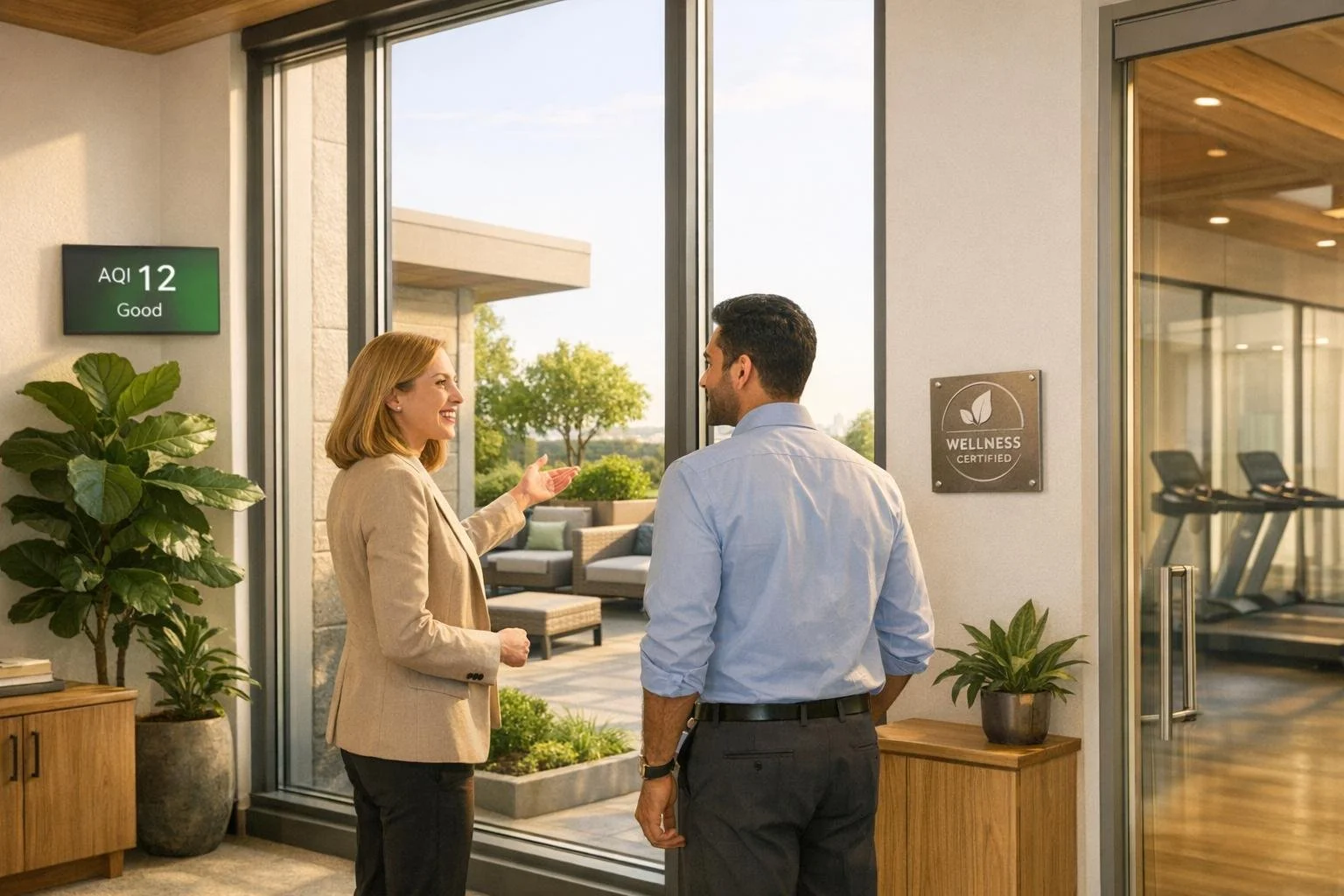
Wellness features in commercial real estate are no longer optional. They directly shape leasing decisions, boost tenant satisfaction, and increase property value. Key takeaways include:
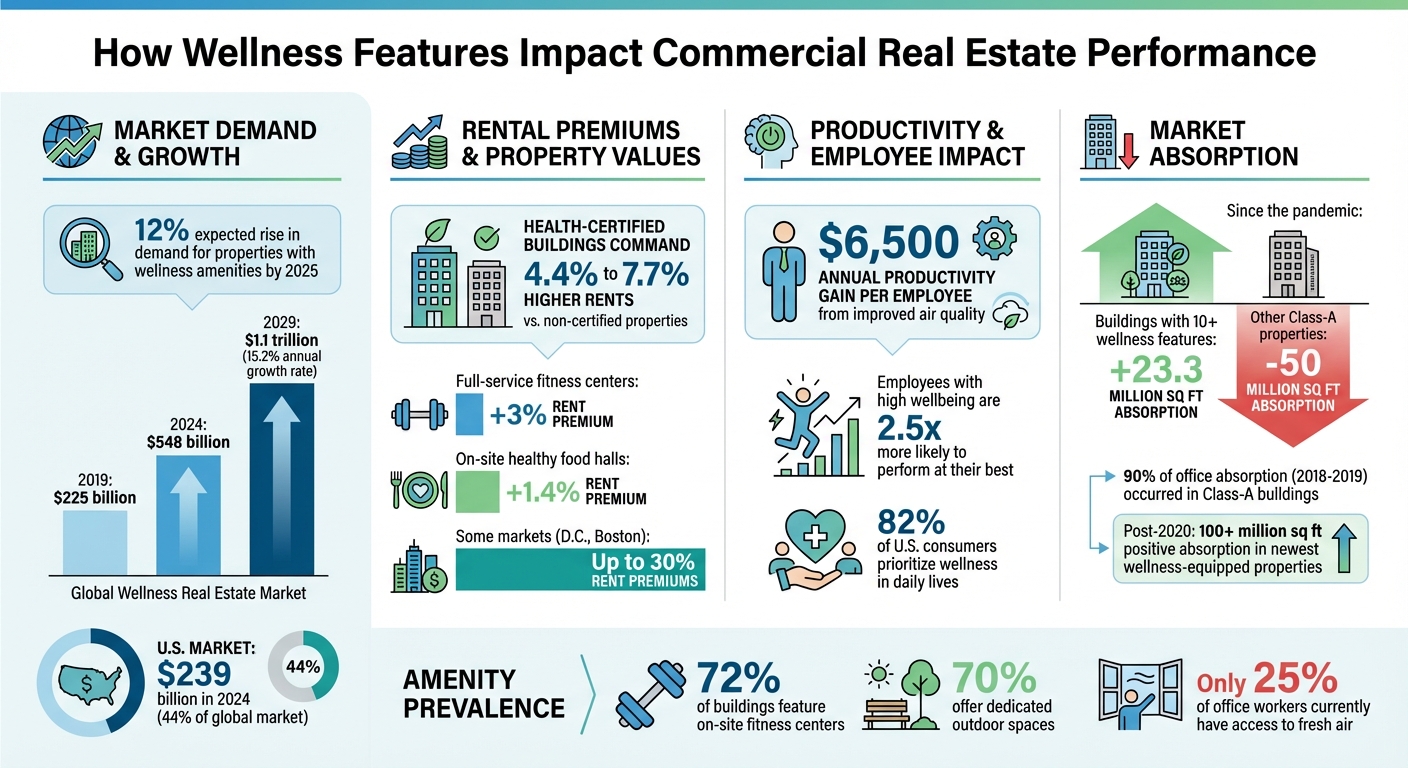
- Higher Demand: By 2025, properties with wellness amenities are expected to see a 12% rise in demand.
- Rental Premiums: Health-certified buildings command 4.4% to 7.7% higher rents compared to non-certified spaces.
- Employee Productivity: Improved air quality alone can add $6,500 in annual productivity per employee.
- Tenant Retention: Wellness-focused properties reduce vacancies and foster longer lease terms.
From fitness centers to outdoor spaces and advanced air systems, wellness features are reshaping tenant priorities and driving market trends. This shift highlights the growing importance of health-focused infrastructure in competitive real estate markets.
Financial Impact of Wellness Features in Commercial Real Estate
Financial Returns from Wellness Features
Rental Premiums and Property Values
Properties with wellness certifications consistently achieve higher rents and values. Studies using hedonic analysis show that certified spaces command effective rent premiums ranging from 4.4% to 7.7% compared to similar non-certified properties [2][3]. A 2025 analysis of U.S. office buildings further supports this, revealing that health-certified offices enjoy rental premiums between 4% and 6% [5][7].
Interestingly, these premiums hold steady regardless of factors like LEED certification, building age, or recent renovations. Specific amenities also contribute to these higher rents. For example, properties featuring full-service fitness centers see a 3% rent premium, while on-site healthy food halls add another 1.4% [3]. Notably, the rent premium for newly constructed, amenity-rich buildings has doubled since the onset of the COVID-19 pandemic, reflecting a shift in tenant priorities [6].
"Buildings that are accredited to a standard of any of industry programs like LEED, WELL, and Fitwel are considered highly by the market, and therefore attract a premium valuation." - Niall McSweeney, Head of Development Advisory, Asia Pacific, Altus Group [8]
These higher rents align with tenants' increasing demand for health-conscious environments. Additionally, they come with the added benefit of boosting tenant retention, further enhancing the financial appeal of wellness-focused properties.
Stable Income Through Tenant Retention
Wellness features do more than just increase rents - they also foster long-term occupancy stability. A 2022 study by QuadReal Property Group, conducted in partnership with the Center for Active Design, analyzed 60 properties and found a clear link between higher Fitwel scores and improved Net Promoter Scores (NPS). Tenants in healthier buildings were far more likely to recommend their properties to others, leading to fewer vacancies and longer lease terms [4].
The financial benefits extend beyond occupancy. Improved indoor air quality alone can increase productivity by an estimated $6,500 per employee annually [3]. Employees with high levels of wellbeing are also 2.5 times more likely to report that they can perform at their best compared to those with lower wellbeing [6]. These factors make wellness-certified properties particularly attractive, as tenants recognize the value of environments that enhance their workforce's health and productivity. Even during economic downturns, such properties remain in demand, as businesses prioritize spaces that support their employees' performance and wellbeing.
sbb-itb-99d029f
Wellness Features as Core Infrastructure
The Shift in Wellness Real Estate Strategy
Wellness features have transitioned from being optional perks to becoming fundamental infrastructure in real estate. This shift reflects a growing demand for health-focused environments, often described as a "shift toward quality" by industry experts [8][6]. Properties that prioritize wellness are seeing higher occupancy rates and premium rents, creating a clear divide between buildings with advanced health features and those without. The latter are increasingly struggling to compete [8].
The numbers tell the story. Between 2018 and 2019, 90% of office absorption occurred in Class-A buildings. Post-2020, this trend surged, with over 100 million square feet of positive absorption concentrated in the newest, most advanced properties equipped with wellness-focused infrastructure [6]. Globally, the wellness market hit $6.32 trillion in 2023, and wellness real estate is projected to grow by 15.8% annually, reaching $912.6 billion by 2028 [8]. These trends underscore a lasting shift: businesses now view wellness as a strategic asset to attract employees back to the office and enhance job satisfaction [8][10].
"Promoting wellness in real estate not only enhances employee well-being and community connection – it also elevates company reputation by aligning with top-tier, sustainable building standards and adding inherent value to the space." - Ray Wong, Vice President, Data Solutions Delivery, Altus Group [8]
With this shift, wellness features are no longer afterthoughts - they are integral to property design and strategy.
Types of Wellness Features Driving Demand
This transformation has led to a focus on specific wellness features that directly influence tenant demand and property success. These features are now built into core systems rather than added later [6]. Key categories include:
- Environmental quality: Advanced HVAC systems, circadian lighting, and high-performance air filtration.
- Physical health: On-site fitness centers, outdoor spaces, and bike storage facilities.
- Social activation: Community lounges, healthy dining options, and organized events.
Recent statistics highlight this evolution. Around 72% of buildings now feature on-site fitness centers, and 70% offer dedicated outdoor spaces [6]. Additionally, walkable locations and proximity to health services significantly impact rental performance, as properties in accessible neighborhoods consistently outperform those that rely solely on internal amenities [5]. With 82% of U.S. consumers prioritizing wellness in their daily lives [8], these features have become essential for attracting and retaining tenants.
A great example of this trend is the August 2024 move by TEB Capital Management - Tom Brady’s family office - to a health-centric development in Florida. This project includes a five-story office building, 66 condo units, and a spa operated by "The Well", a wellness brand [8]. The decision to relocate reflects how wellness infrastructure is increasingly influencing major real estate choices, aligning business goals with health and longevity values.
How Wellness Features Affect Leasing Activity and Tenant Behavior
Tenant Demand for Health-Focused Environments
Wellness features in buildings are doing more than just improving infrastructure - they’re reshaping tenant priorities and leasing trends. Tenants now actively seek environments that promote health and productivity. For instance, better indoor air quality can lead to productivity gains of about $6,500 per employee annually [3]. Employees with higher levels of wellbeing are also 2.5 times more likely to reach peak performance [6]. These numbers make a strong case for integrating wellness features into workplaces.
This growing demand is creating a clear divide in the market. Since the pandemic, buildings with 10 or more wellness features have gained an impressive 23.3 million square feet of absorption, while other Class-A properties saw a loss of over 50 million square feet [12]. By 2025, properties with diverse wellness amenities are expected to see 12% higher demand compared to buildings offering only basic features [1][11].
Additional data backs up this trend. A June 2022 study by the Center for Active Design and QuadReal Property Group, which analyzed 60 properties, found that buildings with higher Fitwel scores also scored higher on Net Promoter Scores (NPS) [4].
"We have found a clear correlation of a higher Fitwel score with a greater willingness of occupants to recommend the building to their friends and colleagues."
- Jamie Gray-Donald, Senior Vice President of Sustainability & EHS at QuadReal Property Group [4]
These findings highlight how wellness features are influencing tenant behavior and leasing decisions.
Case Studies: Wellness-Driven Leasing Strategies
Real-world examples showcase how wellness-focused strategies are transforming leasing outcomes. Take 167 Green Street in Chicago, for example. This property introduced a 17th-floor "amenity penthouse" that includes a rooftop terrace and shared garden seating. This feature directly addressed a critical tenant need: outdoor access. Currently, only 25% of office workers report having access to fresh air [1].
Another standout example is The Old Post Office in Chicago, which adopted a hospitality-inspired leasing model. This strategy included a community manager, concierge services, and two sales associates to welcome guests. These efforts helped attract high-profile tenants to this premium space [1][11].
Beyond these case studies, platforms like CoreCast are helping real estate professionals stay ahead of wellness trends. By tracking wellness-related metrics, CoreCast enables data-driven decisions that align with tenant preferences and market demands.
Market Trends and Growth Projections for Wellness Real Estate
Current Market Size and Future Projections
The wellness real estate market is on a steep upward trajectory. In 2024, the global market hit $548 billion, more than doubling its $225 billion valuation in 2019 [13]. With an impressive 19.5% annual growth rate, it’s outpacing the broader construction industry, which grows at an average of 5.5% annually [14].
Looking ahead, this sector is expected to maintain strong momentum, growing at 15.2% annually through 2029 and reaching a projected $1.1 trillion [13][14]. The U.S. plays a leading role, growing from $100 billion in 2019 to an estimated $239 billion in 2024, with a steady 19% annual growth rate [14]. This positions the U.S. as the largest market globally, accounting for approximately 44% of all activity in wellness real estate [14].
A key driver behind this growth is the shift in perception - wellness features have evolved from luxury extras to essential components of infrastructure. In cities like Washington D.C. and Boston, wellness-certified properties can command rent premiums of up to 30% [17]. Additionally, the number of wellness-certified building projects has surged, increasing more than forty-fold between 2017 and 2023 [16]. This signals a growing acceptance of wellness-focused design as a standard in the industry.
With such strong projections, the market is ripe for innovative approaches, particularly in the realm of mixed-use developments that prioritize wellness as a central theme.
Hybrid and Mixed-Use Developments
Mixed-use developments are emerging as a standout trend within the wellness real estate sector. This category, which merges wellness infrastructure with multi-functional spaces, is projected to grow at a rate of 13.28% during the forecast period [15]. It’s currently the fastest-growing segment in the wellness real estate market.
These projects combine offices, residential units, retail spaces, and recreational areas, all centered around wellness-focused design principles. Researchers describe this trend as "urban regeneration driven by wellness" [14]. Tenants today are increasingly drawn to environments that go beyond functionality, offering spaces that foster social interaction, productivity, and overall well-being [6]. Modern mixed-use developments incorporate features like adaptable layouts, biophilic design (which integrates natural elements), and smart technologies to create these wellness-enhancing environments [15][14].
To capitalize on this trend, real estate professionals are turning to tools like CoreCast, which provides analytics on wellness-related metrics. These insights allow investors to identify high-growth opportunities and align their strategies with tenant preferences. As wellness continues to shape market dynamics, properties that prioritize these features are becoming indispensable assets in competitive real estate landscapes.
Conclusion
Wellness features have become a crucial part of a property's infrastructure, significantly influencing both financial performance and market competitiveness. Data shows that health-certified buildings achieve 4.4% to 7.7% higher effective rents compared to their non-certified counterparts [2][9]. Additionally, properties equipped with a variety of wellness amenities are expected to experience a 12% rise in tenant demand by 2025 [1]. These trends directly enhance property values and provide stronger returns for investors.
The impact of wellness features extends beyond financial metrics. For instance, improved indoor air quality can increase employee productivity by nearly $6,500 per year, while higher wellness scores are associated with better tenant satisfaction, more recommendations, and higher lease renewal rates [3][4].
Real estate professionals can harness these benefits by adopting a data-driven approach. Tools like CoreCast provide comprehensive analytics to pinpoint high-impact wellness features, benchmark portfolio performance, and track real estate portfolio performance. This shift from reactive to strategic management is key to unlocking greater value.
The evidence is clear: properties that prioritize health-driven design and integrate intelligent analytics consistently outperform standard buildings in both tenant appeal and financial outcomes.
FAQs
Which wellness upgrades deliver the fastest ROI in office buildings?
Outdoor spaces - like roof terraces, sky lounges, and courtyards - are some of the best investments for office buildings. They tend to deliver a quicker return on investment compared to indoor perks like gyms. Why? These areas not only command higher rent premiums but also draw tenants more effectively. Plus, they’re a big factor in increasing leasing activity and keeping tenants happy.
How can landlords measure whether wellness features improve renewals?
Landlords looking to understand the impact of wellness features on lease renewals should focus on tracking tenant satisfaction and renewal rates. Research consistently highlights a direct connection: when tenants are more satisfied, they’re far more likely to renew their leases. Properties that include wellness features - like better air quality or natural lighting - not only see improved tenant retention but often command higher rents, which underscores the growing demand for these amenities. By analyzing tenant feedback alongside rent trends and renewal data, landlords can clearly see how these wellness-focused investments shape leasing outcomes.
What does it take to earn a wellness certification like WELL or Fitwel?
To achieve a wellness certification such as WELL or Fitwel, buildings or organizations must adhere to standards that prioritize health, well-being, and effective operational strategies. These certifications evaluate various factors, including design choices, materials used, air and water quality, lighting conditions, and practices aimed at enhancing the health of occupants.