
Data-Driven Vendor Management for CRE
Managing vendors in commercial real estate (CRE) can be overwhelming, especially when outdated tools like spreadsheets and email threads dominate the process. These manual methods lead to inefficiencies, higher costs, and compliance risks. Here's what you need to know:
- 75% of procurement leaders question their data accuracy, and 74% still use spreadsheets for vendor management.
- Manual processes increase emergency repairs by up to 40%, which are far more expensive than planned maintenance.
- Data-driven systems, like CoreCast, use real-time analytics, automation, and performance tracking to cut costs by 12–18% and reduce emergency repairs significantly.
Switching to a centralized, automated platform transforms vendor management into a more efficient and cost-effective process. The result? Lower expenses, fewer risks, and improved decision-making.
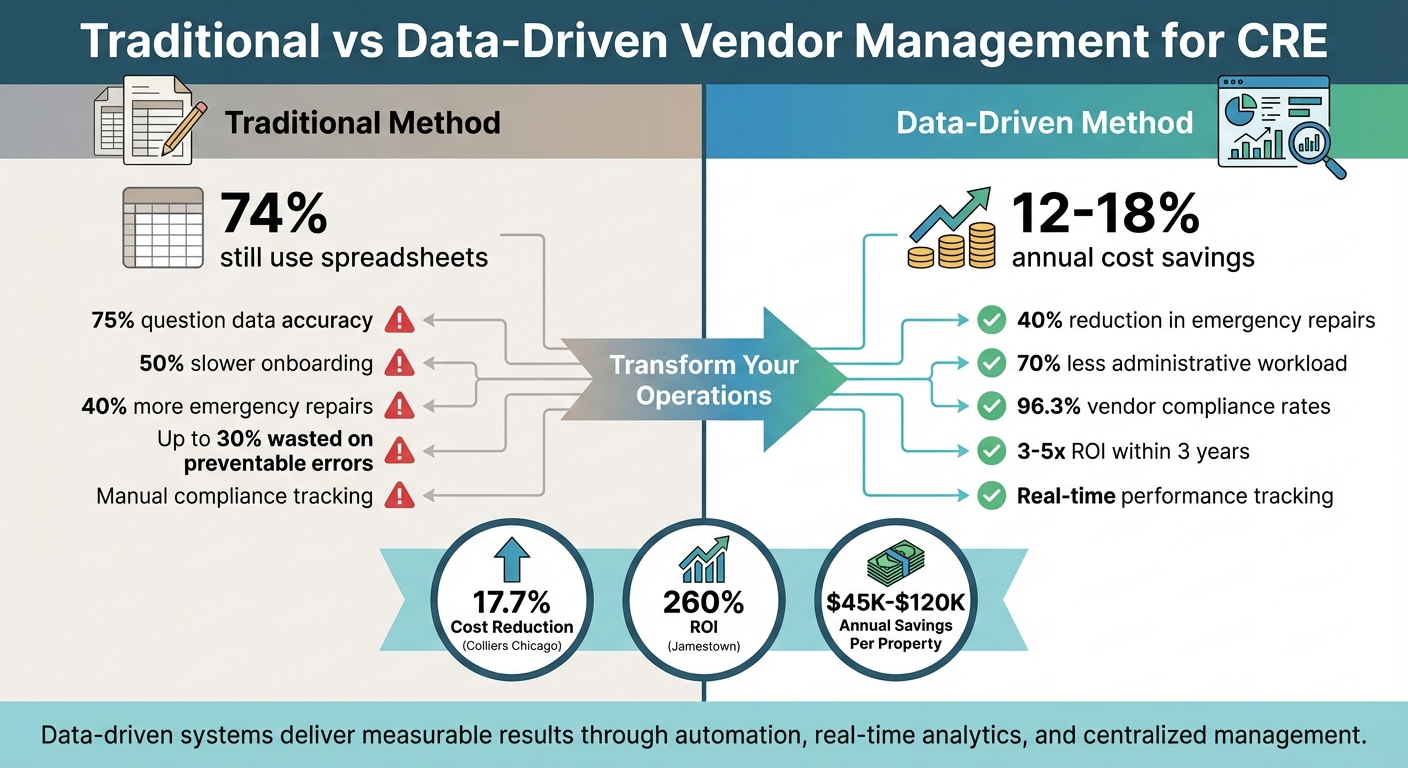
Traditional vs Data-Driven Vendor Management in Commercial Real Estate
1. Traditional Vendor Management
Managing vendors in commercial real estate has historically relied on manual processes that are both time-consuming and prone to errors. Property managers often juggle spreadsheets, emails, and paper files to coordinate contractors across various sites. A staggering 74% of procurement teams still use spreadsheets to track orders and payments, while 79% lack dedicated procurement management software [3]. This outdated approach creates disjointed data silos, making it nearly impossible to gain a clear view of vendor performance or spending trends. This visibility is essential for those looking to benchmark real estate portfolios against industry standards. Below, we’ll explore how these inefficiencies affect operations, cost management, performance tracking, and compliance.
Operational Efficiency
Manual processes weigh down efficiency with endless administrative tasks. From data entry to vendor onboarding, these methods waste valuable staff time and slow workflows. For example, before Colliers Chicago adopted a centralized system for their 300+ buildings, site teams spent countless hours manually tracking vendor credentials and chasing paperwork. This led to inconsistent workflows and compliance risks across their 47 users [6]. Onboarding vendors through traditional methods is also 50% slower compared to software-driven processes [1]. These delays ripple across operations, often leading to the cost overruns discussed next.
"VendorPM has given my team back valuable hours while reducing risk by ensuring we only work with the best vendors for the job. It has changed the game and we never looked back." - Lloyd Berry, Managing Director, Colliers Chicago [6]
Cost Management
Overseeing vendor activities manually opens the door to costly mistakes like invoice mismatches and unnoticed overcharges. Property managers can spend up to 30% of their time coordinating vendor operations when using non-centralized systems [9]. The financial toll is steep: traditional methods can lead to 40% more emergency repairs, which are significantly more expensive than planned maintenance [1]. Without automation, duplicate payments and contract violations often go unnoticed, potentially wasting up to 30% of total vendor spend on preventable errors [8].
"Manual oversight means overcharges slip through, duplicate billings get paid, and contract violations go unnoticed." - Datagrid Team [10]
But the inefficiencies don’t stop with costs; traditional methods also make it nearly impossible to track vendor performance effectively.
Performance Tracking
When managing large portfolios, tracking vendor performance manually becomes overwhelming. For instance, a portfolio of 100 properties might process over 10,000 vendor invoices every month - making it nearly impossible to validate them against contract terms manually [4]. Metrics like "first-time fix rates" are hard to calculate because callbacks often result in new work orders that aren’t tied to the original request. Performance reviews, when they happen, are typically quarterly - far too late to address declining service quality, which can frustrate tenants [4]. Feedback is often scattered across emails, portal comments, and verbal conversations, leaving no unified way to assess vendor reliability.
Risk and Compliance
Using spreadsheets for compliance tracking can leave properties vulnerable to liability. Documents like insurance certificates and professional licenses often expire unnoticed, exposing properties to portfolio risk. Manual systems struggle to keep up with renewal dates, credential updates, and regulatory changes across multiple vendors. Property managers are left performing tedious manual checks, which are still prone to missing critical issues [4]. Automated systems, on the other hand, can fill these gaps by sending alerts for renewals and updates, ensuring compliance.
| Challenge Category | Traditional Method | Consequence |
|---|---|---|
| Data Handling | Spreadsheets and manual logs | 75% of leaders doubt data accuracy [3] |
| Onboarding | Paper-based vetting | 50% slower administrative time [1] |
| Invoice Validation | Manual cross-referencing | Overcharges and duplicate payments [10] |
| Compliance | Manual COI tracking | Liability exposure from expired insurance [4] |
| Performance | Quarterly reviews at best | Too late to address declining service [4] |
sbb-itb-99d029f
2. Data-Driven Vendor Management
Data-driven vendor management takes the guesswork out of the equation, replacing it with real-time analytics. Instead of juggling paperwork and manually updating spreadsheets, property managers can now rely on centralized platforms to organize vendor credentials, track work orders, and monitor performance metrics. This approach shifts vendor oversight from a time-consuming chore to a strategic advantage that directly influences Net Operating Income (NOI) and tenant satisfaction.
Operational Efficiency
Automation has revolutionized vendor management, cutting repetitive tasks by 50–80% [11]. A great example is Related, a multi-market portfolio operator that adopted the VendorPM platform and slashed administrative workloads by 70% while managing vendors across their entire portfolio [7]. These platforms handle everything from verifying credentials to routing work orders based on vendor expertise. They even sync with accounting software, eliminating the need for double data entry.
By centralizing operations, property managers can also adopt a more proactive approach to maintenance. Integrated data tracking allows for optimized scheduling, such as fine-tuning HVAC maintenance cycles. This reduces emergency repairs by up to 40% and cuts utility costs by 15–25% through better system management [1]. These improvements are a key step toward tighter cost control, which we'll explore next.
Cost Management
Streamlined operations naturally lead to better cost management. Real-time data visibility provides property managers with a clearer picture of expenses. Mature vendor management programs report annual maintenance savings of 12–18% and a 3–5x ROI within three years [1][11]. Automated invoice checks catch overcharges and duplicate payments - errors that can account for as much as 30% of total vendor spending [8].
Take Colliers Chicago, for instance. After rolling out VendorPM across 300 buildings, they reduced vendor costs by 17.7% [7]. The platform ensures invoices align with contract terms, flags unauthorized charges like inflated "emergency" rates, and standardizes bidding processes to guarantee competitive pricing. With real-time tracking of cost variances, property managers can step in before budgets spiral out of control.
"VendorPM assures that you will find the ideal vendor at the best price. It simplifies finding vendors, making it a stress-free experience."
– Jeevamala Markandu, Assistant Property Manager, Melbourne Property Management [13]
Performance Tracking
Cost savings are just part of the equation - tracking vendor performance in real time is equally important. Modern systems focus on metrics that matter, providing dashboards that display response times, first-time fix rates (aiming for ≥85%), and SLA compliance (targeting ≥95%) [1]. By capturing every work order detail, these platforms build a performance history that helps identify and address issues early [12][4].
Advanced tools now incorporate IoT sensors and AI to validate vendor claims. For example, sensors can confirm HVAC optimizations by measuring energy reductions and stable temperatures, moving beyond subjective manual logs. This transparency can lead to a 15–20% drop in Operating Expenses (OpEx) through consistent vendor evaluations [12].
"What gets measured gets improved. Properties with systematic vendor tracking see measurable gains in efficiency, cost control, and tenant satisfaction within the first year."
– Logan Anderson, Director, Strategy & Growth, Re-Leased [12]
| KPI Category | Benchmark Target | Action if Below Target |
|---|---|---|
| Emergency Response | < 2 hours | Immediate escalation; activate backup vendor |
| First-Time Fix Rate | ≥ 85% | Root cause analysis; training plan |
| SLA Compliance | ≥ 95% | Performance improvement plan |
| Cost Variance | Within 5% of budget | Scope clarification; approval review |
| Safety Incidents | Zero tolerance | Immediate review; possible suspension |
Risk and Compliance
Traditional compliance checks often leave gaps, but automated systems eliminate these risks. Data-driven platforms compile Certificates of Insurance (COIs), Workers' Compensation, and trade licenses into a single database, sending alerts before credentials expire [2][14]. These systems can even block work orders for vendors with expired credentials, preventing liability issues before they arise [1][7].
Colliers Chicago saw a major compliance boost, reaching 96.3% vendor compliance at the time of project award by using automated tracking for over 300 buildings [7]. The platform also categorizes vendors by risk level, with stricter requirements for high-risk trades like HVAC and roofing. It tracks additional needs such as diversity criteria and health and safety standards [13][15].
"It has helped a great deal with compliance and we're now piloting this great solution with a few key markets in the U.S."
– Mark E. Rose, Chair & CEO, Avison Young [13]
Automated systems also tackle financial risks. Performance reports help managers reduce overspending by 15% and improve budget awareness by 60 percentage points [16]. AI tools analyze invoice patterns to spot fraud, duplicate payments, and contract violations, ensuring these issues are caught before they impact the bottom line [4][15].
Pros and Cons
Building on the earlier insights, let's explore the trade-offs between traditional and data-driven vendor management approaches. Each has its strengths and challenges, shaped by factors like costs, efficiency, and risk management.
Traditional vendor management is appealing for its simplicity - no need for expensive software, minimal training, and no headaches with system integrations. It’s easy to get started, but this simplicity often hides costly inefficiencies. Manual processes, like invoice handling, can lead to overcharges or duplicate payments, while compliance tracking through spreadsheets often misses critical details, such as expired insurance certificates. These oversights can result in significant financial and legal risks[4].
On the other hand, data-driven systems address these shortcomings with automation and analytics. While they require upfront investment in software and integration, the long-term benefits are clear. For instance, some programs have shown a 12–18% reduction in annual maintenance expenses and a 40% drop in emergency repair costs[1]. Automated invoice checks help catch billing issues early, and real-time compliance alerts ensure vendors with expired credentials are flagged before they’re assigned tasks[4][7]. These capabilities can transform vendor management into a more strategic, cost-effective operation.
However, data-driven systems are not without challenges. Integration issues are a major hurdle - 75% of CRE operators cite poor system connectivity as their top concern, while 83% report experiencing "PropTech fatigue" from juggling disconnected tools[17]. Property managers often deal with up to 15 different logins just to handle daily tasks, which can complicate workflows. To succeed, organizations must carefully vet how to integrate third-party tools for compatibility with existing platforms like Yardi or MRI. Without this, even the most promising software risks being abandoned.
| Feature | Traditional Vendor Management | Data-Driven Vendor Management |
|---|---|---|
| Upfront Cost | Minimal (spreadsheets and basic tools) | Moderate to high (software and integration) |
| Administrative Burden | High (manual data entry, emails, phone calls)[4] | Low (automation reduces workload by 70%)[7] |
| Invoice Accuracy | Prone to errors and overcharges[4][8] | Automated validation against contracts[4][7] |
| Compliance Tracking | Manual; risk of lapses[4] | Automated alerts; 96.3% compliance rates[7] |
| Emergency Repairs | Reactive; costly and frequent | Proactive; up to 40% reduction[1] |
| Scalability | Challenging for large portfolios[4] | High scalability with centralized dashboards[4][7] |
| Integration Complexity | None (uses basic tools) | High; requires API connections[17] |
| ROI Timeline | Hard to measure | Achievable within 3 years[1] |
| Primary Risk | Human error, hidden costs, liability exposure[4] | PropTech fatigue, cybersecurity risks[17] |
"If it doesn't integrate, it doesn't get adopted. If end users don't want it, it won't last. If it doesn't prove ROI, it doesn't scale."
– Nick Pipitone, Author, Insights by Blueprint[17]
Conclusion
When comparing traditional methods with data-driven approaches, the advantages of the latter are undeniable. Data-driven vendor management reshapes cost control, risk management, and operational efficiency in commercial real estate. The results are hard to ignore: 12–18% annual savings on maintenance costs, up to 40% fewer emergency repairs, and the potential to recover $45,000–$120,000 annually per property through standardized pricing and accountability[1][5]. These improvements directly enhance NOI and property values.
Consider the success stories: Colliers Chicago implemented a data-driven strategy across 300 buildings, achieving 17.7% savings and 96.3% vendor compliance[6]. Similarly, Jamestown’s pilot program at Waterfront Plaza delivered a 260% ROI and $71,000 in annual savings, paving the way for broader adoption[17]. These figures underscore the tangible benefits of embracing data-driven strategies.
Centralizing vendor data and automating compliance processes also streamline operations significantly. Defining clear performance benchmarks - such as achieving a first-time fix rate of ≥85% and SLA compliance of ≥95% - can lead to measurable efficiency improvements[1][12].
For real estate professionals seeking actionable insights and consolidated data, CoreCast offers a comprehensive solution. By integrating seamlessly with property management systems, CoreCast delivers track real estate portfolio performance and pipeline tracking, enabling users to implement data-driven vendor management strategies that reduce costs and improve operations. Taking this step today ensures a stronger competitive position in the commercial real estate landscape tomorrow.
FAQs
What’s the fastest way to switch from spreadsheets to data-driven vendor management?
The fastest way to move from spreadsheets to a more efficient, data-driven vendor management process is by using an automated platform. Such a platform brings all your vendor data into one place, simplifies workflows, and provides real-time performance tracking. By integrating a system that standardizes tasks like procurement, onboarding, and compliance, you can cut down on errors, reduce manual effort, and make the transition to a streamlined, data-focused approach much quicker.
Which vendor KPIs should I track first across my CRE portfolio?
Tracking key vendor KPIs is crucial for maintaining smooth operations in your commercial real estate portfolio. Important metrics to monitor include:
- Response times: How quickly vendors address service requests.
- First-time fix rates: Aim for a target of 85% or higher to ensure issues are resolved on the first attempt.
- SLA compliance: Measure how well vendors adhere to agreed-upon service level agreements.
- On-time delivery rate: Evaluate the consistency of vendors meeting deadlines.
- Invoice accuracy: Check for precise and error-free billing.
- Contract compliance: Ensure vendors meet all contractual obligations.
By keeping an eye on these KPIs, you can better assess vendor performance and streamline operations.
How do I ensure a new vendor platform integrates with my property management system?
To make the integration process as seamless as possible, start by checking that the platform works well with your property management system and the APIs it supports. Ensuring compatibility is key. Next, focus on standardizing your data - this helps maintain consistency and quality across the board. Automating data flows is another important step, as it enables real-time updates and reduces manual work. To minimize risks, consider rolling out the integration in phases rather than all at once. Finally, don’t overlook security and compliance measures; protecting your data during integration is critical. Following these steps can help simplify operations and improve the accuracy of your data.