
How AI Predicts Real Estate Market Volatility
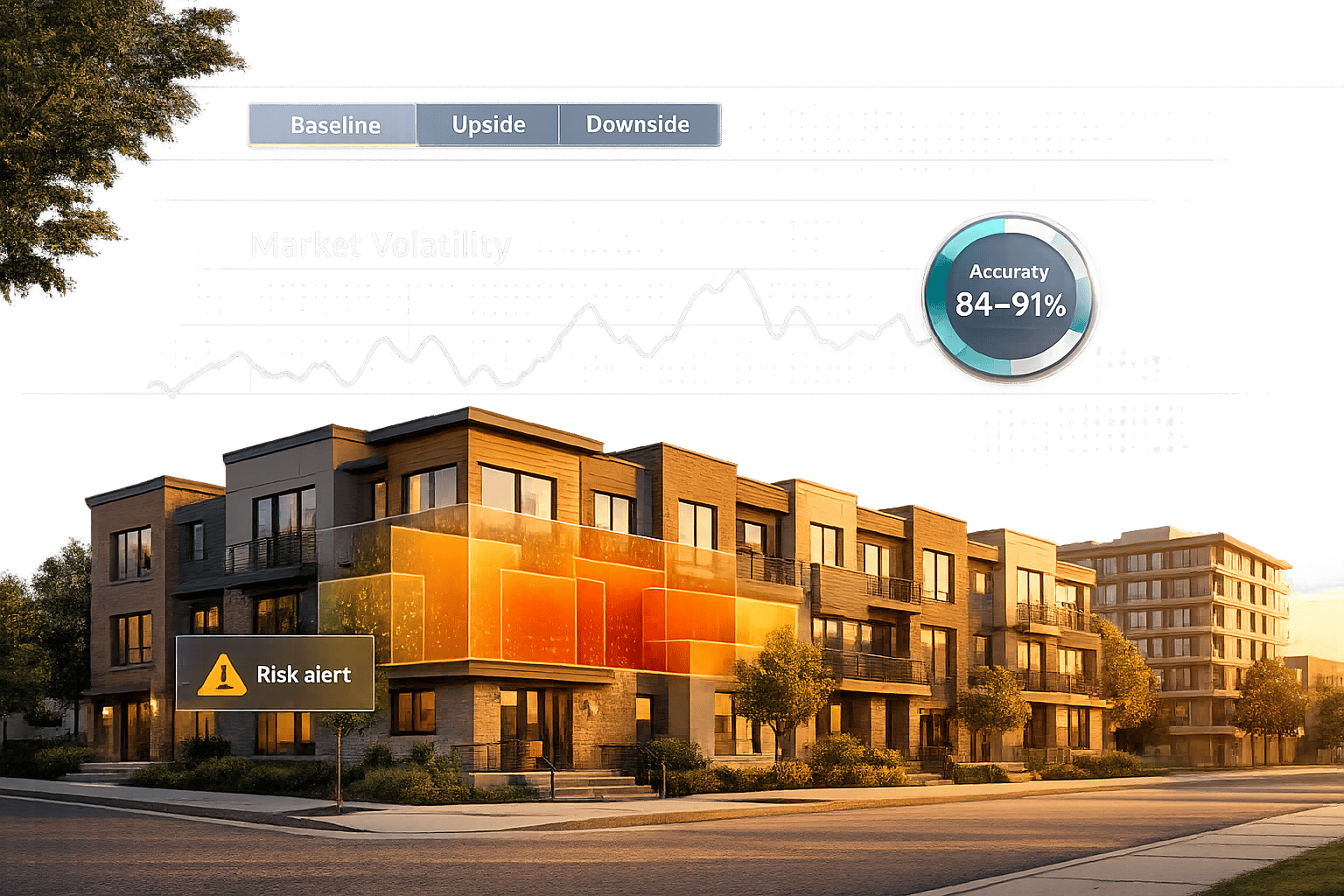
AI is reshaping real estate forecasting by delivering faster, more precise predictions. Unlike older methods that take weeks and rely on past data, AI analyzes over 500 variables - including mortgage applications, building permits, and even social media chatter - to predict market shifts in just hours. With accuracy rates of 84%–91% for short-term forecasts and over 90% for metrics like rent projections, it helps investors anticipate changes and manage risks effectively.
Key takeaways:
- Speed: AI delivers forecasts in 2–3 hours vs. 4–6 weeks for older methods.
- Accuracy: Short-term forecasts achieve 84%–91% accuracy; some metrics exceed 90%.
- Risk Management: AI identifies early warning signs, like submarket saturation or economic challenges.
- Leading Indicators: Focuses on forward-looking data (e.g., mortgage applications, climate risks) to detect trends months ahead.
Platforms like CoreCast streamline these insights, combining advanced forecasting with tools for portfolio analysis and decision-making. By automating workflows and offering scenario modeling, CoreCast helps users operate faster and with fewer errors, making AI a game-changer for real estate professionals.
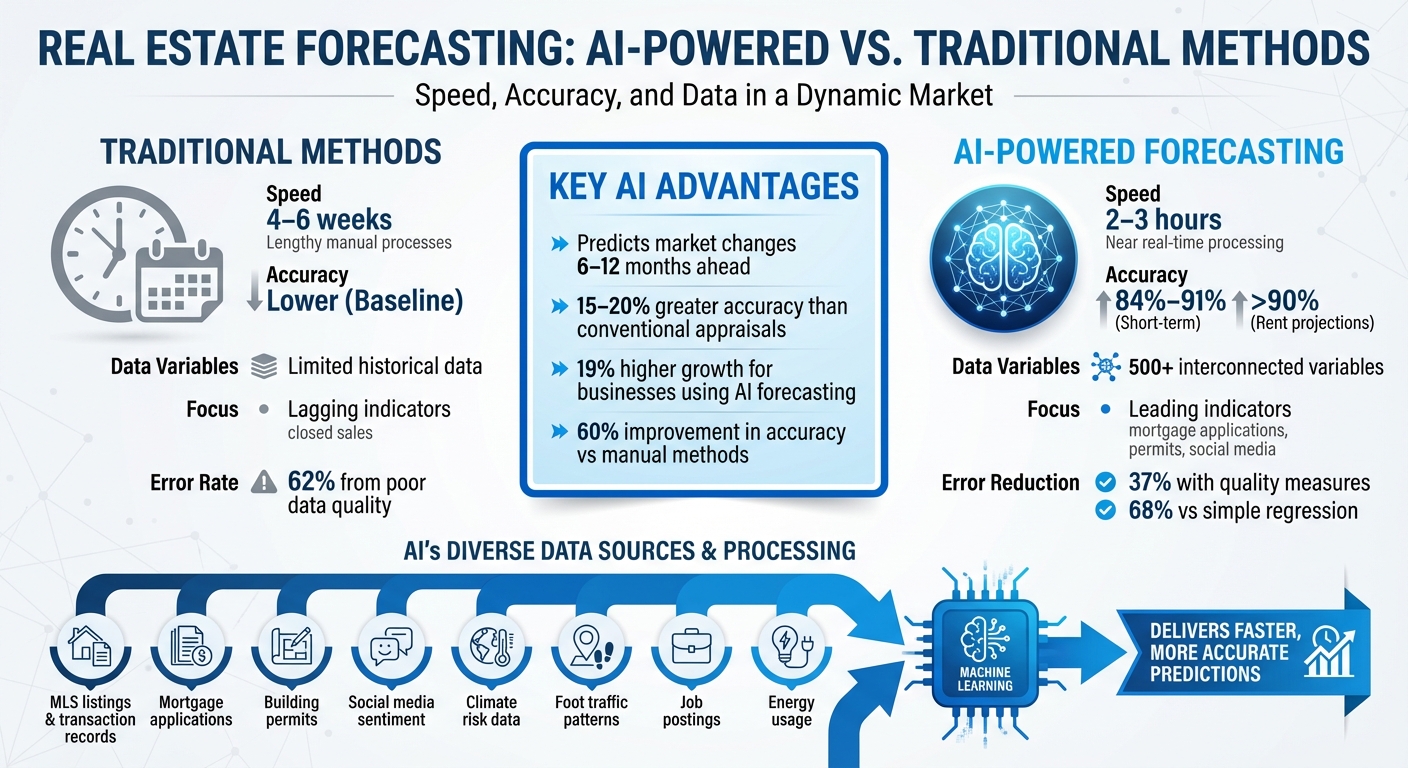
AI vs Traditional Real Estate Forecasting: Speed, Accuracy, and Data Comparison
How AI Collects and Processes Real Estate Data
Data Sources for Predictive Analytics
AI systems gather data from an extensive range of sources to create a detailed view of market trends. While traditional data like MLS listings, historical sales prices, and transaction records remain essential, modern AI also taps into leading indicators that provide early warnings of market shifts. These indicators include metrics like mortgage application volumes, new building permits, job postings, and even online search trends for specific neighborhoods[1][2].
Beyond conventional data, AI also incorporates alternative sources that traditional analysts often overlook. Social media sentiment, for instance, sheds light on public perceptions of certain areas. Mobility and foot traffic data reveal where people are spending their time, while energy usage patterns indicate neighborhood activity levels and occupancy rates. Climate risk data, such as flood probabilities, heat index projections, and rising insurance costs, has become a key factor in assessing long-term market stability. For example, in Austin, Texas, AI systems identified a market correction months in advance by analyzing leading indicators like a surge in construction permits and rising interest rates, even when traditional data pointed to continued growth[1].
AI's strength lies in its ability to analyze forward-looking metrics rather than lagging ones, such as closed sales data. By monitoring mortgage applications, building permits, and job market trends, AI can detect turning points in the market 6–12 months ahead. With the capacity to process over 500 interconnected variables, some AI models achieve prediction accuracy rates exceeding 90% for three-year rent fluctuations[1]. This level of precision is only possible after the data undergoes thorough cleaning and preparation.
Data Preprocessing and Cleaning
Raw data is often riddled with errors and inconsistencies, which can lead to inaccurate predictions. In fact, poor data quality accounts for 62% of forecasting errors[3]. To address this, AI systems first clean and standardize data from multiple sources. Missing values are filled using methods like linear interpolation or K-Nearest Neighbors (KNN), while outliers - such as a high-value luxury sale that could distort neighborhood averages - are identified using the interquartile range (IQR) method and either adjusted or excluded[3].
"Thus, how well we clean and understand the data has a tremendous impact on the quality of the results." - Indraneel Dutta Baruah, Data Scientist[3]
Real estate data often exhibits non-stationary trends, meaning its mean and variance change over time. AI transforms this data into a stationary format - where these metrics remain consistent - using techniques like differencing or detrending. This step is crucial for accurate time-series forecasting. It also provides the foundation needed to benchmark real estate portfolios against historical performance and market standards. For instance, a study on New York City property sales from 2003 to 2015 used the Prophet AI model and achieved a Mean Absolute Percentage Error (MAPE) of just 8% for one-month-ahead predictions by properly accounting for seasonal sales peaks in summer[3]. Companies that prioritize data quality measures can reduce forecasting errors by up to 37%[3]. This rigorous preprocessing ensures the data is ready for machine learning models to deliver reliable forecasts in the real estate sector.
sbb-itb-99d029f
Machine Learning Models for Market Volatility Forecasting
Algorithms Used in Real Estate Forecasting
After thorough data cleaning, advanced algorithms are uncovering market patterns that often go unnoticed by human analysts. Machine learning models excel at identifying nonlinear relationships among more than 500 dynamic variables at once. Unlike traditional forecasting methods, which often depend on straightforward trend lines, these algorithms analyze the complex interplay between factors like employment trends, construction activity, and sensitivity to interest rates.
Time series models are the backbone of real estate forecasting. ARIMA is effective for capturing linear trends, while SARIMA and SARIMAX account for seasonal cycles and external economic drivers like inflation and employment rates, providing a broader market context[3]. Meanwhile, gradient boosting models such as XGBoost have demonstrated remarkable accuracy in detecting early signs of market downturns. For instance, XGBoost has been shown to reduce forecasting errors by 68% compared to simple regression models and by 26% compared to multivariate regression[3].
A major strength of these AI-driven models is their reliance on forward-looking indicators. Traditional methods often focus on closed sales data, which only reflects past activity. In contrast, modern AI tools prioritize leading metrics that can signal market changes 6–12 months in advance[1]. This forward-thinking approach has delivered impressive results, with short-term AI market direction forecasts achieving accuracy rates between 84% and 91%. In some cases, such as predicting multifamily rents in Seattle, accuracy has exceeded 90%[1].
These algorithmic insights also enable AI to simulate various market scenarios, providing a more comprehensive view of potential outcomes.
Scenario Simulations for Market Volatility
AI models go beyond single-point predictions by simulating multiple scenarios to illustrate how different factors might influence the market. Instead of a definitive statement like "prices will increase by 8%", these models produce probability-weighted scenarios that include Bull, Base, and Bear cases. This approach recognizes the inherent uncertainty of markets, offering investors a range of possible outcomes to consider.
These simulations examine how the market might respond to specific events. For example, they can evaluate the effects of a 2% rise in interest rates, analyze the impact of a regional economic slowdown, or explore how shifting demographics could influence property values. By running these scenarios, AI assigns probabilities to each outcome based on historical trends and current conditions. This is especially critical in volatile markets where a single-point forecast could be misleading. As Mark Zandi, Economist at Moody's Analytics, explains:
"Housing markets now react to data in near real time. That speed changes how risk shows up" - Mark Zandi, Economist, Moody's Analytics[4]
Businesses leveraging time series forecasting have reported growth rates 19% higher than those relying solely on intuition[3].
Practical Applications of AI Market Predictions
Assessing Risk and Volatility
AI-powered forecasting is transforming how risk and volatility are evaluated, replacing intuition with data-driven insights. By breaking down complex risk factors - like market cycles, sector exposure, tenant industry concentration, interest rate sensitivity, and lease rollover patterns - AI identifies vulnerabilities and diversification gaps that traditional methods often overlook.
One standout benefit is its ability to provide early warning signals. For instance, behavioral patterns such as changes in listing tour frequency or price drop trends can indicate market shifts weeks before they appear in official price data[2].
Modern AI tools also integrate environmental risk factors into property valuations. These include flood probabilities, heat index trends, and insurance costs - critical considerations for coastal or climate-sensitive portfolios. As environmental factors increasingly influence asset values, especially looking toward 2026, these insights are becoming essential for maintaining market stability. AI’s multi-horizon forecasts, offering 3-month, 12-month, and 36-month predictions with confidence intervals, allow investors to balance short-term market timing with long-term strategy[2].
In addition to mitigating risks, AI uncovers opportunities to enhance portfolio performance.
Improving Portfolio Performance
AI doesn’t just protect investments - it actively boosts portfolio performance by uncovering asset interdependencies and refining allocation strategies. By analyzing how different assets interact and revealing hidden correlations, AI helps optimize diversification and reduce concentration risks.
One practical example is dynamic rent optimization. Machine learning models can suggest unit-specific pricing based on real-time market analytics, competitive properties, and historical leasing trends, enabling property managers to maximize revenue effectively. Similarly, AI-driven acquisition tools can identify properties with features that align with specific investment goals, guiding investors toward high-potential opportunities.
Given the speed of market changes, frequent model retraining - weekly or monthly instead of quarterly - is crucial to stay ahead of emerging trends[2]. That said, AI works best as a decision-support tool rather than a replacement for human expertise. Combining AI insights with in-person research - like visiting neighborhoods to spot developments not yet captured in datasets - leads to more well-rounded and informed investment decisions[2]. This partnership between human judgment and AI technology creates a stronger foundation for success.
How AI Is Changing Real Estate and Mortgages | The Future of Home Buying
CoreCast: AI-Powered Real Estate Intelligence
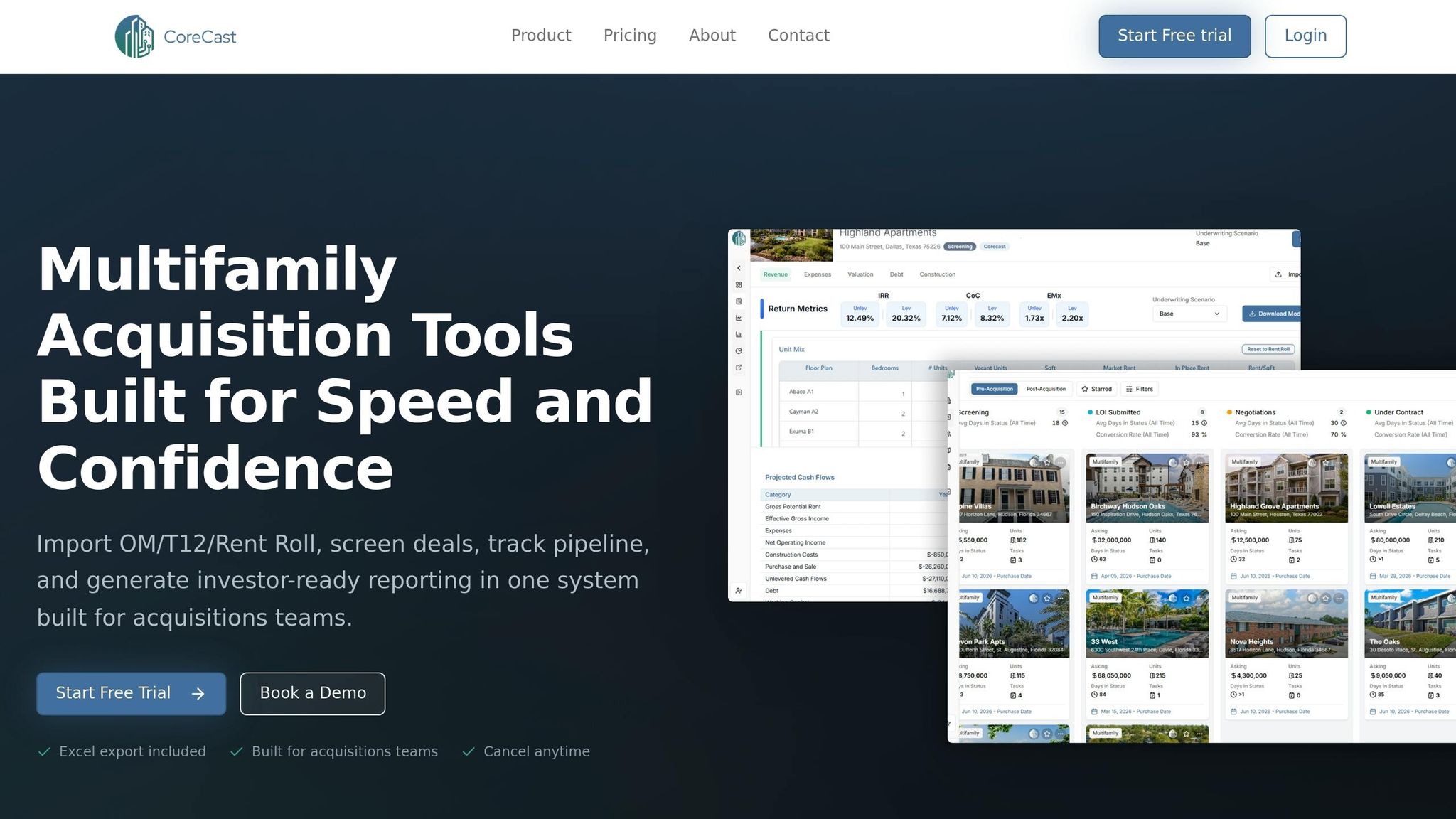
In today’s unpredictable real estate market, relying on scattered spreadsheets and disconnected tools can lead to inefficiencies and errors. Enter CoreCast, an all-in-one real estate intelligence platform designed specifically for professionals managing underwriting, deal tracking, portfolio analysis, and stakeholder engagement. By centralizing these processes, CoreCast eliminates the fragmentation that often slows teams down.
The platform streamlines operations by consolidating multiple tools and subscriptions into a single workspace. With CoreCast, you can underwrite assets across various classes and risk profiles, manage your deal pipeline at every stage, analyze portfolios, and even map out properties alongside their competitive landscapes. This is a game-changer for accuracy, especially when you consider that 88% of traditional Excel models contain errors. CoreCast’s built-in validation logic automatically flags inconsistencies, delivering a 60% improvement in accuracy compared to manual methods. Beyond predictive insights, CoreCast integrates operational tools to help users adapt to market volatility with confidence.
Features for AI-Powered Forecasting
At the heart of CoreCast is its Underwriter Modeling Engine, which leverages advanced machine learning techniques like LSTM networks and time-series models. By analyzing transaction histories, demographic data, and economic indicators, it delivers forecasts with 15–20% greater accuracy than conventional appraisal methods[7]. The Portfolio Insights feature provides a comprehensive view of systemic risks and growth opportunities, going beyond surface-level analysis of individual assets.
CoreCast also includes Scenario Modeling, a tool that allows you to stress-test outcomes by adjusting variables such as rent growth, cap rates, and operating expense inflation. This is especially valuable in unpredictable markets. Real-time alerts keep you informed when conditions shift - whether it’s a surge in rent growth exceeding 10% in a specific submarket or an increase in construction permits - so you can adapt quickly[8]. Integrated Mapping adds another layer of intelligence, enabling you to visualize properties alongside demographic and economic trends. This geographic insight helps identify location-specific risks before they affect asset valuations. While the platform excels at forecasting, it also simplifies everyday tasks through automation.
Simplifying Workflows with CoreCast
CoreCast transforms complex workflows by serving as a centralized hub for financial and operational data. It automates time-consuming tasks like data aggregation, model updates, and the creation of branded investor reports, enabling teams to evaluate five times more sites in the same amount of time[7].
The Pipeline Tracker offers real-time visibility into deals, from evaluation to disposition, reducing the risk of deal slippage and ensuring team accountability. Collaboration tools, including commenting, issue flagging, and change tracking, keep teams aligned without the need for endless email chains. For communicating with stakeholders, the Key Stakeholder Center generates AI-powered reports that provide insights on market volatility, investment scenarios, and portfolio performance, empowering fast, informed decision-making.
During beta testing, CoreCast’s automated forecasting was priced at $50 per user/month. Post-launch, the platform offers tiered pricing options: a Free tier for basic access, Essentials at $75 per user/month, and Pro at $100 per user/month.
Conclusion
AI-powered predictive analytics is reshaping the way real estate professionals handle market uncertainties. Gone are the days of relying solely on outdated spreadsheets or gut instincts. Today, machine learning models process massive datasets in real time, uncovering complex patterns and early warning signals that traditional methods often overlook.
For example, AI improves property valuation accuracy by 15–20%, predicts market changes 90–180 days ahead, and enables companies to operate three times faster than their competitors[6]. These capabilities don’t just enhance forecasting - they also revolutionize risk management and portfolio resilience. By learning from past events like the 2008 housing crisis, AI can differentiate between temporary market corrections and deeper structural issues[5]. Additionally, advanced risk modeling has been shown to cut rent defaults and evictions by up to 20%, helping stabilize portfolios during economic turbulence[7].
Platforms like CoreCast integrate these AI capabilities into a comprehensive real estate intelligence solution. With features like an LSTM-powered forecasting engine, scenario modeling, and real-time alerts, CoreCast enables stress testing, competitive landscape analysis, and automated reporting. This approach enhances accuracy by 60% compared to manual methods and allows for the evaluation of up to five times more sites in the same amount of time[7].
These advancements highlight the growing importance of AI in real estate investing. As challenges around data quality and integration persist, platforms that combine actionable AI insights with efficient workflows will set market leaders apart. The real question is: how quickly can you adopt AI-driven forecasting to stay competitive in this data-centric industry?
FAQs
What data does AI use to spot real estate market shifts early?
AI processes an extensive array of data to provide insights into the real estate market. This includes market trends like employment rates, migration patterns, and housing affordability. It also examines property-specific details, such as lease terms and trade-out rates, alongside regional metrics like construction starts and absorption rates.
Beyond this, AI taps into public records, economic indicators, and demographic shifts to paint a broader picture. It even leverages satellite imagery, social media sentiment, and transaction records to detect subtle changes. Together, this comprehensive analysis helps pinpoint early signs of shifts in the real estate market with impressive accuracy.
How reliable are AI volatility forecasts in fast-changing markets?
AI has proven to be a dependable tool for forecasting in fast-changing markets, with models delivering trend predictions that are typically accurate within a range of 5–10%. These systems also boost forecasting precision by an impressive 15–20%. That said, human expertise is still a key part of the equation, as it plays a crucial role in interpreting these predictions and fine-tuning them to achieve the best possible outcomes.
How can CoreCast help me stress-test deals and portfolio risk?
CoreCast lets you assess deal and portfolio risks with scenario analysis. By simulating how different market conditions - such as shifts in interest rates or economic changes - affect property values and cash flows, it helps you manage risks more effectively and make smarter decisions.