
How Opportunity Zones Impact Real Estate Markets
Opportunity Zones, established by the Tax Cuts and Jobs Act of 2017, are designed to attract private investment into economically struggling areas across the U.S. By offering tax incentives, these zones encourage investors to fund projects that can revitalize distressed communities. Here's what you need to know:
- What They Are: Opportunity Zones are economically challenged census tracts where investments can lead to tax benefits.
- Tax Benefits: Investors can defer, reduce, or eliminate capital gains taxes depending on how long they hold their investments.
- Real Estate Focus: These zones have driven a surge in housing development, particularly in multifamily units, addressing housing shortages while increasing property values.
- Economic Impact: From 2019 to 2025, over 416,000 new residential addresses were added in these areas, with 30.7% of zones seeing home price increases of at least 10% in 2025.
- Policy Updates: In 2025, Congress made the program permanent, introduced rural-specific incentives, and implemented stricter eligibility rules to better target underserved areas.
Investors are leveraging tools like AI-powered platforms to identify high-potential properties, benchmark real estate portfolios, and track market trends within these zones. With the program's permanence and updated policies, Opportunity Zones are set to play a larger role in addressing housing shortages and boosting local economies.
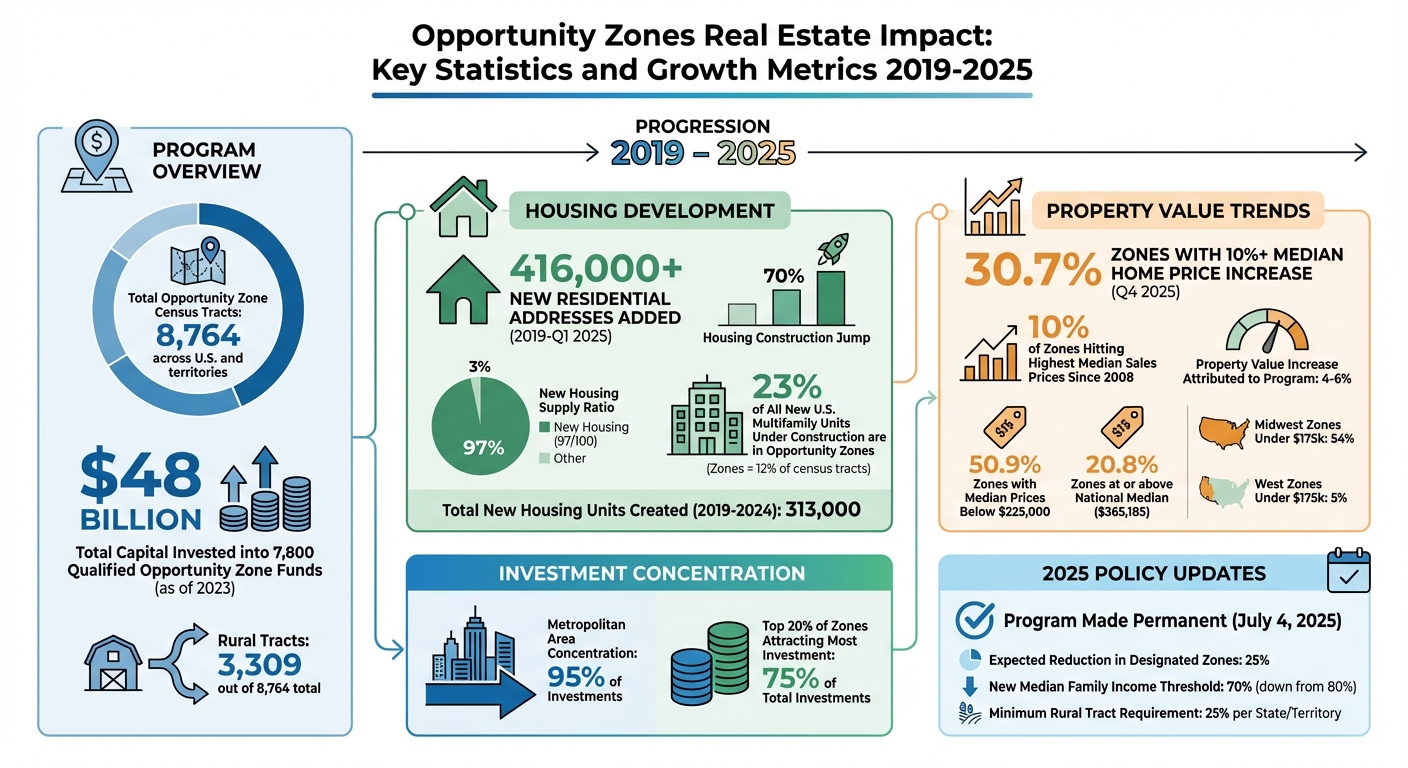
Opportunity Zones Real Estate Impact: Key Statistics and Growth Metrics 2019-2025
Webinar: Utilizing the Opportunity Zone tool for residential development
sbb-itb-99d029f
Economic and Real Estate Effects of Opportunity Zones
Opportunity Zones have significantly impacted housing supply and property values since their introduction. From 2019 through the first quarter of 2025, these areas saw the addition of over 416,000 new residential addresses - a 70% jump in housing construction. Research indicates that for every 100 new addresses created through this program, 97 represent entirely new housing supply [5].
Growth in Housing Supply and Development
The sharp rise in housing construction highlights a focused effort to address the nation's housing shortage. Tax incentives have funneled capital into residential projects, especially multifamily developments, targeting renters in economically struggling areas through integrated real estate platforms. This influx of investment has not only expanded housing options but has also contributed to property value growth.
Changes in Property Values
Property values in Opportunity Zones have generally mirrored national real estate trends, with some areas experiencing notable increases. By Q4 2025, 30.7% of Opportunity Zone tracts saw median home prices rise by at least 10% year-over-year, while about 10% hit their highest median sales prices since the 2008 financial crisis [2]. Rob Barber, CEO of ATTOM, noted:
"The fact that price growth is happening in Opportunity Zones at roughly the same rate it's happening outside of them is a further sign that all sectors of the housing market are being affected by this sustained price increase" [2].
This price growth is often fueled by buyers priced out of costlier markets, where inventory remains tight and costs continue to climb [9][10]. However, sales volumes in many census tracts are relatively low, leading to year-over-year median price fluctuations of over 5% in nearly 90% of analyzed zones [2][8]. Such variability naturally affects market pricing and affordability, as outlined below.
Market Pricing and Affordability Trends
Despite rising property values, homes in Opportunity Zones remain more affordable than the national average. In Q4 2025, 50.9% of these tracts had median sales prices below $225,000, compared to the national median home price of $365,185 [2]. Only 20.8% of Opportunity Zone tracts matched or exceeded the national median [2]. Regional disparities also highlight this affordability gap: in the Midwest, 54% of Opportunity Zone tracts had median home values under $175,000 in Q3 2025, while only 5% of tracts in the West fell into this range [4].
This affordability provides an entry point for buyers with limited resources, positioning these zones as a "stepping stone" for real estate investment and asset management [7][10]. However, neighborhoods with median sales below $125,000 often see slower appreciation and face higher risks, creating a divide between thriving and struggling Opportunity Zones [3][9][11].
Case Studies: Real Estate Projects in Opportunity Zones
These case studies highlight how investments in Opportunity Zones can turn economic strategies into tangible successes. By examining three multifamily projects in the Midwest and Southwest, we see how this program addresses housing shortages while breathing new life into struggling neighborhoods.
Northbend in Tempe, AZ
In 2024, Milhaus and Banyan Residential completed Northbend, a 310-unit development in Tempe, Arizona. This project transformed a neglected county island into a vibrant residential community. Located near key transit routes and educational institutions, Northbend capitalized on its prime location with easy access to major employment centers.
Milhaus invested $39 million in the first phase of what will be a $177 million, 600+ unit development. Notably, this was the first property in the U.S. rezoned specifically to align with Opportunity Zone Program guidelines [12][13]. Brad Vogelsmeier, Vice President of Development at Milhaus, shared:
"Northbend now serves as a catalyst for future housing and tax revenue growth."
While the project requires a 10-year hold to realize its full potential, it is projected to deliver net returns of 10–13% [13]. Similar projects are replicating this success in other parts of the country.
Marcato in Kansas City, MO

Marcato represents a turning point for Kansas City's historic Troost corridor. Completed in 2025 by Milhaus, the project utilized Opportunity Zone tax incentives to attract long-term investment to an area previously overlooked for decades.
This development didn’t just add housing - it brought renewed stability to the neighborhood, paving the way for additional retail and service investments. It stands as a testament to how Opportunity Zone programs can make redevelopment financially feasible in areas once considered unviable [13].
Arrello in Olathe, KS
Arrello, a 228-unit multifamily project in downtown Olathe, Kansas, entered its leasing phase in September 2022. Developed by Milhaus, this project tackled a major hurdle, as Kansas has one of the lowest shares of Opportunity Zone investments nationwide [6]. Despite this, Arrello became part of Milhaus’s growing regional portfolio, which now includes over 2,000 units across the Kansas City metro area.
Strategically located near major employment hubs, Arrello is contributing to the area's revitalization. John McGurk, Vice President of Development at Milhaus, explained:
"the growth and revival of another walkable, amenity-rich community in the thriving KC area."
Arrello’s success underscores how well-placed investments in Opportunity Zones can stimulate community renewal and meet critical housing needs.
Using Technology to Maximize Opportunity Zone Investments
Technology has become a key player in navigating the complexities of Opportunity Zone investments. With 8,764 designated census tracts spread across the U.S. and its territories, investors need advanced tools to identify and evaluate opportunities effectively [6][15]. Modern real estate intelligence platforms now offer AI-powered insights that cover 99% of the U.S. population, providing access to detailed data on property taxes, deeds, mortgages, and even environmental risks across 158 million residential and commercial properties [2][3].
Data Analysis and Portfolio Management
Platforms like CoreCast streamline the investment process by combining real-time insights and portfolio tracking in one place. This makes it easier for investors to evaluate various asset classes and monitor their progress across different deal stages. Such tools are especially valuable in identifying high-potential properties within the intricate framework of the Opportunity Zone program.
Real-time data tracking also sheds light on market trends, revealing significant shifts. For instance, many Opportunity Zone tracts have experienced double-digit price increases, showcasing both growth and volatility. A February 2026 report from ATTOM analyzed 3,633 census tracts using AI-driven analytics and geospatial data. It found that median home prices increased year-over-year in 46.4% of the studied tracts during Q4 2025, with 10% of those tracts hitting their highest median sales prices since 2008 [2]. Rob Barber, CEO of ATTOM, remarked:
"The fact that price growth is happening in Opportunity Zones at roughly the same rate it's happening outside of them is a further sign that all sectors of the housing market are being affected by this sustained price increase." [2]
These analytics are further enhanced by visual tools that help investors map out competitive landscapes within Opportunity Zones.
Mapping Properties and Competition
Mapping tools integrated into platforms like CoreCast provide a spatial perspective, highlighting trends and competition within specific census tracts. These tools allow investors to visualize property locations and identify investment clusters, revealing key patterns such as the program's "urban bias." Research shows that 95% of Opportunity Zone investments are concentrated in metropolitan areas [6]. Additionally, 75% of investments are focused on the top 20% of zones that already attract significant commercial activity [14].
Another striking trend is the concentration of multifamily housing developments in these zones. By 2025, 23% of all new multifamily units under construction in the U.S. were located within Opportunity Zones, even though these zones account for only 12% of all census tracts [1]. These visual insights help investors spot overlooked opportunities and track where the market is shifting.
Custom Reports for Stakeholders
CoreCast enhances investor communication with branded reporting features that compile data and mapping insights into comprehensive reports. These reports offer a detailed view of investment performance and market trends, helping stakeholders stay informed and confident [2][4].
This reporting becomes especially important in demonstrating economic potential in less affluent areas. For example, only 20.8% of Opportunity Zone tracts had median sales prices at or above the national median of $365,000 by late 2025 [2]. By contextualizing affordability metrics and tracking neighborhood-level changes, CoreCast enables investors to craft compelling, data-backed narratives that align with their strategies. These tools not only highlight progress but also strengthen communication with stakeholders, ensuring everyone is aligned toward achieving projected returns.
Policy Changes and Future of Opportunity Zones
The Opportunity Zone program underwent major changes with the signing of the One Big Beautiful Bill Act (OBBBA) on July 4, 2025. This legislation made the program permanent and removed the looming December 31, 2026, sunset clause. With no set deadline, developers now have the flexibility to approach projects at a more deliberate pace [18][19].
Program Extension Beyond 2026
The OBBBA introduced stricter rules for determining zone eligibility and adjusted the timing for designations. Notably, the median family income threshold for eligibility was lowered from 80% to 70% of the area median, and the previous "contiguous tract" rule was removed. Additionally, an "anti-gentrification" trigger disqualifies any tract where the median family income exceeds 125% of the state or metropolitan median. These updates are expected to reduce the number of designated zones by about 25% [18][19].
To ensure Opportunity Zones remain relevant, the program now refreshes zone designations every 10 years. This prevents outdated classifications in areas that have undergone substantial change. During the transition period (2027–2028), both original and newly designated zones will qualify for investment, creating a smoother shift. David G. Shapiro, Partner at Saul Ewing LLP, highlighted the benefits of this approach:
"The rolling five-year gain deferral period takes pressure off investment at the start of the decennial cycle" [18].
Changes to Investment Requirements
The OBBBA also introduced Qualified Rural Opportunity Funds (QROF), which offer a 30% basis step-up after five years and reduce the "substantial improvement" requirement to 50% of the property basis. These changes make rural rehabilitation projects more feasible and took effect immediately on July 4, 2025. Of the 8,764 Opportunity Zone census tracts, 3,309 are classified as rural, and under the new rules, at least 25% of tracts in each state or territory must be designated as rural [18][21][22][23].
Another key adjustment caps permanent gain exclusion at 30 years. After this period, the investment's basis steps up to fair market value, and any further appreciation could be taxed. Enhanced reporting requirements now oblige funds to disclose key details such as employee counts, housing unit totals, NAICS codes, and asset values annually. Non-compliance carries penalties of $10,000 per return, increasing to $50,000 for funds with assets exceeding $10 million [17][21][24].
Impact on Housing Shortages
These updates are poised to reshape investment strategies while addressing housing shortages. Between 2019 and 2024, the original Opportunity Zone program contributed to the creation of 313,000 new housing units. With the redesigned criteria and rural incentives, housing development in underserved areas is expected to accelerate. New reporting requirements will track affordable, market-rate, and mixed-income housing units [20][22][24].
ReImagine Appalachia commented on the program's evolution:
"The program has been criticized for funding projects in places that were already developing... New changes to the law will help with this [by] ensuring low-income places are better targeted" [20].
Conclusion
Opportunity Zones have become a major driver of real estate development, channeling over $48 billion into 7,800 Qualified Opportunity Zone funds across the U.S. as of 2023 [25]. This influx of capital has contributed to property value increases of 4–6% [16]. With Congress now making the program permanent, investors have the stability needed to plan long-term projects in areas that need economic revitalization.
The numbers tell a compelling story: 30.7% of Opportunity Zones experienced median home price increases of at least 10% year-over-year in Q4 2025 [2]. Yet, as Rob Barber, CEO of ATTOM, cautions:
"The situation inside Opportunity Zones still is far from rosy. Significant numbers still face depressed prices. But the latest big picture provides more evidence of home buyers interested in these communities, which can only be a positive lure for the investments that Opportunity Zone incentives are designed to attract" [3].
This dynamic market environment highlights the importance of advanced tools for investors. With 158 million U.S. properties to evaluate [2] and 73% of tracts experiencing significant price swings [11], robust analytics are essential. Platforms like CoreCast simplify this complexity, offering investors an all-in-one solution to underwrite assets, track deals, analyze portfolios with scenario analysis, and visualize market trends on integrated maps.
As Opportunity Zones continue to evolve, the combination of permanent tax incentives, improved reporting standards, and data-driven strategies offers a path to both financial success and meaningful community impact. By using comprehensive analytics, real estate professionals can identify high-potential tracts, validate opportunities, and manage investments with precision - all while contributing to the economic growth of underserved areas.
FAQs
Do Opportunity Zones actually lower my taxes?
Opportunity Zones provide tax perks, such as the ability to defer and reduce taxes on qualifying gains. However, these benefits aren't automatic. To take advantage, you need to meet specific investment and improvement requirements outlined by the program. Your overall tax savings will depend on how well you align with these criteria.
How do I know if a property is in an Opportunity Zone?
To determine if a property is in an Opportunity Zone, look into whether it’s situated within a designated low-income census tract. Use official tools like the IRS Opportunity Zones map or consult local government databases to verify this information.
What are the biggest risks of investing in an Opportunity Zone?
Investing in Opportunity Zones comes with its own set of challenges. One major concern is whether these investments are truly cost-effective. Research indicates that tax incentives tied to these zones don’t always achieve their intended outcomes, like creating jobs or revitalizing neighborhoods.
Another issue is the unintended side effect of rising property prices. When property values climb, it can lead to gentrification, making housing less affordable for long-time residents. This shift can undermine the program’s primary goal: helping low-income communities thrive.