
Automated Deal Tracking for Portfolio Managers
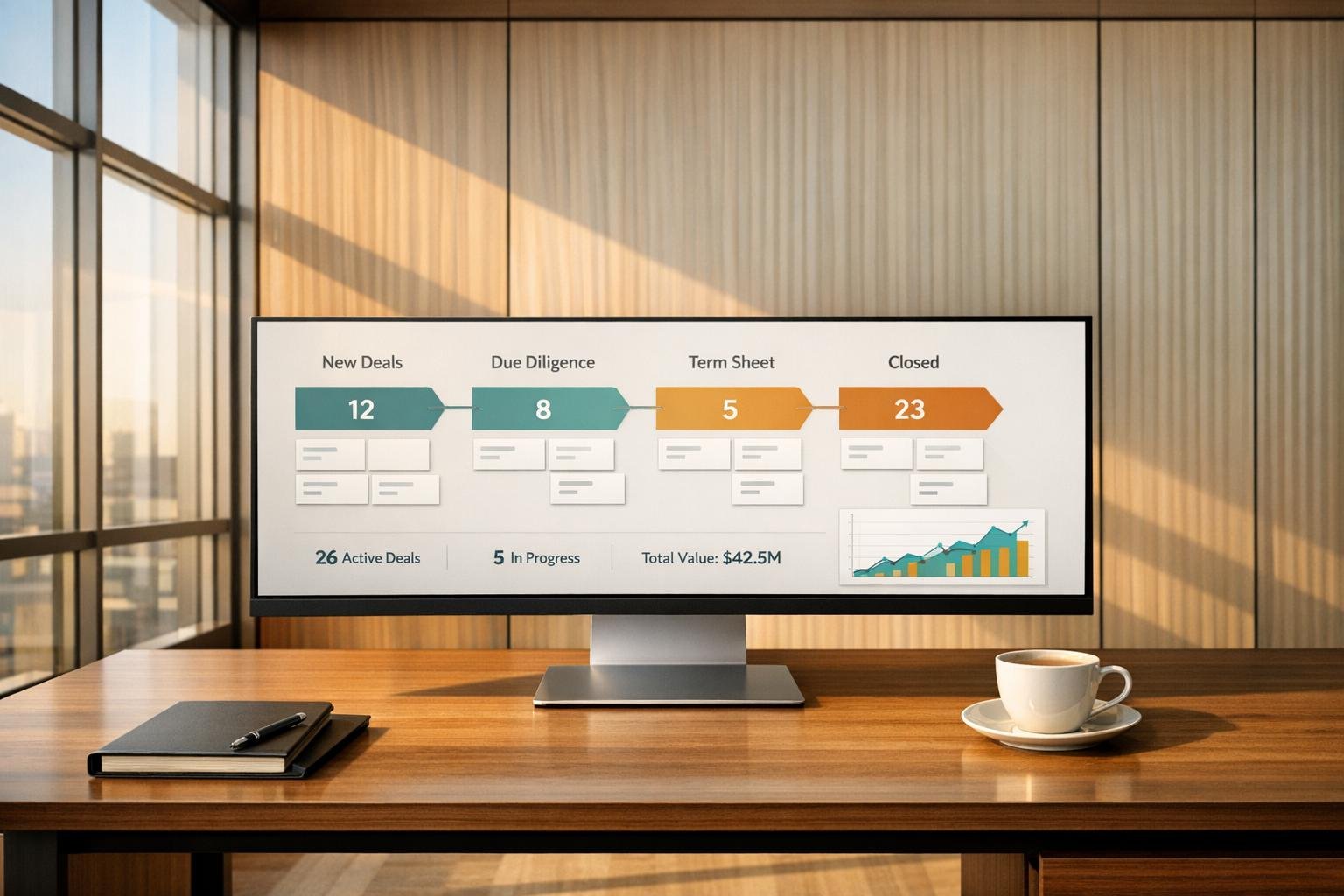
Automated deal tracking simplifies and organizes the complex processes of real estate portfolio management. By replacing manual spreadsheets and email chains with centralized software, it ensures real-time updates, reduces errors, and saves time. Key benefits include:
- Efficiency: Automation cuts contract review time from 92 minutes to 26 seconds and saves 5–15 hours per week on repetitive tasks.
- Accuracy: AI reduces human errors by up to 80% and improves financial consistency.
- Better Results: Companies using automation close 36% more deals and achieve up to 30% higher risk-adjusted returns.
- Real-Time Insights: Live dashboards provide instant updates on deal stages, performance metrics, and market trends.
Platforms like CoreCast integrate tools for deal tracking, portfolio analysis, and reporting, helping managers focus on high-value activities like market research and relationship building. Automation not only improves workflows but also gives portfolio managers a competitive edge in decision-making and scaling operations.
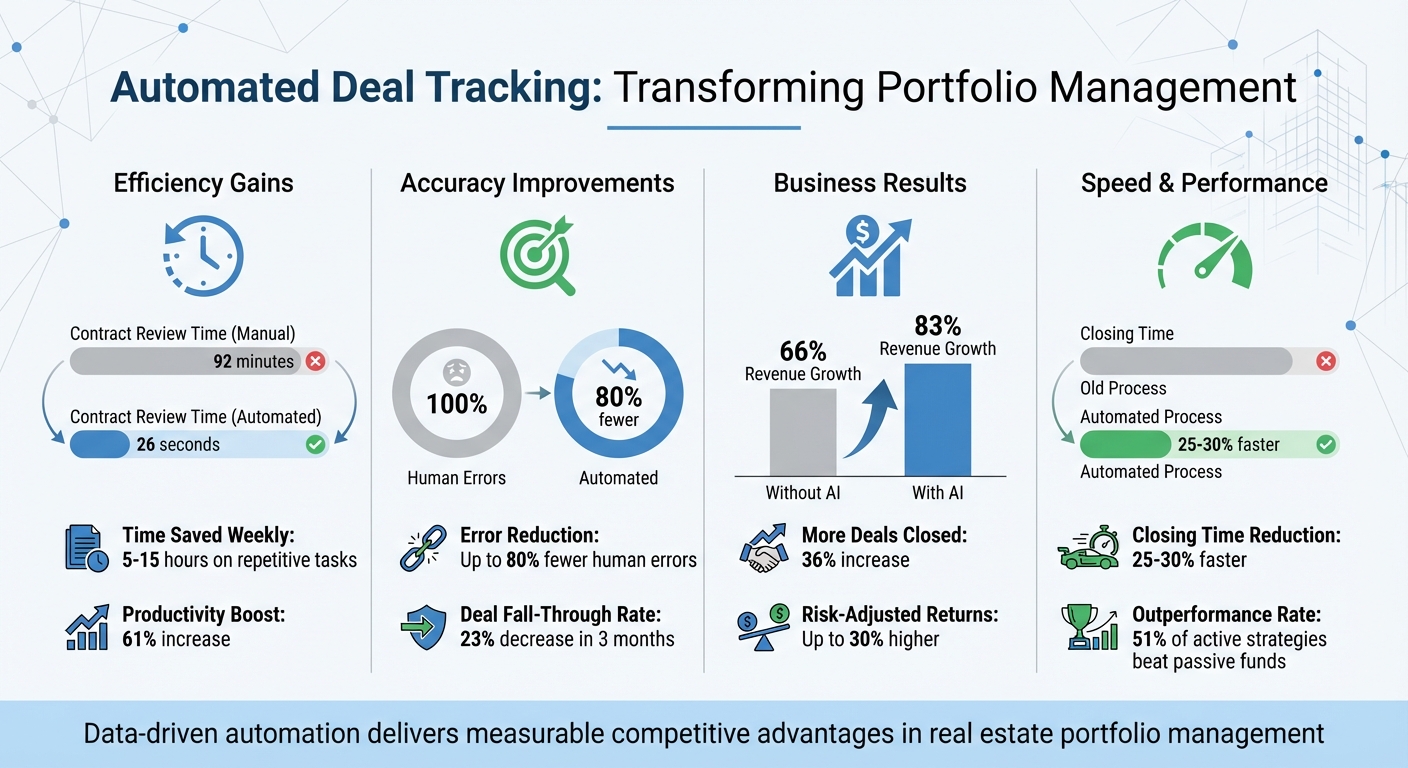
Automated Deal Tracking Benefits: Key Statistics for Portfolio Managers
Core Features of Automated Deal Tracking Systems
Centralized Deal Management
A centralized deal repository brings all deal-related data into one easily accessible location. Portfolio managers can monitor every stage of a deal - from the first interaction to closing - through a unified platform. This system integrates data from various sources like management software, financial tools, and market intelligence platforms to establish a single source of truth[1].
The benefits are clear. Centralized systems eliminate inconsistencies in data formats - such as dates, property identifiers, or financial figures - making it easier to benchmark real estate portfolios and compare deals without manual adjustments. Real-time updates replace outdated monthly snapshots, providing live insights into leasing activity, occupancy shifts, and cash flow. Additionally, gathering all documents, emails, and interaction histories in one place simplifies due diligence and ensures team alignment. Organizations using centralized tracking often see noticeable improvements in lead generation and deal closures, showcasing the power of unified data management.
Once centralized, the deal pipeline becomes even more efficient through stage-specific automation.
Pipeline Stages and Automation
Deal pipelines generally follow distinct phases: Initial Contact, LOI (Letter of Intent), Due Diligence, and Closing[1]. Automation enhances these stages by triggering tasks automatically - such as data entry, scheduling follow-ups, updating CRMs, requesting documents, or sending inspection reminders - eliminating the need for manual intervention.
This automation prevents delays caused by overlooked tasks or administrative bottlenecks. Systems can prioritize deals, flag urgent opportunities, send inactivity alerts, and sort pipelines by factors like close date or deal value. As a result, portfolio managers gain clarity on daily priorities. Automation has been shown to reduce average closing times by 25-30%[4], making workflows faster and more efficient.
With pipeline automation in place, real-time dashboards take efficiency to the next level by offering actionable insights.
Real-Time Dashboards and Reporting
Real-time dashboards provide instant updates on deal progress and critical performance metrics. Unlike traditional CRM tools that simply log activities, these dashboards analyze deal health, track engagement, and identify momentum shifts[1]. Portfolio managers can customize views to monitor portfolio performance, detect allocation imbalances, and receive recommendations for rebalancing[2].
These dashboards seamlessly integrate with tools like document management systems, email platforms, calendars, and cloud storage[1]. Pulling data from the centralized repository and automated pipeline, they create a complete tracking ecosystem. This allows portfolio managers to act quickly, flagging at-risk deals by identifying changes in deal velocity, unusual communication trends, financial irregularities, or market fluctuations[1]. By transitioning from static reports to live dashboards, managers can respond faster to new opportunities and make more informed decisions.
sbb-itb-99d029f
How CoreCast Enables End-to-End Deal Tracking
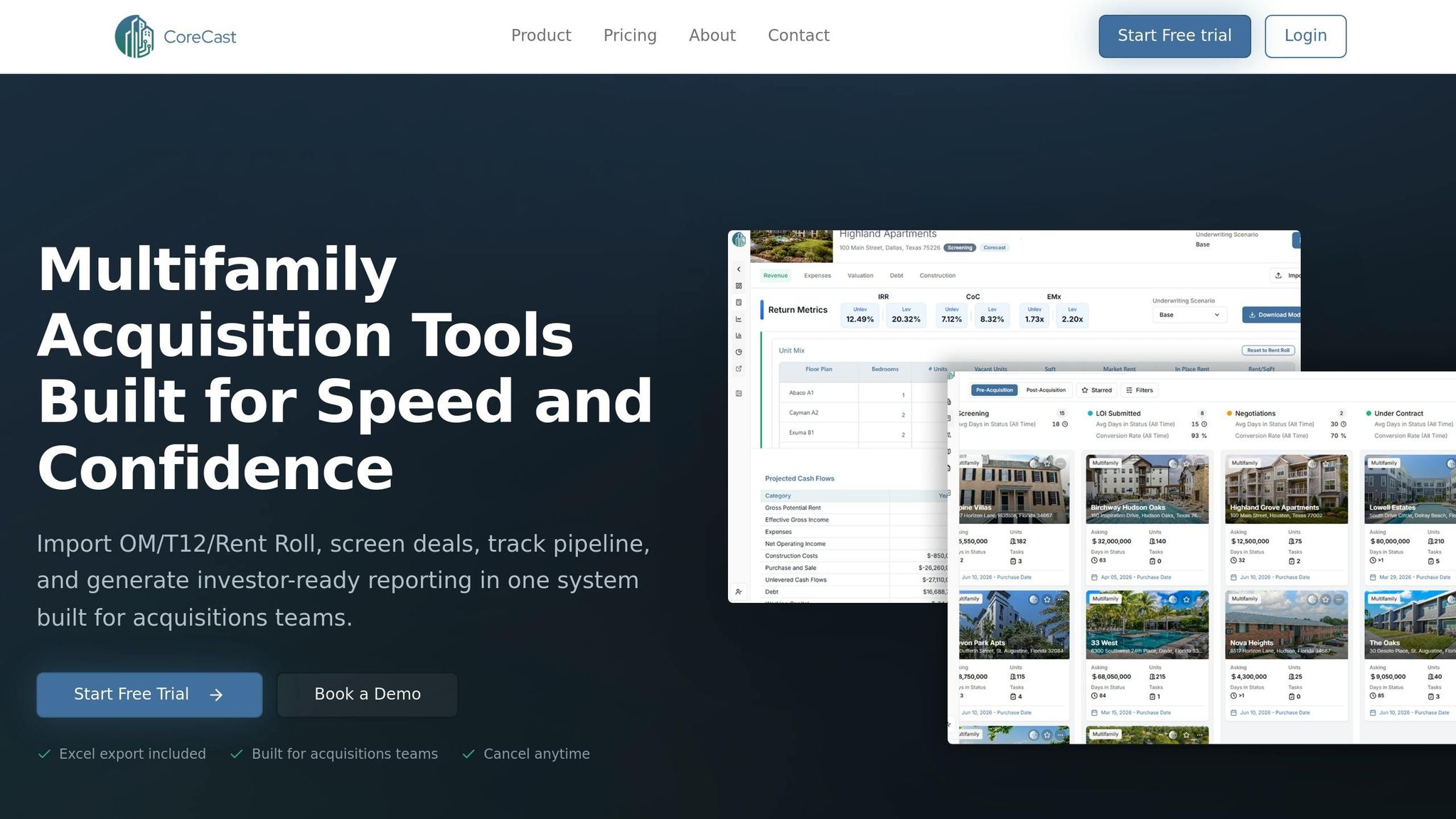
CoreCast (https://corecastre.com) reshapes how real estate professionals manage deal tracking by combining automated pipelines with centralized data. This platform brings everything under one roof - underwriting assets, tracking pipelines, visualizing properties, analyzing portfolios, and generating branded reports. The result? A single, reliable source of truth for every deal, eliminating the hassle of manual data transfers.
One of CoreCast's standout features is its ability to support multiple asset classes. James Gueits, Principal at MHP Operator, shared how it transformed his family office operations:
"Our family office needed a solution to manage legacy real estate assets. They have been instrumental to streamline our valuation and underwriting processes."[5]
By integrating tools that simplify deal execution and decision-making, CoreCast reduces friction at every stage. Let’s dive into how its core features - custom workflows, mapping insights, and portfolio reporting - make this possible.
Custom Workflows and Automation
CoreCast allows portfolio managers to design custom deal stages that align with their unique processes. Whether it’s Lead, Underwriting, Due Diligence, or Closing, each stage can have its own set of automated tasks, reminders, and approvals tailored to the asset class or deal type. For instance, a multifamily acquisition might demand different checkpoints than an office property sale, and CoreCast adapts to these needs without locking users into rigid templates.
The platform’s drag-and-drop Kanban view gives an intuitive snapshot of deal progress. Managers can quickly identify which deals need attention, which are stalled, and which are nearing completion. Automated reminders ensure no critical tasks are overlooked, while customizable approval workflows keep teams aligned, even when handling diverse asset classes and risk profiles.
And it doesn’t stop there - CoreCast also boosts decision-making with its spatial and competitive insights.
Map-Based Visualization and Competitive Analysis
CoreCast’s mapping tools provide a spatial perspective, bringing deals and market data together in one place. Managers can view properties on a map alongside market trends, competitor activity, and performance benchmarks. This feature helps identify risks like geographic concentration, spot underserved markets, and evaluate how new acquisitions complement an existing portfolio.
Instead of juggling separate mapping software and deal tracking systems, CoreCast integrates these functions seamlessly. The map updates in real time as deals move through the pipeline, offering a dynamic view of emerging opportunities and shifting market competition. This spatial intelligence helps managers quickly decide which deals to pursue and where to focus their efforts.
Portfolio Analysis and Stakeholder Reporting
CoreCast’s portfolio module simplifies how managers evaluate their assets. By selecting specific properties, they can generate custom summaries that highlight past performance and future potential, all in one view. The platform integrates with property management and accounting systems like Buildium, QuickBooks, and RealPage, ensuring financials are always accurate and up-to-date in U.S. formats (MM/DD/YYYY dates, USD currency).
For stakeholder communication, the stakeholder center automates the creation and distribution of branded reports. With just one click, managers can produce polished documents that reflect the latest deal statuses and portfolio metrics. This eliminates the need to manually compile and reformat data for investors or partners. Justin Britto, Principal at Maddison Communities AZ, praised this capability:
"A tailored model streamlined our capital-raising efforts, giving my investors confidence."[5]
Benefits of Automated Deal Tracking for Portfolio Managers
Automated deal tracking has reshaped how portfolio managers approach their daily tasks. It’s not just about digitizing old processes - it’s about transforming workflows, decision-making, and deal execution. These changes lead to greater deal throughput and more precise forecasting, as detailed below.
Improved Efficiency and Accuracy
Manual workflows often slow things down and introduce errors. Lou Hong from Dealpath highlights this issue:
"Manual workflows are error-prone and can cause significant delays."[6]
Automation tackles these challenges head-on by managing repetitive tasks like data entry, document routing, and status updates. With automated deal tracking, teams report a 61% productivity boost[6]. This allows portfolio managers to concentrate on evaluating opportunities while ensuring consistent deal scoring and due diligence.
By streamlining processes, automation naturally increases the capacity to manage more deals effectively.
Increased Deal Flow and Closing Rates
When automation reduces administrative burdens, managers can handle a higher volume of deals without compromising quality. Features like automated task assignments and enhanced transparency keep deals moving smoothly through the pipeline. This reduces cycle times and improves closing rates. Additionally, managers can quickly spot bottlenecks and adjust their strategies and perform scenario analysis in real time to maintain momentum.
Better Forecasting and Decision-Making
Real-time data offers portfolio managers a clearer picture of where deals stand, eliminating the need for outdated spreadsheets. This enhanced visibility supports accurate forecasting, as managers can better predict when deals are likely to close. Automation also removes emotional bias from decisions by relying on predefined rules and algorithms, ensuring consistent results - even in volatile markets[7].
Advanced platforms further enhance decision-making by calculating key metrics like time- and dollar-weighted returns against benchmarks. For example, between July 2023 and July 2024, 51% of actively managed strategies outperformed the average passive fund[8]. This demonstrates how data-driven approaches can lead to stronger outcomes.
Steps to Implement Automated Deal Tracking
Implementing automated deal tracking doesn’t have to be complicated. You can break it down into three practical steps: focus on impactful automations, link essential data sources, and keep refining your workflows.
Start with High-Priority Automations
Kick things off with automations that deliver instant results, like lead assignment and reporting. For instance, automated lead routing can assign deals by geography or asset type in seconds, instead of hours. One real estate brokerage saw a 23% drop in deal fall-through rates within just three months by adopting these automations[1]. For due diligence, AI tools can handle tasks like contract reviews, cutting down on manual work[1]. Businesses leveraging these automations typically close 36% more deals on average[1].
These quick wins set the stage for integrating key data sources.
Integrate Key Data Sources
Early on, connect tools like your CRM (e.g., HubSpot or Salesforce), property databases, and email platforms to ensure seamless data flow. API integrations make this possible by syncing data automatically, eliminating the need for manual updates. For example, linking your CRM with property databases can auto-log emails, calls, and meetings, while email tools can trigger follow-up reminders based on recent activity. To avoid issues, ensure integrations handle US-specific formats like USD currency, MM/DD/YYYY dates, and proper number formatting. Platforms like CoreCast even offer third-party integrations that update your pipeline in real time, with automated data collection at set times like 6:00 AM[2].
Once your systems are connected, you’ll need to keep an eye on performance.
Monitor and Optimize Workflows
During the initial setup phase, review your workflows weekly, then transition to monthly reviews as things stabilize. Track key metrics like deal velocity (how quickly leads close), win probability, pipeline coverage, and any automation errors. Built-in analytics dashboards can help you spot issues, such as deals stuck in one stage for over two weeks or portfolio allocation drifting beyond 5%. Teams that use AI-driven monitoring report 83% revenue growth, compared to 66% growth without AI[1]. Regular data audits - combining manual checks with automated alerts - ensure workflows stay accurate and compliant. Adjust processes as needed based on performance metrics and team feedback to keep everything running smoothly[3].
Conclusion: The Future of Portfolio Management with Automation
Automation is transforming portfolio management by shifting the focus from reactive, periodic reviews to proactive, continuous oversight. Instead of uncovering risks weeks after they arise, automated systems flag issues as they emerge. This shift not only saves time on tasks like rent roll cleanup and manual data entry but also allows managers to zero in on more strategic activities, such as analyzing market trends and fine-tuning investment strategies.
Another major advantage of automation is its ability to support scalability. With automated processes, teams can manage growth - like expanding from 25 properties to 50 or more - without needing a proportional increase in resources. By integrating underwriting, pipeline tracking, mapping, and reporting into a single platform, automation eliminates data silos, ensures consistency, reduces errors, and enhances investor trust with professional, automated reporting.
CoreCast takes these efficiencies a step further by offering a comprehensive real estate intelligence platform. The system enables users to underwrite various asset classes, track deals through different pipeline stages, visualize properties and competitors on integrated maps, conduct in-depth portfolio analysis, and create branded reports for stakeholders - all within one streamlined solution. With integrations to property management systems and real-time visibility, CoreCast redefines how the entire investment lifecycle is managed.
As the industry moves toward SaaS platforms with AI-powered predictive modeling and spatial intelligence, automation is no longer optional - it’s essential. Portfolio managers who embrace automation early will be better positioned to standardize workflows, automate critical tasks, and consolidate data effectively. The gap between automated and manual operations will only grow, making early adoption key to staying competitive. Platforms like CoreCast equip managers with the tools they need to leverage these advancements and secure long-term success in an ever-evolving market.
FAQs
What deals should I automate first for quick wins?
When it comes to automation, focusing on deals that offer the best chance for quick closures and have clear, actionable data is a smart starting point. Here's how you can approach it:
- Early-Stage Deals: Begin by automating tasks in the lead generation and qualification stages. Automation tools can handle repetitive work like follow-ups, data entry, and initial outreach, saving time and ensuring no leads slip through the cracks.
- Deals Close to Completion: For deals in the negotiation or closing stages, automation can help eliminate bottlenecks. Use it to manage documents, send timely reminders, and streamline communication with stakeholders. These tools can significantly speed up the process and reduce delays.
By strategically automating these stages, you can make your sales process more efficient while keeping your team focused on high-value tasks.
How do I integrate automated deal tracking with my existing systems?
To bring automated deal tracking into your workflow, consider using a platform like CoreCast. It connects effortlessly with tools like CRM systems, property management software, and document management platforms. By automating these processes, you can say goodbye to manual tasks and reduce errors in your data.
Make sure your tools are API-compatible, then set up the integration settings to automate the flow of information. This setup allows for real-time insights, smoother workflows, and better portfolio analysis - all managed within one centralized platform.
Which metrics best predict deal closings and portfolio risk?
When it comes to assessing the likelihood of deal closings and understanding portfolio risk, a few financial metrics stand out. These include IRR (Internal Rate of Return), cash-on-cash return, cap rate (capitalization rate), and debt coverage ratio.
Each of these metrics provides a different lens to evaluate financial health and investment performance. Together, they equip portfolio managers with the tools needed to make informed, data-driven decisions that align with their strategic goals.