
AI Tools For Multifamily Market Analysis
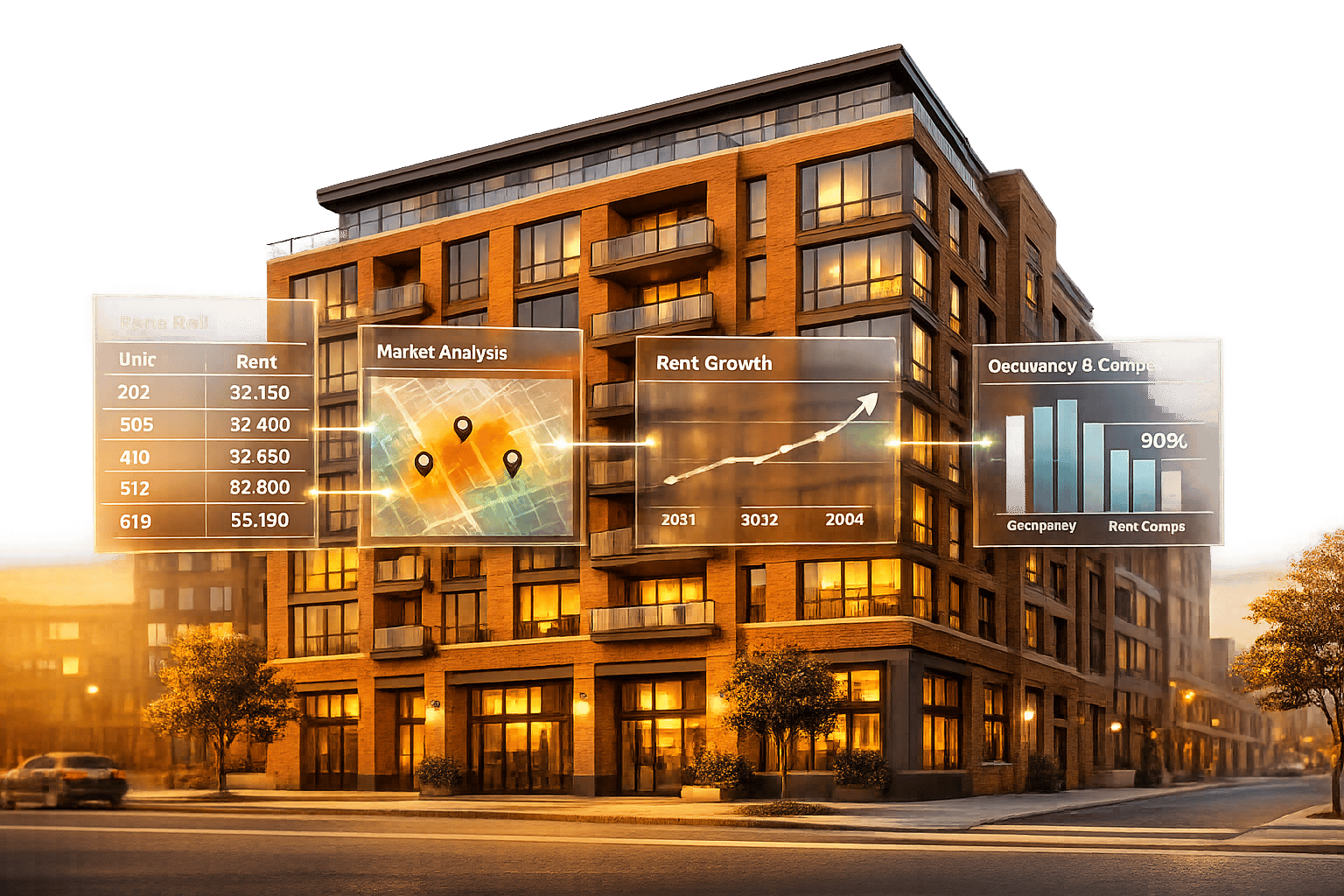
Using AI tools, investors can now:
- Save time: Automate tasks like rent roll parsing, reducing hours of manual work to minutes.
- Improve accuracy: Identify anomalies and benchmark expenses against thousands of properties.
- Enhance decision-making: Use predictive analytics to forecast demand, adjust pricing, and track market trends in real time.
Platforms like CoreCast integrate data collection, underwriting, and reporting into one centralized system. This eliminates the inefficiencies of manual spreadsheets and scattered tools, helping investors make faster, data-driven decisions. With operating expenses up 50% since 2015 and rising debt costs, adopting AI tools is no longer optional - it’s a smarter way to stay competitive in 2026 and beyond.
Most Investors Use AI Like a Beginner…Here’s the Pro Method
sbb-itb-99d029f
Common Problems in Multifamily Market Analysis
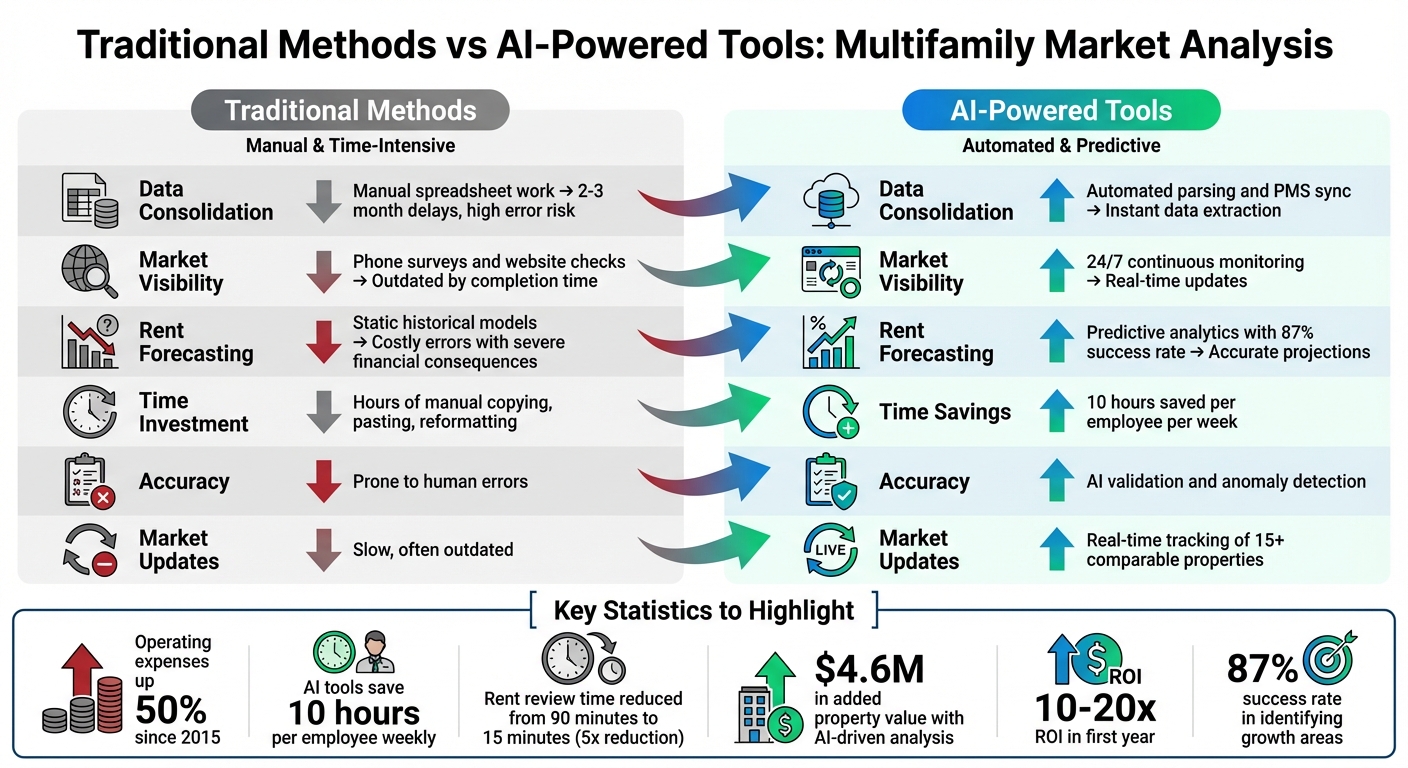
Traditional vs AI-Powered Multifamily Market Analysis Comparison
Analyzing multifamily markets isn't without its hurdles. Real estate professionals often grapple with challenges that can slow down processes, reduce profitability, and affect the overall quality of deals.
Scattered Data and Manual Work
One of the most time-consuming issues is dealing with fragmented data. Information often comes in various formats - like broker PDFs, multiple spreadsheets, or incompatible exports - forcing professionals to spend hours manually copying, pasting, and reformatting. This process is not just tedious; it's prone to errors, delaying the start of any meaningful analysis.
Interestingly, property management teams leveraging AI tools have managed to save up to 10 hours per employee each week by automating these tasks [2]. However, consolidating data through integrated platforms is only part of the problem. Professionals also face difficulties in obtaining timely insights into the market.
Poor Market Visibility
Getting a clear picture of the competitive landscape can feel like a guessing game. Traditional methods - such as calling competitors, manually browsing websites, or even driving around to check properties - are too slow to keep up with rapid market changes. By the time these surveys are completed, rents or concessions may have already shifted.
Online visibility adds another layer of complexity. For example, when Google's AI Overview appears in search results, organic clicks drop by an average of 34.5% [5]. According to RealPage staff, "AI rewards clarity, recency, and authority over keyword density" [5]. Without structured and machine-readable property data, market visibility becomes even harder to achieve. Furthermore, 44% of investment committees express distrust in AI-driven analyses when the underlying data isn't transparent [7]. These gaps in visibility directly impact the accuracy of rent forecasts, which brings us to another major challenge.
Unreliable Rent and Market Forecasts
Errors in rent forecasting can lead to significant financial setbacks. With operating expenses soaring nearly 50% since 2015 [1], having accurate projections is now more critical than ever.
The financial risks are stark. For instance, a vacancy of 50 units priced at $1,700 per month results in losses exceeding $84,000 per month. Even a single unit sitting vacant for just one week can cost around $425 [1]. Add to this the fact that skilled labor shortages are delaying construction by an average of 1.98 months [4], and predicting when new supply will hit the market becomes a daunting task.
| Challenge | Traditional Approach | Real Impact |
|---|---|---|
| Data Consolidation | Manual spreadsheet work | 2–3 month delays; high error risk [3] |
| Market Visibility | Phone surveys and website checks | Outdated by the time analysis is complete [6] |
| Rent Forecasting | Static historical models | Costly errors with severe financial consequences [1] |
The bottom line? Without better tools and processes, multifamily professionals risk basing decisions on outdated or incomplete information, potentially jeopardizing their investments and market strategies.
How AI Changes Multifamily Market Analysis
AI is reshaping how multifamily market analysis is conducted by automating tedious tasks and delivering real-time insights. Instead of relying on outdated, time-consuming methods, AI-powered tools provide instant intelligence, transforming decision-making throughout the investment process.
Automated Data Collection and Analysis
Gone are the days when asset managers spent hours manually gathering data from various sources. With AI, automated market surveys now track property data and the 15 nearest comparable properties, updating automatically - saving the 5-10 hours per week typically spent on competitive intelligence [11].
For example, AI processed over 700 sites in just 72 hours for tasks like rent roll parsing, concession analysis, and market rent forecasting - a process that would take weeks with traditional spreadsheets [12]. This includes automated rent roll parsing to detect missing units or duplicate leases and concession analysis that evaluates data from hundreds of residents without manual effort [12]. Purpose-built AI systems continuously abstract, classify, and validate data, ensuring accuracy and efficiency [10].
By streamlining data collection, AI also positions operators to anticipate market trends effectively.
Predictive Analytics for Market Trends
Once data is compiled, AI employs predictive analytics to forecast market demand. Through demand forecasting, AI examines lead activity, tours, market fluctuations, and conversion patterns to identify demand shifts. This allows operators to adjust pricing and leasing strategies ahead of time [8].
The financial impact of these insights is substantial. For example, one operator reported 8.2% sequential NOI growth from Q1 to Q2, a 7.3% daily occupancy improvement between March and September 2025, and a 5x reduction in rent review time, cutting analysis from 90 minutes to just 15 minutes per property [8]. Another case showed $4.6 million in added property value and 3.5% stronger net rental income growth compared to properties that didn’t use AI [8]. Additionally, AI-driven models achieved an 87% success rate in identifying growth areas over three years, with properties leveraging geospatial insights seeing 7.3% higher annual returns [9].
But AI doesn’t stop at forecasting - it also enhances visibility into market dynamics.
Better Visibility with Integrated Tools
AI platforms offer a unified view of competitive positioning within a single workspace. These tools provide real-time updates on rents, concessions, and availability metrics [11]. Map-based analytics visually display properties alongside their competition, while online reputation tracking monitors Google reviews and competitor comparisons [11].
Accuracy is a major advantage. For instance, SurfaceAI, recognized as a top-performing AI tool for multifamily, uses 24/7 continuous monitoring instead of periodic updates [10]. Asset managers leveraging this technology often see a 10-20x ROI in their first year, thanks to gains in occupancy, pricing, cost reductions, and a 60-80% reduction in reporting time [11].
CoreCast: AI-Powered Platform for Multifamily Insights
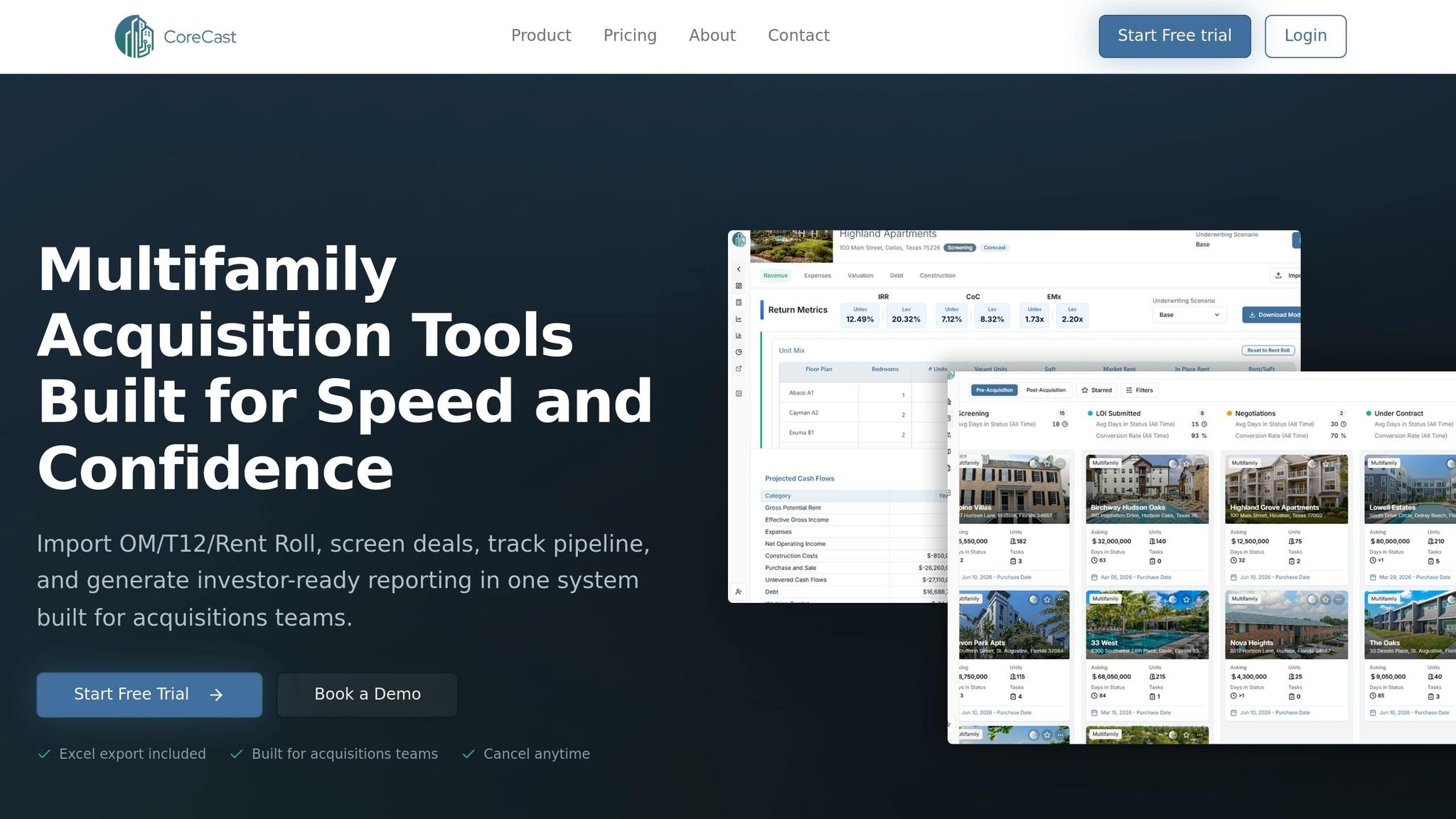
CoreCast is setting a new standard for multifamily market intelligence by harnessing the power of AI. It provides a centralized platform where real estate professionals can seamlessly underwrite deals, monitor their pipelines, analyze portfolios, and deliver reports to stakeholders. With experience in underwriting over $20 billion in assets[13], CoreCast streamlines workflows through automation.
Main Features of CoreCast
CoreCast combines tools that typically require separate platforms into one integrated system. It supports underwriting for various asset classes, including multifamily, office, retail, industrial, student housing, and mobile home parks[13][14]. Beyond underwriting, its stakeholder center offers live portals with customizable permissions for limited partners, lenders, and other stakeholders, eliminating the need for manual PDF updates.
"What once took an analyst an afternoon now takes seconds"[14]
- Jared Stoddard, Chief Product Officer at CoreCast
"Our family office needed a solution to manage legacy real estate assets. They have streamlined our valuation and underwriting"[13]
- James Gueits, Principal at an MHP operator
AI Capabilities and Forecasting
CoreCast’s AI engine tackles data entry challenges with automated document parsing. Users can upload documents, and the platform instantly extracts and maps data into underwriting models[14]. It also integrates with major property management systems like Yardi, AppFolio, RealPage, Entrata, and Buildium, syncing historical performance, lease data, and expense ratios automatically[14].
The conversational AI feature allows users to update complex assumptions in plain language. For instance, a user could say, "CoreCast, I'm underwriting a mixed-use development... Can you layer in stabilized assumptions for each use?"[14]. The platform then updates key metrics - like IRR, equity multiple, and cash-on-cash returns - in real time as users adjust variables like CapEx, rents, or exit cap rates vs. growth rates. This eliminates the need to navigate cumbersome Excel models[14].
Manual Methods vs. CoreCast AI
The advantages of CoreCast become evident when comparing traditional methods to its AI-driven approach:
| Feature | Manual Methods | CoreCast AI |
|---|---|---|
| Data Entry | Manual typing from PDFs/Excel | AI document parsing and direct PMS sync[14] |
| Market Comps | Scattered across multiple subscriptions | Integrated mapping with competitor visualization[13][14] |
| Underwriting | Rigid Excel models | Conversational AI with real-time updates[14] |
| Reporting | Manual PDF creation and email updates | Live stakeholder portals with customizable permissions[14] |
Looking ahead, CoreCast plans to introduce features like automated construction draws, AI-generated investor reports, and predictive sourcing tools that suggest deals based on user preferences and market trends[14]. By centralizing data and forecasting capabilities, CoreCast helps investors identify emerging multifamily opportunities with greater accuracy.
How to Use CoreCast for Better Multifamily Strategies
Getting Started with CoreCast
The first step to using CoreCast is connecting it to your property management software. CoreCast works seamlessly with platforms like AppFolio, Yardi, RealPage, Entrata, and Buildium. This integration pulls in historical performance data, tenant-level details, and rent rolls automatically, cutting out the need for manual data entry. If you're evaluating potential acquisitions, you can upload seller financials in formats like PDF, Excel, or even images. The AI then extracts and organizes the data into underwriting models in just seconds [14].
CoreCast simplifies your workflow by replacing multiple logins and scattered Excel spreadsheets with one unified workspace. During its beta phase, which launched in Q3 2025, CoreCast is available for $50 per user per month [15]. When Version 1.0 officially launches, there will be three pricing tiers: Free, Essentials ($75 per user per month), and Pro ($100 per user per month) [13].
Once your account is set up, you’re ready to dive into CoreCast’s suite of analysis tools.
Using CoreCast for Analysis
After integration, CoreCast’s geospatial mapping feature gives you a powerful way to visualize your pipeline and assess regional exposure. This interactive tool allows you to filter deals by factors like risk profile, stage, or product type. It’s especially handy for identifying clusters of multifamily investment opportunities, such as those in the Southeast region [14].
From there, you can use the Output View to track dynamic performance metrics. CoreCast updates key figures - like IRR, equity multiple, cash-on-cash returns, and DSCR - in real time as you tweak variables such as exit cap rates or CapEx. This eliminates the headache of constantly rebuilding Excel models to account for market changes. You can even run sensitivity analyses by adjusting hold periods or cap rates to see how they impact returns [14].
For investor relations, CoreCast offers live stakeholder portals. These secure, real-time portals allow limited partners, lenders, and joint venture partners to access updated performance metrics, distributions, and compliance documents. Instead of sending out PDFs manually, you can use customizable permission settings to control what each stakeholder sees [14].
Upcoming Features and AI Automation
CoreCast has even more in store with upcoming AI-driven features designed to make multifamily market analysis even smoother. Future updates will include automated construction draw management to ease the approval process for development projects and AI-generated investor reports to simplify quarterly updates. Predictive sourcing tools are also on the way, helping you discover deals based on your historical activity and emerging market trends. Additionally, smart cap table management will make it easier to visualize equity waterfalls, and deeper integrations with accounting tools like QuickBooks will streamline financial workflows [20,21].
Conclusion
Key Takeaways
The days of relying on fragmented data and outdated methods for investment decisions are numbered. AI tools like CoreCast are transforming how multifamily market analysis is done. Forget clunky spreadsheets - AI-powered platforms address issues like scattered data, unreliable forecasts, and limited insights. By automating data collection, offering predictive analytics, and streamlining workflows into one cohesive platform, tools like CoreCast equip investors with the speed and precision to spot lucrative opportunities before competitors can.
The results speak volumes. AI-driven revenue management has shown $4.6 million in added property value and 3.5% stronger growth in net rental income in practical applications. It has also slashed rent review times from 90 minutes to just 15 minutes per property [8]. These kinds of gains separate market leaders from the rest of the pack.
CoreCast takes this a step further by consolidating underwriting, pipeline tracking, portfolio analysis, and reporting into a single, user-friendly platform. It delivers real-time insights as market conditions shift, giving users a competitive edge. And with pricing starting at just $50 per user per month during beta - and a Free tier available at launch - there’s no reason not to give it a try.
As Jared Stoddard, the Founder of CoreCast, puts it:
"The way commercial real estate operators work today is fundamentally dysfunctional... It's not just inefficient. It's insane" [14].
For investors looking to stay ahead, adopting AI tools now isn’t just smart - it’s essential for thriving in 2026 and beyond.
FAQs
What data do I need to run AI-based multifamily market analysis?
To conduct an AI-powered analysis of the multifamily market, you’ll need a variety of data sources. Essential inputs include:
- Property-specific data: Transaction records, rental rates, vacancy rates, lease terms, and details about property features.
- Market trends: Information on price changes over time, upcoming or ongoing infrastructure projects, and other market dynamics.
- Regional economic indicators: Employment levels, migration patterns, and other factors that shape the local economy.
When you combine these datasets, AI tools can help you make precise forecasts and assess risks with greater confidence. This approach ensures your analysis is both data-driven and contextually relevant.
How can AI help me spot emerging multifamily hotspots faster?
AI makes it easier and faster to spot promising multifamily investment areas by analyzing massive datasets in real time. It sifts through information like property transactions, demographic changes, infrastructure developments, and economic trends to uncover patterns that traditional methods might overlook. With predictive analytics, AI can even forecast trends such as rental demand and vacancy rates. This means investors can catch early signs of growth, helping them identify up-and-coming markets with speed and precision - giving them a real competitive advantage.
How does CoreCast turn rent rolls and PDFs into underwriting outputs?
CoreCast leverages AI to pull and validate data from rent rolls and PDFs, spot anomalies, and fill in financial models. This approach speeds up the underwriting process by delivering initial valuations both quickly and with precision, helping to save time and minimize mistakes.