
How Data Analytics Improves Workforce Allocation

Managing your workforce better starts with data. Companies that use data analytics to allocate resources see fewer disruptions, lower costs, and higher productivity. Here's why it works:
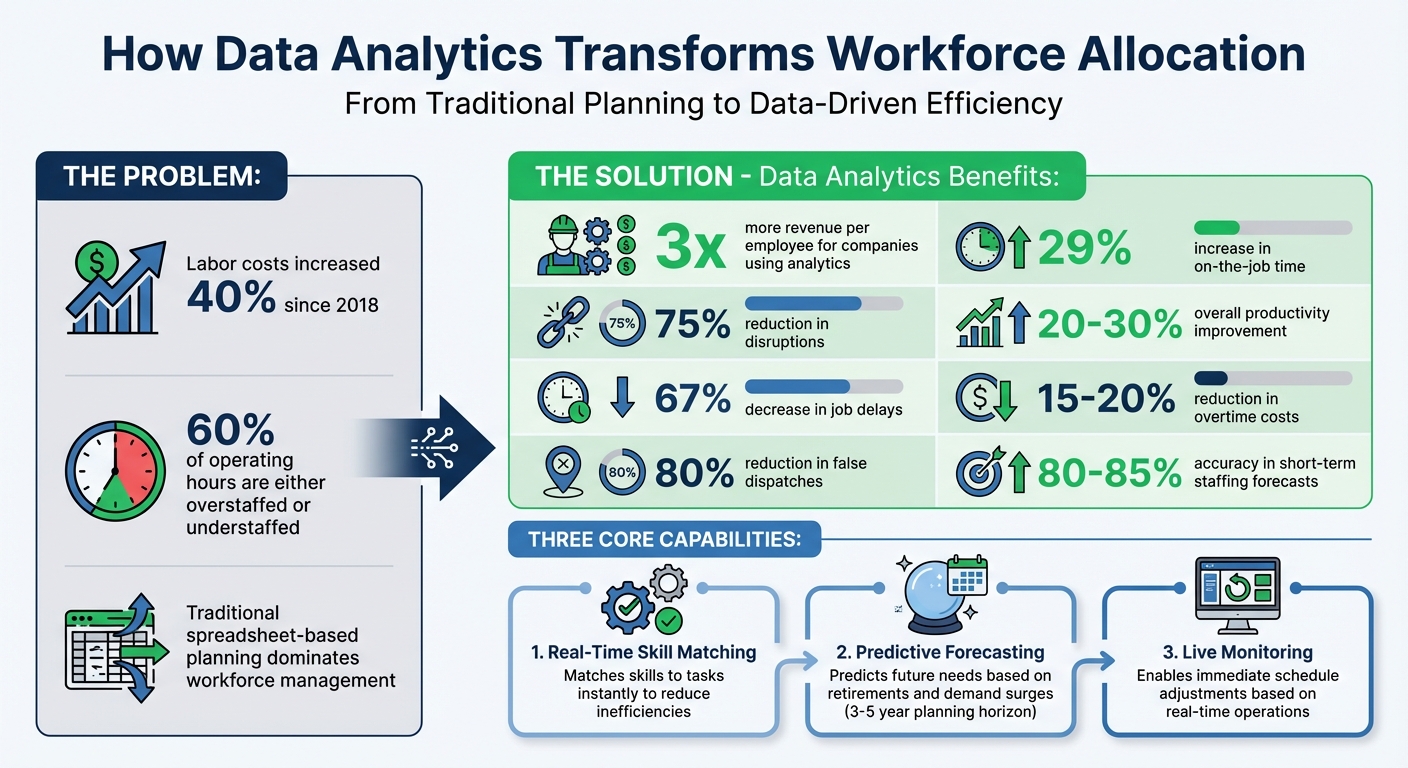
- Labor costs have risen by up to 40% in some industries since 2018, while outdated tools like spreadsheets still dominate workforce planning.
- Up to 60% of operating hours are either overstaffed or understaffed, leading to inefficiencies and increased risks.
- Companies leveraging analytics generate 3x more revenue per employee compared to others.
Data analytics tools solve workforce challenges by:
- Matching skills to tasks in real-time to reduce inefficiencies.
- Predicting future needs based on trends like retirements or demand surges.
- Monitoring operations live, allowing immediate adjustments to schedules.
Case studies prove its impact: A utility company cut job delays by 67% and false dispatches by 80% using AI-powered scheduling tools. Platforms like CoreCast further simplify workforce management by integrating real-time data, predictive planning, and portfolio tracking into one system. The result? Better decisions, reduced costs, and more efficient teams.
Data Analytics Impact on Workforce Allocation: Key Statistics and Benefits
Workforce Challenges and Data-Driven Solutions
Common Workforce Allocation Problems
Real estate and construction teams face a variety of challenges that can derail project timelines and inflate budgets. With labor costs making up as much as 70% of total business expenses [6], managing the workforce effectively is essential for profitability.
One major issue is the sequential nature of job stages, which creates interdependencies that manual planning struggles to manage. This often leads to delays, idle crews, and ballooning costs [1]. Construction projects demand specific skills and crew sizes, but mismatches in these areas - such as crews arriving without the right tools or materials - can lead to "false truck rolls." These unnecessary dispatches drive up operational costs without contributing to actual progress [1].
Scheduling becomes even more complex when disruptions occur. Employee absences, emergency tasks that disrupt pre-planned schedules, and sudden surges in demand can throw everything off balance. On top of that, inconsistent processes and human biases can introduce errors, inefficiencies, and even regulatory risks [1]. These issues highlight the need for smarter, data-driven approaches.
How Data Analytics Solves These Problems
Data analytics offers a way to tackle these challenges by replacing guesswork with systematic, data-backed decision-making. Instead of relying on manual methods or subjective choices, AI-powered scheduling tools can re-optimize plans within minutes, taking into account factors like sequential tasks, crew qualifications, travel distances, and real-time availability [1].
For example, in November 2022, a significant US electric and gas utility tested a machine learning–based schedule optimizer at one of its service centers. Over just six weeks, disruptions dropped by 75%, delays by 67%, and false truck rolls by 80%. Meanwhile, on-the-job time increased by 29%, and overall productivity improved by 20–30% [1].
Data analytics addresses workforce challenges in several ways. Predictive gap analysis combines project planning with labor market trends to identify talent shortages before they become problems, ensuring timelines remain intact [4][3]. AI-driven heuristic dispatching assigns tasks based on worker skills, ensuring that the right crews handle complex stages of a project [1]. Additionally, geographic optimization reduces travel time, enabling field teams to spend more hours on productive tasks.
Data Analytics Applications for Workforce Optimization
Skill-Based Allocation and Matching
Analytics platforms simplify scheduling by breaking tasks into categories like job stages, crew assignments, demand types, shift variations, and mobility needs [1]. Using heuristic optimization, these tools align worker skills with tasks, considering factors like availability and location [1]. For example, in real estate, AI models analyze occupancy and event schedules to efficiently deploy service teams, such as janitorial or catering staff [8]. Additionally, gap analysis helps uncover "skill adjacencies." One noteworthy case is an Asian oil and gas company that chose to upskill employees in critical roles rather than hire externally, addressing skill gaps more effectively [3].
Predictive Staffing and Forecasting
Analytics doesn't just solve immediate staffing needs - it also helps organizations plan for the future. Predictive models take a long-term view, typically spanning three to five years, to ensure the right people with the right skills are available when needed [3]. These models run "what if" scenarios to assess the effects of retirements, labor market trends, and potential project disruptions [4][2]. By identifying issues like training delays or equipment shortages early, companies can avoid reactive "hire-fire" cycles and adopt a more stable approach to workforce management [2][3].
For instance, a global telecommunications company used advanced analytics to pinpoint 12 critical competencies, shifting from external recruitment to internal talent development. This strategy led to a noticeable increase in revenue per employee [3]. Similarly, a North American telecommunications provider achieved 80% to 85% accuracy in short-term staffing forecasts by analyzing daily data. This level of precision helped cut overtime costs by 15% to 20% and reduced staffing imbalances - issues that typically affect up to 60% of operating hours in traditional static models [1][2]. By focusing on future needs, companies can directly address inefficiencies in staffing and resource allocation.
Real-Time Monitoring and Adjustments
While long-term strategies are essential, real-time monitoring ensures day-to-day operations stay efficient and flexible. This approach allows organizations to respond quickly to unexpected events, such as employee absences or sudden spikes in demand [1]. Dynamic updates on job statuses and crew availability enable managers to make immediate, actionable scheduling adjustments [1]. Interactive tools further streamline this process, giving managers the flexibility to adapt schedules on the fly [1].
"Consider the workplace as a continuous learning loop where data is constantly collected, analyzed, and applied to improve performance and user experience." - Deloitte and Cisco [5]
This ongoing feedback transforms workforce management from a static, one-time process into a dynamic system. By linking scheduling models with demand forecasts, companies can identify mismatches between workforce supply and demand before they escalate into last-minute crises. This ensures teams remain aligned with real-world conditions, rather than relying on outdated assumptions.
Results of Analytics-Driven Workforce Allocation
Efficiency Gains and Cost Reductions
A U.S. electric and gas utility tested a machine learning–powered schedule optimizer over six weeks and saw impressive results. Emergency job disruptions - those unforeseen events that can derail entire schedules - dropped by 75%. Job delays were cut by 67%, and "false truck rolls" (when crews show up but can’t complete tasks due to missing tools or materials) fell by 80%. Productivity among field workers jumped by 20–30%, with time spent actively working increasing by about 29% [1].
In another example, an Asian oil and gas company analyzed the capabilities of 50 different roles and discovered that 40% of critical positions could be filled by upskilling existing employees. This reduced their reliance on external hiring [3].
"S&P 500 companies that excel at maximizing their return on talent generate an astonishing 300 percent more revenue per employee compared with the median firm."
– Neel Gandhi, Sandra Durth, and Vincent Bérubé, McKinsey & Company [3]
Better Decision-Making Through Data
These efficiency improvements also enhance decision-making by turning workforce planning into a data-driven process. Analytics replaces guesswork with actionable insights, helping leaders proactively address skills gaps before they escalate into major challenges. Real-time labor market data and internal capability signals allow companies to simulate the effects of interventions before committing resources [9]. However, speed remains critical - 57% of business executives admit they’ve missed opportunities because they couldn’t make workforce decisions quickly enough without advanced analytics [9].
Organizations are now moving away from reactive "hire-fire" cycles and adopting more sustainable workforce strategies. These strategies consider retirements, market trends, and potential disruptions years in advance [3]. Tools like interactive dashboards and drag-and-drop scheduling systems ensure that AI-driven insights are not just theoretical but actively implemented by field teams [1]. As workforce planning shifts from a once-a-year task to an ongoing process integrated into quarterly reviews, businesses gain the flexibility to adapt to changing conditions while maintaining long-term stability [9].
sbb-itb-99d029f
CoreCast: Enabling Smarter Workforce Allocation
Real-Time Insights for Workforce Monitoring
In real estate, keeping tabs on properties, personnel, and resources tied to development projects, acquisitions, and portfolio operations is no small feat. CoreCast simplifies this process by refreshing data in real time, consolidating key elements like operational costs, human resource inputs, and project timelines. This makes it easier for managers to track team deployment across multiple deals and asset classes while quickly evaluating the impact on overall portfolio health.
With its Output View, CoreCast provides real-time updates on returns and management metrics. Teams can instantly see how changes to staffing or project scope affect the broader portfolio. For example, when an analyst tweaks assumptions about construction timelines or labor costs, the platform reveals the ripple effects portfolio-wide - no more juggling disconnected spreadsheets or endless email threads. As Jared Stoddard, CoreCast's Chief Product Officer, explains:
"What once took an analyst an afternoon now takes seconds" [7].
These real-time insights set the stage for more advanced, AI-driven predictive planning.
AI-Driven Predictive Planning
CoreCast takes automation to the next level with AI-powered document parsing. It can extract critical data from rent rolls, T-12s, and income statements in seconds, eliminating the need for manual data entry. This not only saves valuable time but also builds a foundation for predictive planning, allowing teams to make smarter decisions about workforce allocation. By integrating with leading property management and accounting systems, CoreCast leverages historical data to forecast future labor needs based on actual project performance and market trends.
The platform's future plans include AI-driven automation and predictive sourcing tools to identify staffing patterns and market opportunities before they escalate into challenges [10]. For teams focused on development, CoreCast offers construction management tools that track project timelines, costs, and scopes. This helps teams allocate labor and resources more efficiently as projects advance through various phases. This shift from reactive adjustments to predictive planning aligns with the industry's move from annual budgeting cycles to real-time demand forecasting.
Integrated Portfolio and Workforce Management
CoreCast doesn't stop at predictive tools - it also integrates portfolio and workforce management features to streamline operations. Its Pipeline Tracker monitors properties from the pursuit stage through acquisition, development, and eventual sale. This end-to-end visibility helps firms better align their acquisition and disposition teams, ensuring the right expertise is available at every stage of the deal. Additionally, CoreCast's geospatial mapping feature offers a visual representation of deal flow and project clusters. This tool helps firms manage regional risks and allocate personnel strategically based on market density, ensuring resources are deployed where they're needed most.
Workforce Analytics Explained: How Data is Shaping the Future of Work
Conclusion
Data analytics is reshaping how workforce allocation is managed. Instead of relying on gut feelings or outdated spreadsheets, real estate firms now have access to real-time data and AI-driven insights that make matching talent to projects more efficient. This evolution from reactive scheduling to predictive planning reduces disruptions, minimizes downtime, and optimizes how talent is utilized.
The impact is clear in the numbers. S&P 500 companies that excel at maximizing the return on talent generate three times more revenue per employee compared to median performers [3]. One case study even showed that AI-driven scheduling could reduce disruptions by over 60% while significantly boosting productivity.
CoreCast brings these transformative tools directly to real estate professionals. By integrating portfolio tracking, pipeline management, and workforce monitoring into a unified platform, it eliminates the inefficiencies caused by fragmented systems. Real-time updates offer instant insight into how staffing changes influence portfolio performance, while predictive tools help teams anticipate and meet future demands. This seamless integration allows firms to shift from reactive decision-making to proactive, strategic workforce management.
These advancements are more than just operational improvements - they offer a real competitive edge. As McKinsey highlights:
"Strategic workforce planning (SWP) offers greater fluidity of resources and increases efficiencies by allowing organizations to understand their future capacity and capability gaps" [3].
With CoreCast, real estate teams can move beyond reactive management and embrace strategic talent deployment, turning workforce allocation into a powerful advantage in a competitive market.
FAQs
How can data analytics make workforce allocation more efficient?
Data analytics takes workforce allocation to the next level by turning scattered employee, project, and cost data into clear, actionable insights. By examining worker profiles - such as their skills, certifications, and availability - alongside real-time project updates, schedules, and labor costs, analytics tools help managers assign the right people to the right tasks at the right time. This approach minimizes inefficiencies like overstaffing, idle time, and unnecessary overtime, ultimately reducing labor costs while boosting productivity.
On top of that, analytics tools uncover performance trends and forecast future staffing needs. This allows managers to plan for demand surges, avoid skill mismatches, and adjust schedules more effectively. Predictive models can even flag potential bottlenecks early, helping teams sidestep delays and keep projects on track. The outcome? A more agile workforce that runs smoothly, improves profitability, and keeps employees engaged and motivated.
How can AI-powered scheduling tools improve workforce management?
AI-driven scheduling tools are changing the game in workforce management by automating and fine-tuning shift assignments. These tools tap into real-time data - like demand forecasts, employee availability, and last-minute absences - to create schedules that are not only efficient but also reduce downtime, overtime costs, and wasted resources. The result? Higher productivity and staffing that matches business needs perfectly.
By analyzing historical patterns and real-time performance, these systems strike a balance between workloads, ensure compliance with labor laws, and even consider employee preferences. This thoughtful approach helps boost employee morale and cut down on turnover. Plus, when schedules are dependable, disruptions are kept to a minimum - leading to happier customers and reduced operational costs.
In essence, AI-powered schedulers turn scheduling into a strategic advantage, enabling businesses to build a more efficient, resilient workforce that can easily adapt to shifting demands.
How do predictive staffing models help businesses plan for future workforce needs?
Predictive staffing models use historical workforce data - like hiring trends, turnover rates, skill sets, and performance metrics - to predict future labor needs. By spotting patterns in employee movement, project demands, and skill gaps, these models give businesses a head start in preparing for staffing requirements.
Armed with this information, companies can plan recruitment efforts more effectively, design focused training programs, and outline succession plans. This approach not only cuts down the time needed to fill open positions but also boosts employee retention and improves hiring outcomes. When businesses incorporate predictive analytics into workforce planning, they often experience lower turnover rates, increased internal mobility, and a stronger alignment between talent and company goals, all of which contribute to better overall performance.