
Negotiation Strategies for Colocation Agreements

Securing a colocation agreement isn’t just about finding space for your servers - it’s about ensuring reliable access to power, cooling, and connectivity while managing costs in a tight market. With vacancy rates below 2% in North America and colocation rates up 17% over five years, effective negotiation is critical. Here’s a quick breakdown of what you need to know:
- Preparation Matters: Start with a detailed internal audit to avoid overpaying for unused capacity. Many businesses only use 40–50% of the power they pay for.
- Compare Providers: Keep at least four options open during negotiations to save up to 24% on proposals.
- Understand Costs: Factor in hidden fees like cross-connects and power reserves. Opt for metered billing if usage is low.
- Lock in Pricing: Negotiate fixed annual increases (under 3%) and expansion rights to avoid future cost spikes.
- Service Guarantees: Strong SLAs with clear uptime metrics and penalties for failures protect your investment.
- Plan for Growth: Include clauses for expansion, technology upgrades, and flexibility to scale resources as needed.
This guide covers every step, from assessing needs to finalizing contracts, ensuring you get the best terms and avoid costly mistakes.
Top issues when considering a Data Center Transaction: Co-Location Services, Finance & Contracts SLA
sbb-itb-99d029f
Assessing Your Infrastructure Requirements
Before reaching out to any colocation provider, it’s crucial to have a clear understanding of what you actually need. Did you know that over 50% of mission-critical colocation projects are handled in-house by IT teams without external consultants[5]? This highlights why thorough internal preparation is essential. Unfortunately, many organizations skip this step, leading to misaligned contracts. Even more concerning, most colocation customers only use 40% to 50% of the power capacity they pay for[2]. That’s a lot of wasted resources - and money.
Taking the time for a detailed assessment offers two major benefits. First, it helps you avoid over-provisioning, so you’re not stuck paying for space and power you’ll never use. Second, it gives you a solid foundation for negotiations, enabling you to push back on inflated proposals with confidence.
Conducting an Internal Audit
Start by creating a complete inventory of your equipment. Count every server, storage device, and network component to calculate your total rack units (U). Then, determine your power density needs in kilowatts (kW) per rack. Don’t rely on nameplate ratings - they often exaggerate actual usage. Instead, measure the real power draw to avoid paying for capacity you won’t use[7].
Look at both your current usage and your growth projections for the next three to five years. Keep in mind that in many markets, it can take 2–3 years to deliver additional power[1]. Underestimating your future needs could lead to costly delays. Decide whether you need provisioned power (a fixed capacity you pay for regardless of usage) or metered power (billed based on actual consumption). High-density deployments - sometimes requiring 50 kW or more per rack - may also demand advanced cooling solutions like liquid cooling or specialized containment systems[11].
Don’t forget to evaluate your connectivity needs. This includes IP transit, bandwidth commitments, and the number of cross-connects you’ll require for carriers or cloud on-ramps like AWS, Azure, or GCP. Also, determine the redundancy level you’ll need for power and cooling (N, N+1, or 2N), depending on how critical your workloads are. Finally, review any compliance requirements. If your organization must meet standards like HIPAA, PCI-DSS, or SOC 2, make sure the facility aligns with these obligations[4].
Once you’ve mapped out your technical needs, bring in key decision-makers to align these findings with your financial and legal priorities.
Engaging Key Stakeholders
Involving the right stakeholders early is critical. The finance team should assess budget constraints and calculate the total cost of occupancy. Meanwhile, the legal team needs to review compliance requirements and liability caps. Operations can weigh in on whether physical access is necessary or if remote support services will suffice.
Jeff Howell, Chief Growth Officer at ENCOR Advisors, advises: "Engage internal stakeholders early to articulate and consider all operational needs during the negotiation process. This approach helps avoid misalignment and ensures that your chosen colocation facility supports your business objectives"[4].
Before starting the RFP process, gather these groups to define your top three priorities. For example, you might prioritize uptime over cost, security over location, or flexibility over price stability[6]. This alignment not only minimizes surprises later but also enables you to negotiate terms like expansion rights or pay-as-you-grow models that fit your timeline. Plus, it ensures your budget constraints are baked into the contract.
Evaluating Colocation Providers
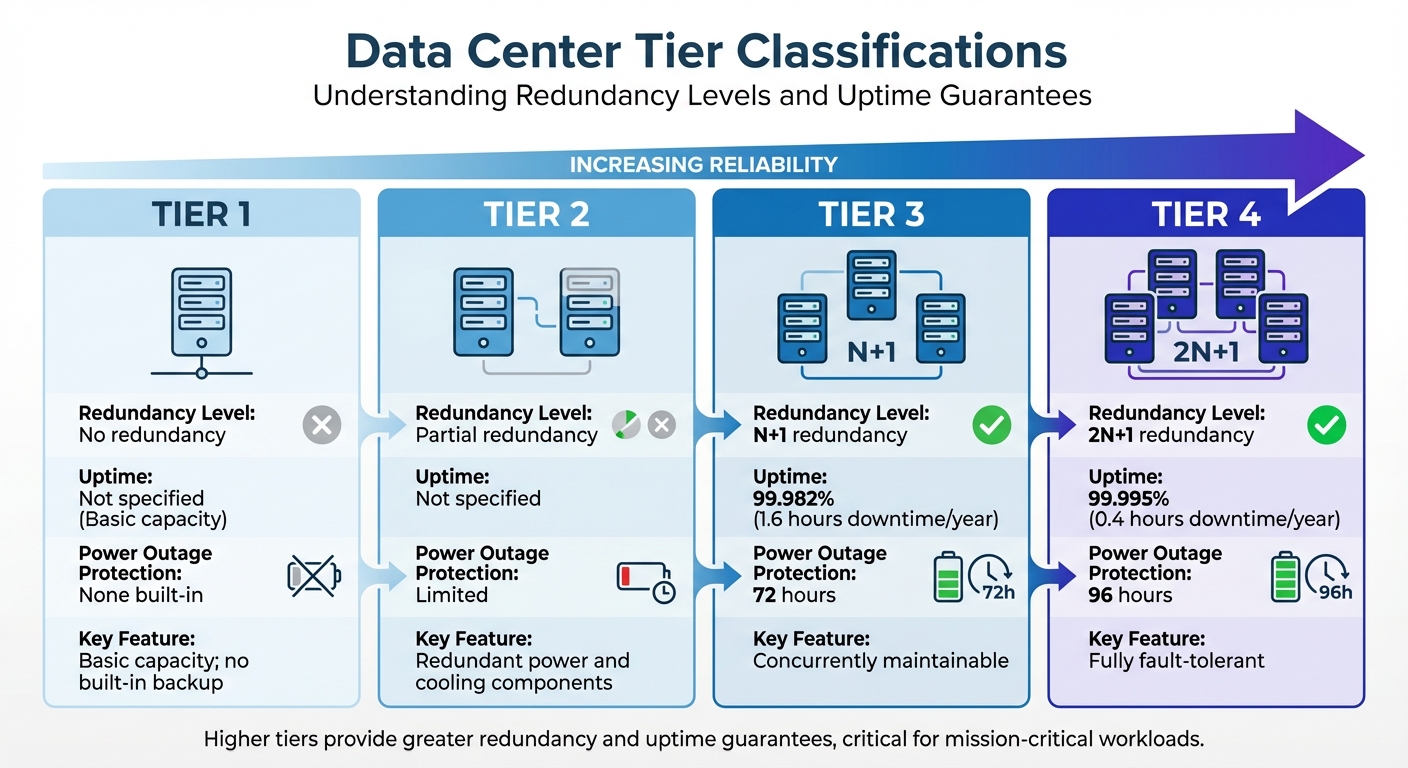
Data Center Tier Classifications: Redundancy and Uptime Comparison
After conducting your internal audit and gathering stakeholder input, the next step is to assess colocation providers. Knowing your requirements is essential, but selecting the right provider can be tricky. Many companies end up overspending because they rush this process. The upside? In Tier 1 metropolitan markets, you’ll usually find 12 to 30 or more enterprise-class providers to choose from[5]. That variety gives you both options and bargaining power.
To make an informed choice, create a framework that goes beyond flashy marketing. Focus on the technical details, financial stability, and compliance history of each provider. The goal isn’t simply to find the cheapest option but to identify a partner who can meet your uptime needs, accommodate future growth, and remain reliable throughout the contract term.
Provider Evaluation Criteria
Start by examining infrastructure reliability. A facility’s Tier classification - such as Tier I, II, III, or IV - indicates its level of redundancy and uptime. For example, a Tier III facility provides 72-hour power outage protection and is designed for concurrent maintenance, while Tier IV facilities ensure 96-hour protection and are fully fault-tolerant. Always verify these claims through third-party certifications and recent audit reports.
Next, consider Power Usage Effectiveness (PUE). A lower PUE means the facility operates more efficiently, particularly in cooling, which can reduce your effective cost per kilowatt-hour. Pay close attention to pricing models: some providers charge for provisioned power (a fixed reservation fee), while others use metered power (you pay only for what you use). Since most colocation customers utilize just 40% to 50% of their allocated power capacity[2], this distinction can significantly impact costs.
Compliance and security are critical. Ensure the provider has certifications like SOC 2, ISO 27001, HIPAA, or PCI DSS, depending on your industry’s needs. With the average cost of a data breach reaching $4.45 million per incident in 2023[4], cutting corners here is risky. Evaluate physical security measures, such as biometric access controls, 24/7 on-site personnel, and extensive video surveillance. These factors not only ensure safety but also strengthen your position during negotiations.
Another key factor is connectivity. Opt for carrier-neutral facilities that offer access to multiple IP transit providers, diverse cross-connect options, and direct cloud on-ramps to platforms like AWS, Azure, or GCP. Being tied to a single carrier can limit flexibility and increase costs over time. Lastly, assess the provider’s financial stability. Since this is a long-term relationship, confirm they’re on solid financial ground by requesting financial statements or credit ratings when possible.
| Data Center Tier | Redundancy Level | Typical Uptime/Resiliency |
|---|---|---|
| Tier 1 | No redundancy | Basic capacity; no built-in backup |
| Tier 2 | Partial redundancy | Redundant power and cooling components |
| Tier 3 | N+1 redundancy | 72-hour power outage protection; concurrently maintainable |
| Tier 4 | 2N+1 redundancy | 96-hour power outage protection; fully fault-tolerant |
Armed with these technical and financial benchmarks, you’ll be better positioned to negotiate effectively.
Maintaining Competitive Leverage
One common mistake organizations make is narrowing their choices to a single provider too early. Michael Rareshide, Executive Vice President at Site Selection Group, explains:
"Too often, customers narrow their preferred option too soon, but if they keep a few more finalists in the mix, the additional leverage can usually result in 8% to 24% savings from the initial proposal"[5].
To maximize your leverage, keep at least four providers in the running until the final negotiation stage. The moment a provider realizes they’re your only option, your bargaining power disappears. Use a formal Request for Proposal (RFP) to compel providers to compete on specific terms. Request detailed breakdowns of costs, including monthly recurring charges (MRC), non-recurring charges (NRC), cross-connect fees, and additional expenses like remote hands support.
When comparing proposals, normalize costs to a common metric, such as Total Cost of Occupancy (TCO) or dollars per kilowatt at peak usage. This ensures you’re making an apples-to-apples comparison. For larger infrastructures, consider a multisourcing strategy. Distributing workloads across multiple providers can help you avoid vendor lock-in and capitalize on each provider’s strengths.
Finally, timing can make a difference. Closing negotiations near the end of a month or quarter might help you secure better deals, as sales teams often push harder to meet their targets. Be cautious, though - don’t reveal any urgency on your end. Keeping your timeline flexible can work to your advantage.
Negotiating Pricing and Financial Terms
Once you've narrowed down your provider options, it's time to hammer out the financial details. With data center vacancy rates in North America dipping below 2% in many Tier 1 markets[1], the balance of pricing power has shifted toward operators. But don’t worry - there are still ways to find savings if you know where to look and how to negotiate.
Your Total Cost of Occupancy (TCO) involves more than just the monthly rack fee. It includes Monthly Recurring Charges (MRC) for services like space, power, and connectivity, as well as Non-Recurring Charges (NRC) for setup, installation, and migration. Since most customers only use 40–50% of their allocated power[2], opting for metered billing can help you avoid overpaying for unused capacity.
Be on the lookout for hidden fees that can quietly inflate your costs. For example, cross-connects, PDU leases, and power safety reserves can add up quickly. PDUs, for instance, might cost an extra $50 per month[14]. Some providers also require a 20% power safety reserve, meaning if you’re paying for a 2.4 kW rack, you may only be able to use 1.9 kW.
Reducing Monthly and Non-Recurring Charges
One way to tackle NRCs is by committing to a longer-term contract, typically 3 to 5 years, which can help you waive setup fees that often range from $1,000 to $2,000[13]. If a waiver isn’t an option, try spreading these costs into your MRC. For example, a $2,000 setup fee divided over 36 months adds roughly $56 to your monthly bill.
Another strategy is to negotiate a license fee abatement for the first 60–90 days, along with a discounted rate for the first year[5]. This can ease the financial burden during migration and initial deployment, when you’re not yet using full capacity. Brien Posey from TechTarget emphasizes that focusing on total monthly expenses, rather than just the base lease rate, often yields better results[6].
Bundling services like space, power, and connectivity can also lead to significant savings. By right-sizing your capacity and normalizing proposals to a common metric - such as dollars per kilowatt at peak usage - you could lower your overall costs by 30–40%[3]. These steps not only cut immediate expenses but also help maintain flexibility for future needs.
Once you’ve optimized your upfront costs, shift your attention to securing long-term pricing stability.
Long-Term Pricing Protections
In multi-year agreements, shielding yourself from price increases is key. Most colocation leases include annual escalators, which are pre-set percentage increases typically between 2.5% and 5%[1]. Over the past five years, global colocation rates have risen by 17%[1], and without caps, renewal prices can skyrocket - jumping from $75 per kW to as much as $150 per kW.
To avoid surprises, negotiate fixed annual increases or caps upfront. Instead of agreeing to vague "market rate" escalators, lock in a specific percentage - ideally under 3%[15]. Michael Rareshide, Executive Vice President at Site Selection Group, advises:
"Using your renewal option should be a worst-case scenario since you would then be locked in to pre-determined rents"[10].
Start renewal discussions 18 to 24 months before your contract ends. This gives you time to explore other options and avoid being stuck with unfavorable terms.
If you foresee growth, secure expansion rights with fixed pricing to ensure additional power or space won’t be subject to market spikes when you need it[5]. You might also want to include technology refresh clauses, which allow access to updated infrastructure without steep price increases[4]. Consider adding periodic review clauses as well, so you can reassess and renegotiate if market conditions shift in your favor[4].
| Fee Type | Common Examples | Negotiation Strategy |
|---|---|---|
| NRC | Setup, cross-connect install, migration | Request waiver for long-term contracts or spread costs into MRC[2] |
| MRC | Power, bandwidth, PDU lease, support | Negotiate volume discounts; cap annual increases at less than 3%[15] |
| Hidden Fees | Power reserve, change fees, expedited support | Push for "free" monthly changes; pay only for used power[14] |
These strategies not only help you manage costs effectively but also ensure you’re prepared for future growth and market changes.
Defining Service Level Agreements and Performance Metrics
Once pricing is locked in, the next step is ensuring the service provider delivers exactly what they promise. This is where a Service Level Agreement (SLA) comes into play. A strong SLA doesn't just outline expectations - it enforces them with measurable metrics and penalties for non-compliance.
While providers often present SLAs as non-negotiable, you can push for clearer terms, broader coverage, and stronger accountability. Knowing what to ask for - and how to negotiate - can make all the difference. Let’s dive into the key elements of an SLA that ensure your agreement is both solid and enforceable.
Core SLA Components
One of the first things to address is uptime guarantees, typically expressed in "nines" of availability or by Tier classifications. For instance, a Tier 3 facility offers 99.982% uptime (about 1.6 hours of downtime per year), while Tier 4 facilities boast 99.995% uptime, translating to just 0.4 hours of downtime annually [16]. However, not all "five nines" are created equal. Some promises might only cover power, while others extend to cooling, connectivity, and other crucial systems [6].
To avoid disputes, establish clear boundaries. For power, this might mean defining responsibilities at the Power Distribution Unit (PDU) or Automatic Transfer Switch (ATS). For networks, clarity at the edge router is essential [17]. Additionally, set environmental benchmarks, such as specific air temperature and humidity levels in cold aisles, to protect your equipment from potential damage [17].
Negotiating service credits is another critical step. These credits, calculated as a percentage of your Monthly Recurring Charge (MRC), compensate for missed commitments. For example:
- Uptime between 99.0% and 99.5% might trigger a 10% credit.
- Falling below 99.0% could result in a 15% credit [17].
Most agreements cap credits at 50% of the MRC and require you to report issues within an hour, followed by a formal claim within 30 days [17]. However, keep in mind that service credits are often your sole and exclusive remedy [17][18]. This means you typically can't pursue breach-of-contract claims for the same incident. To guard against recurring failures, negotiate chronic failure termination rights, allowing you to exit the contract without penalties if the provider consistently underperforms [18][4].
| Service Level (Uptime) | Typical SLA Credit (% of MRC) |
|---|---|
| 99.5% – 99.95% | 5% of the affected cabinet |
| 99.0% – 99.5% | 10% of the affected cabinet |
| Less than 99.0% | 15% of the affected cabinet |
Source: Advanced Hosting Colocation SLA [17]
Performance-Based Incentives
Beyond the basics, consider including performance-based incentives in your SLA. While not common in colocation agreements, these can reward providers for exceeding expectations, further enhancing your service experience.
To ensure accountability, your SLA should include strict reporting timelines and measurement verification protocols. Specify how performance will be measured, such as the placement and number of sensors for temperature and humidity. Also, clarify whether power downtime is defined by failure in one or both redundant circuits [17][18]. This level of detail prevents providers from exploiting vague terms.
Set clear notice periods for maintenance - 72 hours for planned work and as little as 15 minutes for emergencies [17]. Additionally, outline support response metrics, including "Acknowledge Time" (how quickly the provider logs your ticket) and "Response Time" (how quickly a technician is available or on-site) [17]. For rented equipment, an eight-hour replacement window is a common benchmark [17].
Attorney Emily Naughton of Greenberg Traurig explains, "A well-drafted SLA establishes clear performance standards and quantifiable damages in the event of a service level failure, allowing both parties to avoid protracted legal disputes" [18].
Ultimately, the goal isn’t just to have an SLA - it’s to create one that is enforceable, measurable, and tailored to your business priorities.
Securing Scalability and Flexibility Provisions
Once you've locked in the financial and performance terms, it's crucial to ensure your agreement is equipped to handle future growth and technological changes using real-time analytics. Your current infrastructure demands are unlikely to remain static over the next few years. That's why provisions for expansion and flexibility are essential to avoid being stuck with outdated technology or facing unexpected cost increases.
Expansion Rights and Pay-As-You-Grow Models
One of the first things to secure is a right of first refusal (ROFR) for adjacent space. This guarantees you priority access to nearby cages or suites when you need to expand, keeping your infrastructure streamlined and easy to manage [4][5]. Additionally, negotiate fixed expansion pricing for future power needs. By locking in the price per kilowatt-hour (kWh) at the outset, you can shield yourself from potential cost hikes imposed by the provider later on [5].
"To need additional power after the SLA in place without clear definition in the agreement puts all the leverage into the operator's hands", explains Michael Rareshide, Executive Vice President at Site Selection Group [5].
Another key consideration is implementing pay-as-you-grow models. These allow you to scale your usage gradually, avoiding the need to pay for full capacity from the start. For example, you can negotiate a ramp-up period where costs are based on actual power consumption. This might include license fee waivers for the first 60 to 90 days or discounted rates during the first year [5]. This way, you're not overpaying for unused resources.
It's also wise to negotiate contraction rights, which give you the ability to return unused space or power within a specified timeframe. This kind of flexibility is essential if your initial growth projections turn out to be overly optimistic [5].
While these measures address capacity, it's equally important to ensure your infrastructure stays aligned with evolving technology.
Technology Refresh Clauses
Colocation facilities are built to last decades, but the pace of technological innovation far outstrips that timeline. Including technology refresh clauses in your agreement ensures you won't be stuck with outdated systems as advancements occur. These provisions allow you to upgrade to newer technologies - like liquid cooling for AI workloads or edge computing capabilities - without renegotiating your entire contract [4][1].
Modern facilities are already preparing to handle higher densities, scaling from current levels of 30 to 50 kW per rack to future demands exceeding 100 kW per rack [1]. Refresh clauses enable you to tap into these advancements seamlessly. You can structure these provisions with spend shift options, allowing you to reallocate funds to modify your hardware configuration without incurring penalties [12]. Additionally, you might negotiate to have non-recurring charges (NRCs) for upgrades spread across your monthly recurring charges (MRCs), minimizing upfront costs [2].
Jeff Howell, President of ENCOR Advisors, underscores this point: "Include technology refresh clauses to ensure access to updated infrastructure" [4].
Legal Considerations and Risk Mitigation
After finalizing operational terms, the next step is building a legal framework to shield your business from unexpected risks. This involves ensuring your negotiated benefits are enforceable while safeguarding your organization's interests. A colocation agreement merges aspects of property and IT contracts, requiring legal protections tailored to its unique nature. Jocelyn S. Paulley, Partner and Co-leader of Data Protection and Cyber Security at Gowling WLG, explains:
"A colocation agreement is a unique blend of both [property and IT agreements]. The property element is the space... The IT element of the agreement only covers infrastructure used to support IT i.e. the power and cooling" [8].
With operational terms in place, legal protections are essential to ensure these agreements hold firm.
Core Legal Clauses
A well-constructed colocation agreement starts with clear definitions of liability limits and indemnification protections. Providers often cap their liability and exclude indirect or consequential damages, so negotiate terms that reflect your actual risk exposure [19][20]. Indemnification clauses should shield you from third-party claims, like intellectual property infringement related to the services provided [20]. Additionally, ensure you maintain Comprehensive General Liability (CGL) insurance of at least $1,000,000 per occurrence, along with Employers Liability and Workers' Compensation coverage [20].
Termination rights are another critical aspect. Your contract should allow you to exit if the provider commits an uncured material breach (with a typical 30-day cure period), undergoes a change of control, or if their facility lease expires [20][4]. These safeguards - such as the 30-day cure period, $1,000,000 in CGL insurance, and a "Change of Control" clause requiring six months' notice - are standard in strong agreements.
Data protection and compliance clauses are non-negotiable. Your agreement must mandate adherence to regulations like GDPR and PIPEDA and industry standards such as SOC 1/2/3, ISO 27001, and PCI-DSS [22][4]. Data breaches can be financially devastating, with an average cost of $4.45 million per incident in 2023. Jeff Howell, President of ENCOR Advisors, emphasizes:
"Data breaches can have significant financial repercussions, averaging around $4.45 million per incident in 2023. Assess physical security, network security, and infrastructure protection in colocation agreements to safeguard confidential information" [4].
Lastly, include clear equipment removal terms. Specify that equipment left behind for more than 30 days is considered abandoned. This avoids disputes over ownership and retrieval costs [20].
While these clauses form the backbone of your legal protections, it's also vital to address how unexpected events and disputes will be handled.
Force Majeure and Dispute Resolution
Force majeure clauses offer protection when unforeseen events make fulfilling the contract impossible or impractical. However, courts interpret these clauses narrowly, covering only events explicitly listed or closely related [24][25]. Your agreement should include specific scenarios like natural disasters, war, terrorism, labor strikes, power grid failures, and "disease, medical epidemics, or outbreaks" [24][25]. Using terms like "commercially impracticable" or "inadvisable" instead of "impossibility" gives you more flexibility [25].
Set a "drop-dead" date - 30, 60, or 90 days - after which either party can terminate the agreement if the force majeure event continues [24][26]. This prevents indefinite obligations. Clarify whether payment obligations pause during disruptions and how pre-paid fees are managed [25][26]. As Janice M. Ryan, Partner at Venable LLP, notes:
"In a force majeure clause, every word matters and can change the impact of the clause's applicability" [25].
For dispute resolution, establish a clear process before resorting to litigation. Specify the legal jurisdiction (venue of law) for disputes, typically where the facility is located [2][21][23]. Document every service failure with detailed logs, including dates, times, and personnel involved. This creates a reliable paper trail for reference [23]. Use formal notices - via postal services requiring signatures or email read receipts - to ensure the provider is legally notified [23]. If issues persist, set a deadline for renegotiation before considering costly litigation [23]. Engaging legal counsel with expertise in technology service litigation can significantly strengthen your position, especially when only 30% of companies use third-party advisors for colocation negotiations [4][23].
Finalizing and Executing the Agreement
Once legal protections are in place, the next step is to ensure every negotiated term is accurately documented before signing. A thorough final review helps avoid costly mistakes and lays the groundwork for a productive partnership.
Final Review Checklist
Begin by cross-checking your original requirements with the finalized Master Service Agreement (MSA). The MSA serves as the comprehensive document for all terms, conditions, and expectations, with the Service Level Agreement (SLA) often included as a separate exhibit [2]. Make sure any verbal commitments from negotiations are now formalized as enforceable obligations through detailed legal revisions [2].
Financial transparency is a top priority. Double-check that all Non-Recurring Charges (NRCs) and power billing methods are clearly outlined - whether they’re based on actual kWh usage (metered) or a flat fee for reserved capacity (provisioned) [2][7]. Look for any hidden fees that could inflate your base lease cost [4][6][7]. Additionally, confirm that annual rent escalation limits are clearly defined to maintain predictable costs over time [6][9].
Review SLA benchmarks to ensure they cover critical elements like power, cooling, connectivity, and support response times [6]. Make sure any penalties for SLA breaches - such as service credits - are clearly detailed [4][28]. For scalability, verify that clauses include your "right of first refusal" for adjacent space and fixed pricing for future power expansions. This prevents the provider from gaining undue leverage as your needs grow [4][5].
| Review Category | Key Verification Steps |
|---|---|
| Financials | Ensure all NRCs are listed; confirm power billing model (metered vs. provisioned); check rent escalation limits [6][9] |
| SLAs | Confirm uptime guarantees; verify service credits for downtime; ensure cooling and connectivity are included [6][28] |
| Scalability | Confirm right of first refusal for adjacent space; verify fixed pricing for power expansion [4][5] |
| Operations | Verify 24/7/365 on-site staff availability; ensure remote hands response times are documented [6][14] |
| Compliance | Check certifications (ISO 27001, SOC 1/2/3, PCI DSS); confirm data privacy compliance (GDPR) [4][27] |
Once all these elements are confirmed, you’re ready to finalize and sign the agreement, setting the stage for ongoing monitoring.
Execution and Monitoring
After completing the review, executing and monitoring the agreement ensures its terms deliver value over time. Make sure all negotiated points - like pricing, scalability, and SLAs - are clearly documented and actively tracked throughout the contract’s duration.
Set up independent monitoring systems immediately after execution. Keep a detailed log of service outages and performance metrics to support claims for service credits, if needed [28]. Secure access to portals or data feeds that allow real-time tracking of power usage and environmental conditions [27].
Plan for annual contract reviews to confirm that pricing and capacity still align with your business needs and market conditions [28]. Carefully review Monthly Recurring Charges (MRCs) and Non-Recurring Charges (NRCs) to catch billing errors - one-time fees, like upgrades, should never appear as recurring costs [2]. Maintain open communication with your provider through regular updates to stay informed about facility improvements and emerging technologies [4]. This proactive approach ensures your agreement remains beneficial throughout its term.
Conclusion
Wrapping up the negotiation process requires a thoughtful approach to secure lasting value. Achieving a strong colocation agreement hinges on preparation, clarity, and flexibility, all working together to deliver the best outcomes. Preparation involves planning at least three years ahead and conducting detailed internal audits to avoid over-provisioning. Without this groundwork, businesses risk losing up to 9% of annual revenue due to poorly structured contracts [29].
Clarity is equally critical. A transparent agreement helps sidestep hidden costs and misunderstandings. By fully understanding your Total Cost of Occupancy (TCO) - which includes non-recurring charges, monthly fees, and power pass-through costs - you can budget more effectively, especially in a market where global colocation rates have risen 17% over the past five years [1]. Clearly defined Service Level Agreements (SLAs) with specific benchmarks for availability and compensation terms also help reduce future disputes.
Flexibility is what ensures your infrastructure investment can adapt to future needs. With AI-driven workloads pushing power densities to 50–100+ kW per rack and power delivery timelines stretching up to three years, including expansion rights and technology refresh clauses in your contract is no longer optional [1][4]. Keeping multiple providers in play during negotiations can also lead to savings of 8% to 24% on initial proposals [5].
Today’s market landscape adds another layer of complexity. In Tier 1 North American markets, where vacancy rates have fallen below 2%, providers hold considerable pricing power [1]. However, you can counterbalance this by leveraging competitive tension, data-supported proposals, and strategic timing. For example, negotiating near the end of a quarter and maintaining several provider options can lead to significant discounts on both pricing and additional services.
A successful colocation agreement finds the right mix of cost efficiency, performance, and adaptability. By focusing on these principles and monitoring the agreement after it’s in place, you can navigate the challenges of a tightening market and position your organization for long-term success.
FAQs
What should I measure before requesting colocation quotes?
Before diving into colocation quotes, it's essential to evaluate a few critical factors to make informed decisions:
- Power usage (kW per rack): Take stock of your current power consumption and estimate future needs. This ensures you're adequately prepared and can avoid under- or over-provisioning.
- Rack density and capacity: Check if the facility can handle high-density configurations and whether there's room for growth if your needs increase.
- Billing model: Familiarize yourself with how power is billed - whether it's a fixed rate or based on metered usage - so you can plan your budget accordingly.
- Space requirements: Figure out how much physical space you'll need, whether it's individual racks, cages, or larger setups.
- Scalability: Consider how easily the provider can accommodate your growth and whether they offer redundancy options to support reliability.
By evaluating these aspects, you'll be better equipped to compare quotes and negotiate terms that align with your needs.
How do I compare proposals fairly across different providers?
When comparing colocation proposals, it's essential to zero in on the most critical factors: pricing models, service levels, contract terms, and flexibility. Start by examining the pricing structure - are costs fixed, or are they pass-through expenses like power and cooling? Pay close attention to escalation clauses, renewal terms, and whether the provider allows for customization to suit your needs.
Another key aspect is evaluating the total cost of ownership (TCO) over the life of the contract. This gives you a clearer picture of the long-term financial commitment. Finally, make sure the service level agreements (SLAs) align with your operational requirements. A thorough review of these elements will help you make an informed and balanced decision.
Which contract clauses best protect against future price hikes?
To protect yourself from potential price hikes, include clauses in your agreement that lock in fixed rent or set predetermined power escalation rates. You might also want to add terms that limit increases over the contract's duration and address pass-through charges for electricity costs. These steps can help you maintain more stable and predictable expenses throughout the term of the agreement.