
How AI Predicts Real Estate Investment Risks
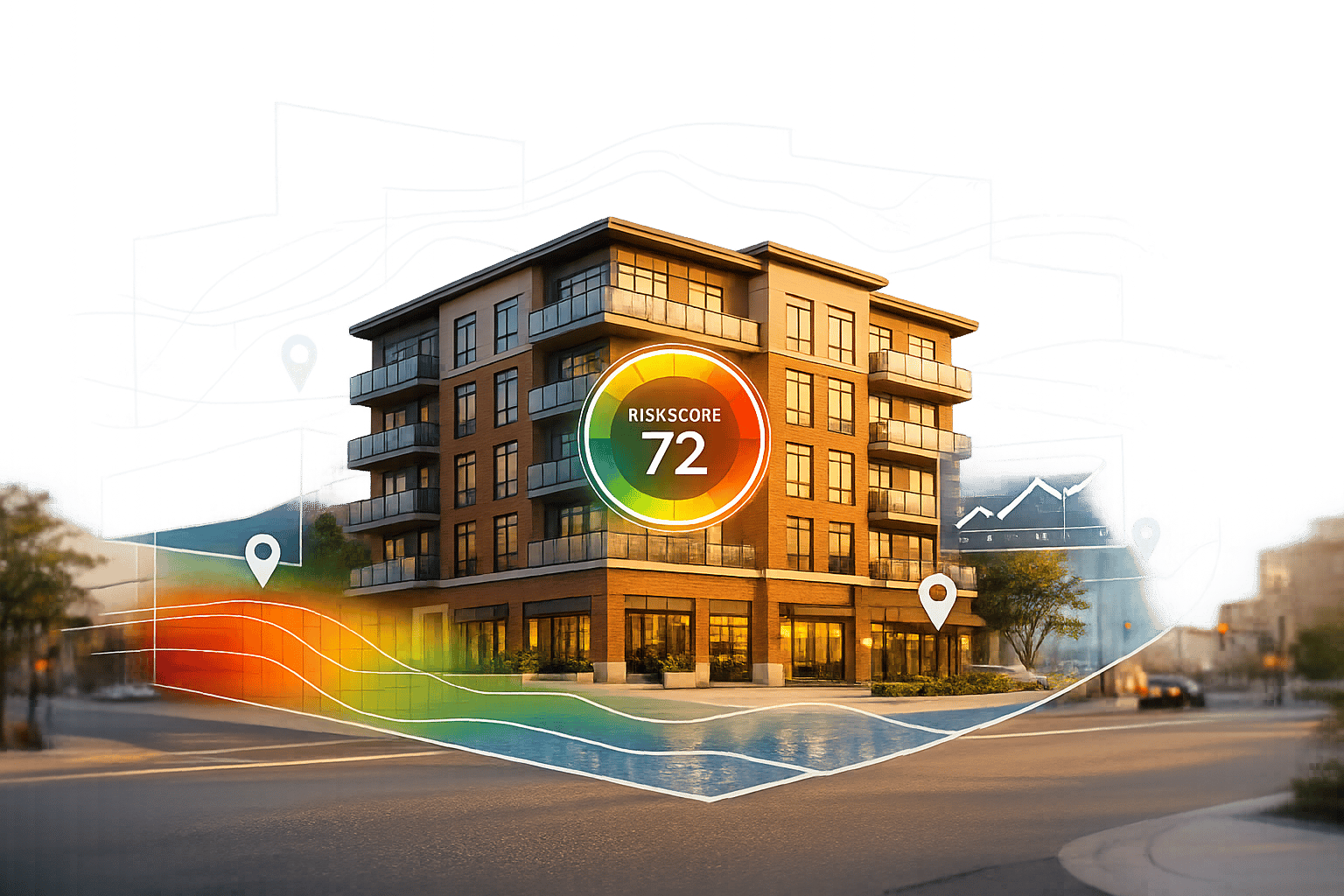
AI is reshaping how real estate investors assess risks. By analyzing massive datasets within minutes, AI identifies patterns and delivers risk assessments with up to 98% accuracy. This approach helps investors foresee issues like market downturns, tenant defaults, and zoning challenges, enabling smarter decisions and minimizing financial losses. Key steps include:
- Data Collection: AI gathers and processes structured (e.g., property records) and unstructured data (e.g., city planning documents).
- Model Selection: Algorithms like neural networks and decision trees analyze data for risk predictions.
- Simulations: Tools like Monte Carlo simulations test investment performance under various market conditions.
- Risk Scoring: AI consolidates insights into a Property Investment Risk Analyzer Tool (TRS) for easy comparison of investment opportunities.
- Workflow Integration: Platforms like CoreCast streamline data analysis, reporting, and decision-making.
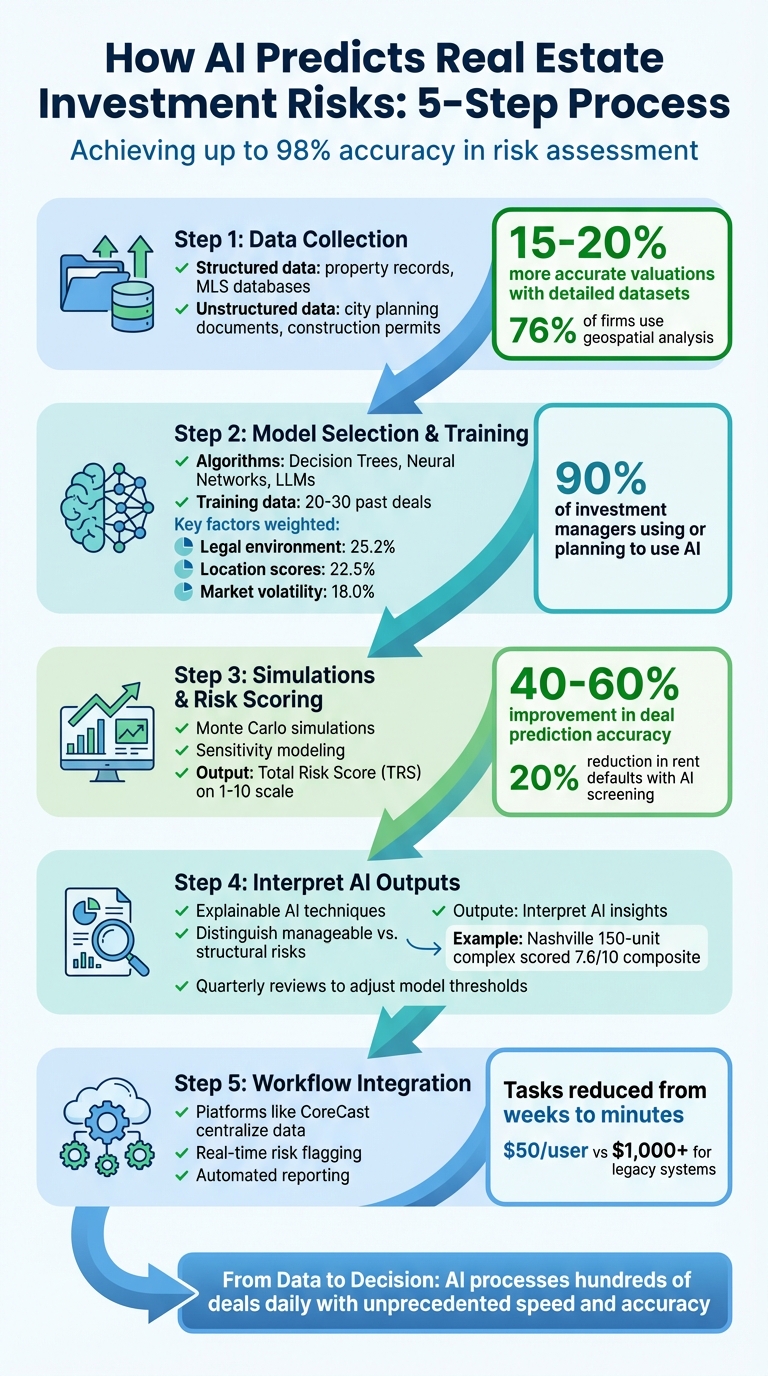
5-Step AI Risk Prediction Process for Real Estate Investment
AI in Real Estate Systems: Machine Learning for Valuation, Risk, and Smart Assets | Uplatz

sbb-itb-99d029f
Step 1: Gathering Data Inputs for AI Models
AI risk prediction models thrive on quality data. The backbone of any accurate risk assessment lies in collecting a wide range of reliable information from various sources. This means pulling together structured data - like property records - and unstructured data, such as construction permits and legal documents. The tricky part? Combining these diverse datasets into a format that machine learning algorithms can actually use. Once this foundation is set, the focus shifts to identifying and processing the most relevant variables for predicting risks.
Data Required for Real Estate Risk Analysis
To accurately assess investment risks, AI models need access to several types of data. Property-specific details - like location, size, condition, and nearby amenities - help algorithms evaluate location-based risks and growth potential. Market trends and historical performance data, such as rental activity, vacancy rates, past cash flows, and sales records, are equally critical for forecasting. Studies show that AI property valuation becomes 15–20% more accurate when provided with detailed datasets [3].
Broader economic indicators and demographic data also play a key role. Metrics like interest rates, employment levels, GDP growth, and inflation help models understand the larger economic picture. Geospatial data - covering zoning laws, flood risks, and infrastructure - sharpens the model’s ability to predict risks. Notably, 76% of real estate investment firms already use geospatial analysis to inform their decisions [2]. Additional inputs, such as tenant credit scores, construction permits, material costs, and sustainability metrics, further enhance predictions. For instance, AI-driven tenant screening has been shown to reduce rent defaults and evictions by as much as 20% [3].
Combining Data from Multiple Sources
Effectively using these different types of data requires consolidation. Real estate information is scattered across many sources, including public records, MLS databases, economic reports, and proprietary platforms. To achieve accurate predictions, these sources must be unified into a centralized dataset. Research has demonstrated that integrating data from multiple platforms significantly boosts prediction accuracy [4].
Tools like CoreCast simplify this process by merging data from various sources into a single workspace. This approach streamlines workflows, allowing real estate professionals to access property details, market trends, and portfolio insights in one place. By centralizing data, CoreCast eliminates the need to manually compile information from separate platforms, reducing errors and saving time.
"In real estate, the art of the deal is increasingly becoming the science of the data." – Edward Glaeser [2]
Step 2: Selecting and Training Predictive Algorithms
Once data is unified, the next step is selecting the right algorithms and training them for precision. Different machine learning models bring unique strengths to the table. For instance, some are better at identifying patterns in structured data, while others excel at handling complex, non-linear relationships. The key is to match the algorithm to the specific risk factors you're analyzing. Take linear regression, for example - it’s great for straightforward price predictions but often falls short when dealing with interaction effects, like those between location and market volatility. On the other hand, ensemble methods and neural networks are better equipped to handle these complexities, making them more suitable for capturing the nuances of real estate risk dynamics [5].
Choosing Machine Learning Models
Several machine learning algorithms have shown promise in real estate risk prediction:
- Decision Trees: These simplify investment decisions into clear, binary outcomes, making them easy to interpret.
- Neural Networks: Ideal for working with large datasets, they can uncover hidden patterns that simpler models might overlook.
- Large Language Models (LLMs): These are gaining traction for analyzing unstructured text - such as earnings calls or news articles - to extract sentiment and detect emerging risks [6].
Proprietary models, especially those trained on specialized datasets like 400,000 earnings transcripts, often outperform general-purpose tools in delivering insights [6]. The choice of algorithm should align with the specific risk factor being assessed. It's worth noting that over 90% of investment managers are now using or planning to use AI, with more than half incorporating it specifically into risk management efforts [8]. After selecting the right model, the next crucial step is training it on well-prepared data.
Training AI Models with Clean Data
Training models effectively starts with clean, structured data. Historical data from 20 to 30 past deals - covering both successful investments and missed opportunities - provides a solid foundation. Running two to three testing iterations ensures the model's outputs align closely with real-world scenarios [7].
Equally important is feature selection. Instead of overwhelming the model with an excess of variables, focus on the ones that genuinely influence investment decisions. For example, factors like the legal environment, location scores, and economic indicators often carry the most weight. Research shows that the legal and regulatory environment contributes 25.2% to risk scoring, while location scores account for 22.5% [5][7].
Additionally, the rise of explainable AI (XAI) is helping professionals understand the reasoning behind a model’s risk assessments. This transparency is not just helpful for regulatory compliance but also builds trust in AI-driven decision-making [5].
Step 3: Running Simulations and Generating Risk Scores
Use simulations powered by AI models to produce actionable risk scores. These simulations explore a variety of scenarios, providing insights into how investments might perform under diverse market conditions. The result? Faster, data-driven decision-making.
Simulating Market Conditions
AI models often rely on Monte Carlo simulations to predict how investments respond to different variables. For example, they might examine factors like material lead times or subcontractor availability to evaluate potential schedule and cost risks [1]. By running thousands of iterations with varying assumptions, these models provide a clearer picture of potential outcomes.
Sensitivity modeling is another key tool, helping investors understand how returns might degrade under stressed conditions, such as rising interest rates or shrinking cap rates [1]. This approach identifies which variables could have the most significant impact on your strategy. Additionally, the model compares present-day data with historical market patterns known for strong performance [9]. However, it’s crucial to recognize the limits of these predictions. As Raj Singh, CEO of Altrio, explains: "Predictive AI will not be able to forecast trends in rents or asset prices... the only thing the recipient of this prediction knows for sure is that the reality will be different" [9].
These simulations feed directly into the calculation of a Total Risk Score, offering a streamlined way to assess investment risks.
Calculating Risk Scores
Once the simulations are complete, the next step is to consolidate the data into a single, easy-to-interpret metric. AI aggregates the results into a Total Risk Score (TRS) - a number that simplifies complex, multi-dimensional data into a format that’s straightforward to compare. For instance, the RECIR framework uses a weighted approach, assigning 25.2% of the score to the legal and regulatory environment, 22.5% to location quality, and 18.0% to market volatility [5]. Other factors, such as property condition, economic trends, and environmental risks, also contribute smaller but meaningful percentages.
The TRS operates on a 1–10 scale, making it easy to rank deals in your pipeline. A high score might indicate a promising opportunity, while a lower score could highlight areas needing further investigation. To ensure accuracy, calibrate the model using data from 20–30 past deals [7]. Typically, two to three iterations are enough to fine-tune the results. Custom AI models often outperform generic tools, improving prediction accuracy by 40% to 60% when determining which deals are worth pursuing [7].
AI goes beyond just scoring. It can also assist with pre-Phase I screening, pulling data like EPA records, flood zone maps, and contamination histories. This helps flag high-risk sites before you invest $5,000–$15,000 in formal environmental assessments [1]. Additionally, AI can benchmark hard cost estimates against regional databases like RSMeans, identifying potential underpricing or inconsistencies in contractor bids [1].
Step 4: Interpreting AI Outputs for Investment Decisions
AI-generated risk scores only become truly useful when you know how to interpret them effectively. The real value lies in understanding the factors driving these scores and using that knowledge to shape actionable investment strategies. This step is where raw data transforms into meaningful, strategic decisions.
Understanding AI-Generated Insights
The Total Risk Score (TRS) combines key risk factors using established weightings, making it easier to distinguish between risks that can be addressed (like property condition) and those that are more intrinsic (such as zoning or legal challenges). With explainable AI, techniques like permutation importance reveal the main contributors to a score. This allows investors to determine whether risks are manageable or structural. The industry is moving away from decisions based on intuition and toward data-driven, proactive assessments. These tools help identify potential issues - like permitting delays or contractor risks - while connecting broader economic trends to specific property-level impacts [5]. By understanding these insights, investors can turn abstract numbers into practical strategies.
Making Investment Decisions with AI Data
AI doesn’t just assess risks; it also refines the process of evaluating deal potential and identifying strategic opportunities. Take this example: In February 2026, a multifamily investor analyzed a 150-unit apartment complex in Nashville using a custom AI scoring model. The model produced three key scores: a "Value Creation" score of 8/10 (indicating rents 15% below market), a "Market Fundamentals" score of 9/10, and a "Financial Attractiveness" score of 6/10. Despite the lower financial score, the weighted composite score of 7.6 led to a decision to pursue the investment [7].
Custom AI models tailored to specific investment strategies consistently outperform generic tools [7]. To maintain accuracy, investors should conduct quarterly reviews to adjust model thresholds and weights as market conditions change. This approach ensures you avoid deals that might look promising on the surface but don’t align with your broader strategy.
Step 5: Using AI Insights Through CoreCast
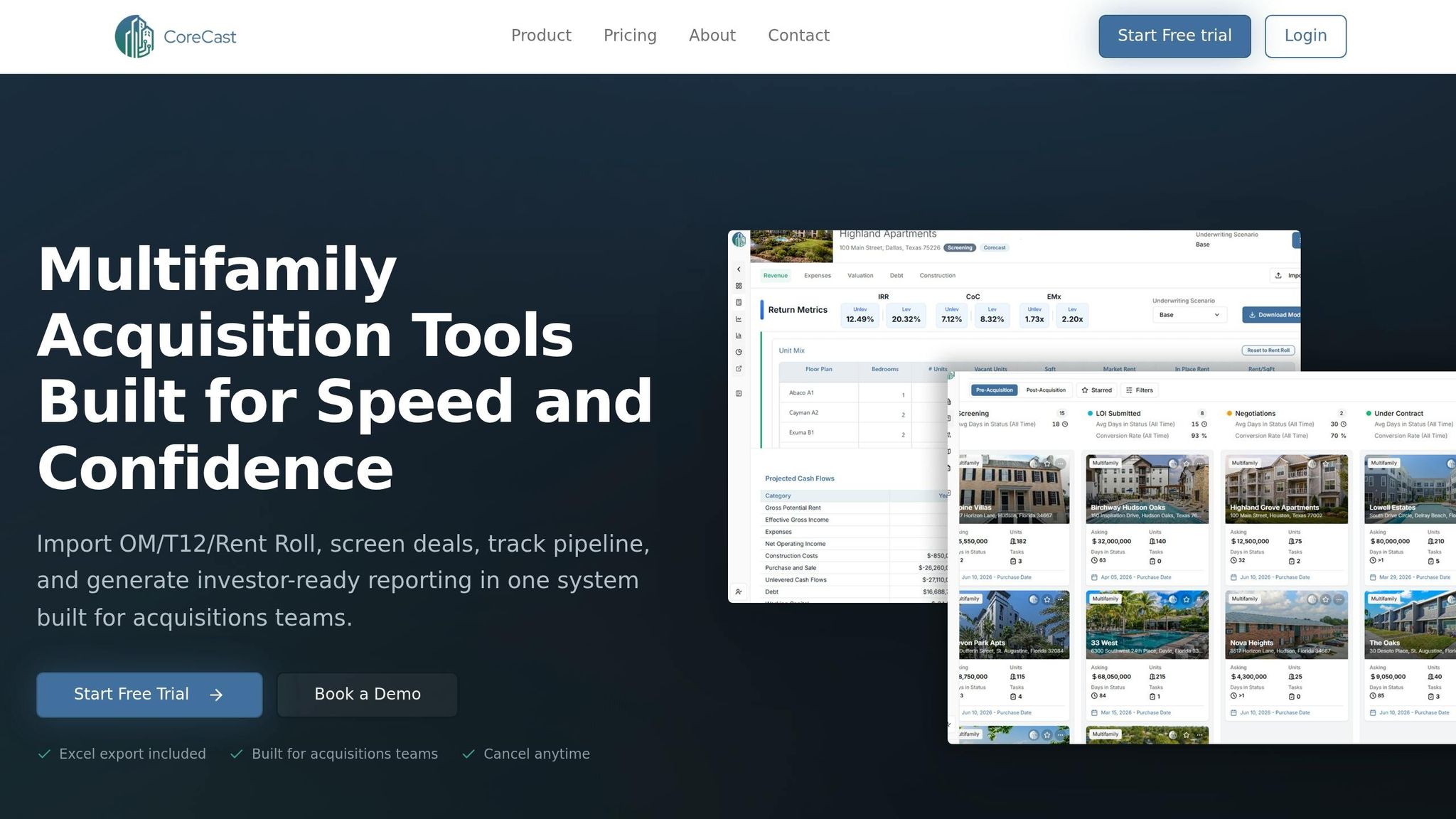
CoreCast takes your AI-generated insights and integrates them directly into your investment workflow, offering a seamless way to incorporate risk scores into real estate decision-making. This platform doesn’t just enhance risk prediction - it transforms AI insights into actionable steps throughout the investment process. By replacing scattered spreadsheets and disconnected tools, CoreCast creates a unified system designed to improve workflow efficiency and streamline operations.
CoreCast's Role in Risk Prediction
With CoreCast’s Underwriter module, analysts can build detailed models in just a few minutes. The platform uses machine learning-powered validation checks to ensure data accuracy before producing risk scores. It brings together data from multiple sources - like geospatial information, market trends, property valuations, and tenant credit data - into a single, cohesive system. This allows you to underwrite any asset type or risk profile, whether it’s multifamily, industrial, retail, or office, while maintaining consistency across your organization.
CoreCast also offers real-time risk flagging and deal scoring, helping investors identify potential issues early in the due diligence process. For instance, the platform supports cash flow projections that incorporate rental trends, expense patterns, and market conditions, resulting in more dependable forecasts [3]. Tenant credit assessments go beyond traditional credit scores, analyzing broader data points to cut down on rent defaults and evictions by up to 20%. Additionally, stress testing tools let you model scenarios like interest rate hikes or economic downturns without the need to manually rebuild financial models [3]. This comprehensive risk prediction framework feeds directly into your operational workflows, making them more efficient and insightful.
Simplifying Workflows with CoreCast
CoreCast centralizes portfolio analysis, stakeholder reporting, and pipeline tracking into one platform, significantly cutting down on administrative tasks. By consolidating cash flows, it provides a complete view of your portfolio, allowing you to assess diversification and benchmark real estate portfolios to identify underperforming assets. The integrated mapping feature offers geospatial insights, helping you evaluate location-based risks and understand the competitive landscape.
The platform’s automated reporting tools generate customized, branded reports and provide centralized portals where stakeholders can access real-time data. This eliminates the hassle of manual data transfers, version control issues, and formatting spreadsheets. The time and cost savings are substantial: underwriting tasks that once took weeks can now be completed in minutes. During the beta phase, monthly costs are as low as $50 per user - far less than legacy systems that often exceed $1,000 per user. Plus, CoreCast can process hundreds of deals daily, compared to the limited capacity of traditional methods.
Conclusion
Key Takeaways
AI-powered risk prediction in real estate follows a structured process: collecting diverse and clean data, choosing and training suitable algorithms, running simulations to produce risk scores, analyzing the results, and embedding these insights into decision-making workflows. When equipped with high-quality datasets, AI models can achieve 15-20% higher accuracy, providing a strong benchmark for guiding investment strategies [3]. Tools like CoreCast streamline this process, moving away from disjointed spreadsheets to a centralized platform that manages everything from underwriting to portfolio evaluations.
The combination of speed and scalability is a game-changer. Tasks that once took hours or days can now be completed in minutes, allowing hundreds of deals to be processed daily. This efficiency doesn’t just save time - it leads to smarter decisions. For example, investors leveraging predictive AI models have been able to spot asset deterioration earlier than traditional methods, reducing capital losses on underperforming properties, as highlighted by the National Association of Realtors [10]. These advancements lay a strong groundwork for the next wave of real estate analytics.
What's Next for AI in Real Estate
The next chapter of AI in real estate is all about deeper integration and real-time adaptability. As current models demonstrate their reliability, there’s a growing shift toward real-time monitoring and dynamic risk management. Investors now track evolving factors like tenant credit declines, local crime rates, and debt exposure as they happen [10]. According to McKinsey, AI-driven forecasting has enabled institutional investors to shrink valuation errors and align financing terms more closely with projected asset performance [10].
AI’s future applications are expanding rapidly, with potential to enhance fraud detection, transaction analysis, and forecasting property maintenance costs [11]. For instance, AI can now link online reviews to tenant turnover rates or analyze zoning meeting notes to anticipate disruptions [10]. However, challenges like the need for more interpretable models, better privacy safeguards, and standardized data infrastructure across markets still need to be addressed [11]. As these hurdles are overcome, AI will become an indispensable part of everyday investment strategies, making advanced risk analysis accessible to investors at every level.
FAQs
What data is needed to predict real estate risk with AI?
To forecast real estate risk using AI, you need a broad set of data covering various aspects of the market and economy. Essential inputs include property listings, transaction histories, demographic patterns, employment statistics, infrastructure developments, geospatial information, and lease agreements. By combining these elements, AI models can study both historical and current trends, offering insights into potential risks, market changes, tenant behaviors, and operational hurdles with greater precision.
How reliable is an AI Total Risk Score (TRS) in real-world markets?
AI Total Risk Scores (TRS) boast impressive accuracy, reaching up to 96% in target markets and an even higher 99% nationwide when predicting rent growth. These scores are designed to minimize errors and reduce biases in risk assessments. However, their reliability hinges on two key factors: the quality of the data used and how well the results are interpreted within the context of specific markets. Proper application is essential to make the most of their predictive power.
How can CoreCast fit AI risk scoring into my underwriting workflow?
CoreCast weaves AI-driven risk scoring seamlessly into your underwriting process, pulling insights from a variety of data sources - market trends, property specifics, economic signals, and geospatial information. Its tools flag potential risks and offer predictive insights, simplifying your decision-making process. By automating risk evaluation and centralizing data, CoreCast enables more precise investment analysis, minimizes manual mistakes, and boosts efficiency - all within its comprehensive real estate intelligence platform.