
Guide to Environmental Due Diligence for Data Centers
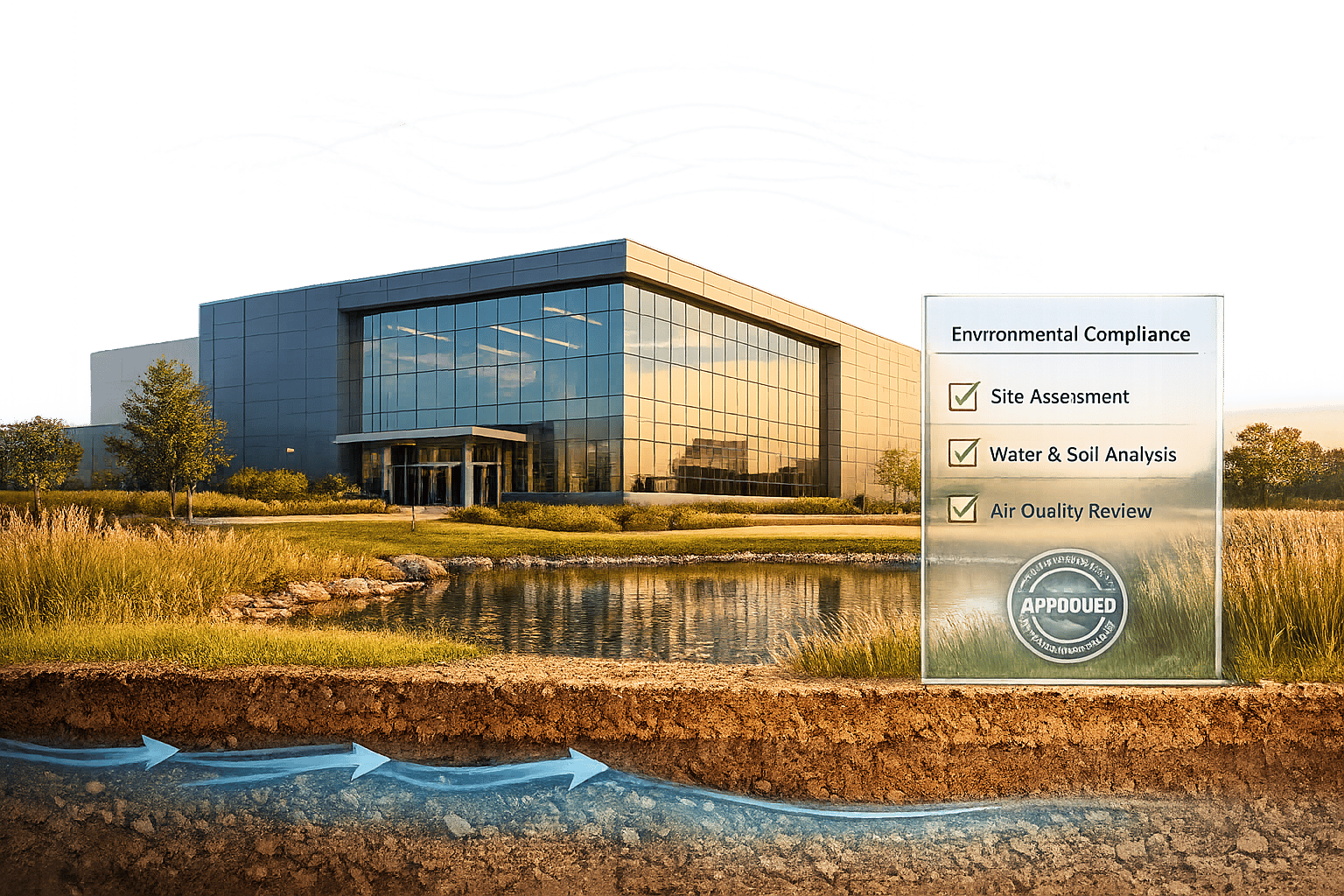
Environmental due diligence (EDD) is essential for identifying risks like contamination, regulatory non-compliance, or water and air quality issues using real-time CRE analytics in data center projects. Skipping this step can lead to massive costs, such as cleanup under CERCLA or penalties for regulatory violations. For example, Hilcorp Energy paid over $2.9 million in fines and remediation in 2024 for Clean Air Act breaches.
Key takeaways:
- EDD Steps: Start with a Phase 1 ESA to review records, inspect sites, and identify risks like hazardous substances. Move to Phase 2 ESA for detailed testing if needed.
- Risks for Data Centers: High water use, emissions from backup generators, and regulatory hurdles like air and water permits.
- Compliance Matters: Laws like the Clean Water Act and Endangered Species Act require early planning to avoid delays.
- Emerging Trends: Regulations like heat recovery mandates in France and higher utility rates for data centers in Georgia are reshaping the industry.
EDD isn’t just about compliance - it protects investments, ensures smooth operations, and builds trust with stakeholders. Utilizing real-time dashboards for portfolio management can further streamline this oversight. The article explores strategies for managing risks, securing permits, and staying ahead of evolving regulations.
Building Responsibly: Site Development for Sustainable Data Centers | Melissa Asher
sbb-itb-99d029f
Steps in the Environmental Due Diligence Process
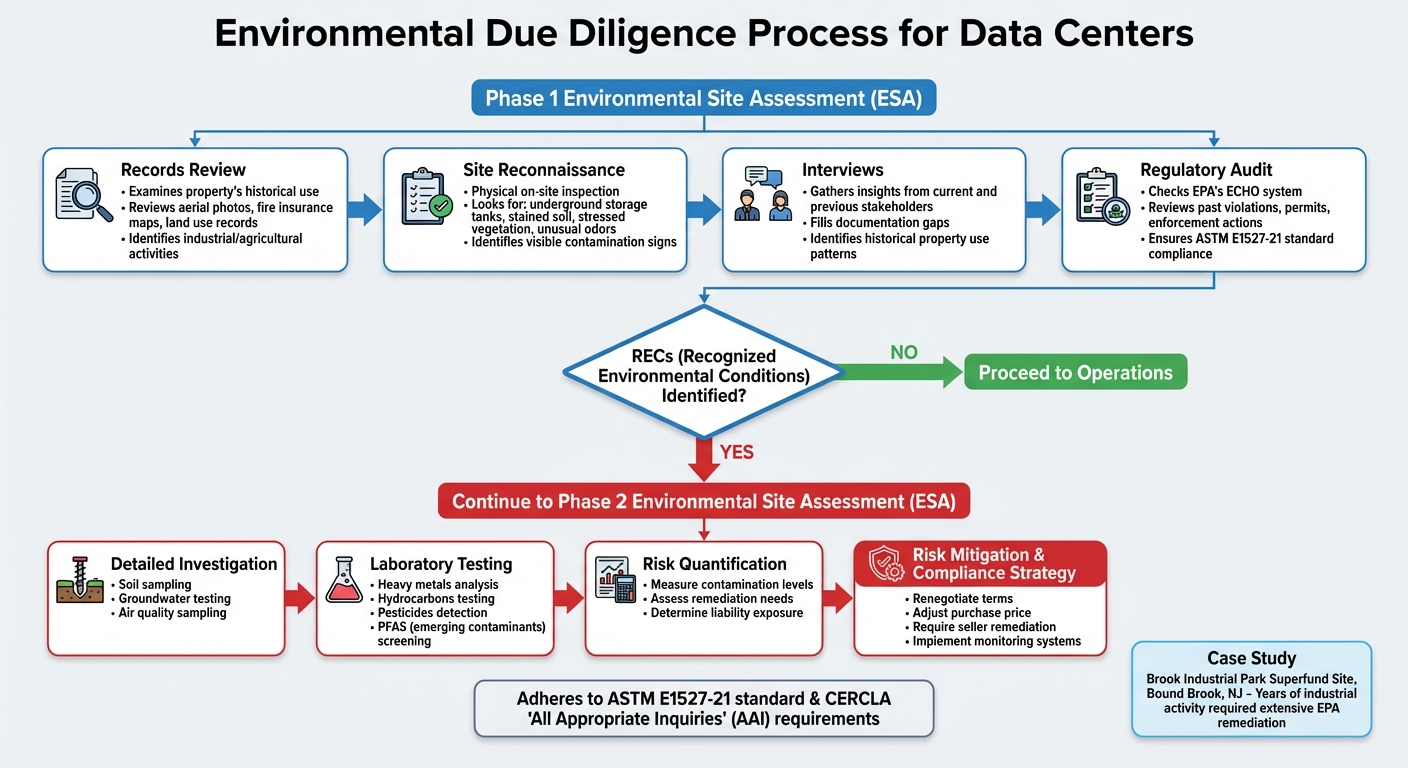
Environmental Due Diligence Process for Data Centers: Phase 1 and Phase 2 ESA Steps
The environmental due diligence process is designed to uncover potential risks early on, ensuring safety and compliance with regulations. For data centers, this process follows a systematic approach, starting with a Phase 1 Environmental Site Assessment (ESA), often managed through integrated real estate platforms. This initial step is a non-intrusive review of a property’s history, relying on sources like aerial photos, fire insurance maps, and land use records to identify any industrial or agricultural activities that might have caused contamination [1].
"Phase 1 ESAs are non-intrusive reviews conducted by an environmental professional designed to identify and assess the potential for contamination to be present." - Jeannine T. Bishop, Partner, Morgan Lewis [6]
The review also includes an on-site inspection where professionals look for warning signs such as underground storage tanks, stained soil, stressed vegetation, or unusual odors. Interviews with current and previous property stakeholders further help identify Recognized Environmental Conditions (RECs) - evidence suggesting the possible presence of hazardous substances. These assessments adhere to the ASTM E1527-21 standard, meeting the "All Appropriate Inquiries" (AAI) requirements under CERCLA, which can protect landowners from liability if contamination is discovered [1].
Phase 1 Environmental Site Assessment (ESA)
A Phase 1 ESA involves four key components that together provide a comprehensive view of potential environmental risks:
- Records Review: Examines the property’s historical use.
- Site Reconnaissance: Includes a physical inspection to identify potential contamination signs.
- Interviews: Gathers insights from people familiar with the property’s history to fill in gaps left by documentation.
- Regulatory Audit: Checks databases like the EPA’s ECHO system for past violations, permits, or enforcement actions [1].
An example of the importance of this process is the Brook Industrial Park Superfund Site in Bound Brook, New Jersey. Years of industrial activity left the area with significant soil and groundwater contamination, requiring extensive EPA remediation efforts [1]. If a Phase 1 ESA uncovers RECs, a Phase 2 ESA is initiated. This step involves detailed investigations, such as soil, groundwater, or air sampling, to measure contamination levels. Laboratory testing may focus on heavy metals, hydrocarbons, pesticides, or emerging contaminants like PFAS [1].
Risk Assessment for Data Centers
Data centers face specific environmental challenges that differ from those of other commercial properties. For example, cooling systems in large facilities - especially those supporting AI workloads - can consume millions of gallons of water daily. This makes it critical to assess local water availability and infrastructure capacity [4]. As cooling technologies evolve, with a shift toward liquid or immersion cooling, water use assessments gain even more importance.
Other risks include evaluating exposure to flood zones, wetlands, and extreme weather. Backup generators, necessary for uninterrupted operations, can introduce additional challenges. These generators may affect air quality due to emissions during tests or emergencies, and their noise can provoke opposition in suburban areas [2]. For instance, in 2024, Hilcorp Energy Company faced $1.275 million in EPA penalties for Clean Air Act violations and had to invest $1.65 million in compliance measures [1]. Identifying such risks is a critical step before obtaining the necessary permits.
Regulatory Compliance and Permits
Obtaining the right permits is a crucial part of ensuring smooth data center operations. For instance, air quality permits are essential for both primary and backup power systems due to their emissions. Similarly, water use permits confirm that cooling systems won’t exceed local infrastructure limits, especially in regions facing water scarcity. Land use compliance also comes into play, addressing requirements under laws like the Clean Water Act (Section 404), the Endangered Species Act, and the Migratory Bird Treaty Act. These laws ensure the protection of wetlands, special-status species, and historical or archaeological sites [1][2].
In France, by April 30, 2025, data centers with capacities over 1 MW must conduct cost-benefit analyses on heat recovery and are increasingly expected to redistribute excess heat to public heating networks [2]. Additionally, verifying third-party certifications, such as SOC 1, SOC 2, ISO 27001, and NIST frameworks, is a standard practice for ensuring operational security and integrity during the due diligence process [2].
Environmental Factors Affecting Data Center Operations
Environmental factors play a huge role in determining how data centers operate, from permitting processes to costs and long-term feasibility. Elements like air quality, water resources, and site-specific conditions can influence everything from regulatory approvals to operational expenses. Addressing these factors during the planning stages can save time, money, and potential headaches down the road.
Air Quality Regulations and Permits
Air quality regulations, particularly under the Clean Air Act, have a significant impact on data centers, especially those with large fleets of backup generators. When emissions from these generators hit major-source thresholds, facilities often need to secure Title V permits, which come with strict oversight.
The location of the facility also matters:
- In nonattainment areas (regions failing to meet National Ambient Air Quality Standards), operators must implement the Lowest Achievable Emission Rate (LAER) and often purchase emission offsets.
- In attainment areas, the requirements are less demanding, typically requiring Best Available Control Technology (BACT).
Regulators are increasingly treating large backup generator systems as traditional power sources rather than emergency-only equipment. This shift introduces more stringent requirements, like dispersion modeling and health risk assessments. For example, in Quincy, Washington, a health study revealed that local data centers accounted for about 12% of the city’s allowable diesel particulate emissions [7]. To stay compliant, operators should carefully schedule generator testing to avoid times when nitrogen oxide (NOx) levels or ozone conditions peak [7].
| Regulatory Factor | Attainment Areas | Nonattainment Areas |
|---|---|---|
| Standard | Best Available Control Technology (BACT) | Lowest Achievable Emission Rate (LAER) |
| Modeling | Standard dispersion modeling | More rigorous health-risk assessments |
| Offset Obligations | Not usually required | Often mandatory |
| Permit Complexity | Moderate | High (Title V level complexity) |
As the industry moves toward cleaner alternatives, operators are exploring options like battery energy storage systems (BESS), hydrogen-ready fuel cells, and natural gas turbines to replace traditional diesel generators. For facilities using natural gas for backup or primary power, compliance with the EPA’s Greenhouse Gas Reporting Program (40 CFR Part 98) becomes essential [7].
Water Consumption and Cooling Systems
Water use is another major challenge for data centers, particularly as AI workloads drive up heat production. Cooling systems can consume millions of gallons of water daily [4], with cooling alone accounting for nearly 40% of a facility’s total energy use [7]. This makes efficient water management critical for both environmental and financial reasons.
Regulations are evolving to encourage the use of reclaimed or non-potable water and enforce "basin-neutrality", ensuring that water use doesn’t strain local supplies. Operators must also submit drought contingency plans and meet Water Usage Effectiveness (WUE) benchmarks. Public reporting of WUE, alongside Power Use Effectiveness (PUE), is becoming more common [7]. Additionally, cooling tower blowdown requires industrial wastewater permits, and new rules mandate disclosure of PFAS in immersion cooling fluids [7].
Different cooling methods have unique environmental trade-offs:
- Liquid and immersion cooling: Highly efficient for high-density workloads but require specialized fluids and management.
- Evaporative cooling: Moderately efficient but demands significant water, making it unsuitable for water-stressed areas.
- Closed-loop liquid systems: Reduce water waste but involve higher upfront costs [4].
Operators must closely monitor WUE and work with third-party auditors to ensure compliance with local water management standards [7].
Flood Zones, Wetlands, and Site Constraints
Site-specific environmental constraints, like flood zones and wetlands, can create significant challenges for data center development. Addressing these issues early in the planning process helps avoid delays and unexpected costs. For instance, wetlands are subject to strict protections under Section 404 of the Clean Water Act, and these rules apply not just to the building site but also to access roads and other project-related areas [2].
Tools like GIS mapping help identify flood risks and delineate wetlands [1]. Beyond wetlands, developers must also consider the presence of special-status species protected by laws like the Endangered Species Act and the Migratory Bird Treaty Act [2][3]. Facilities in disaster-prone areas face additional risks from severe weather, threatening both operations and investment value [4].
Environmental reviews often involve public input, and community groups are increasingly vocal about the ecological impact of new developments [2][3]. Transparency about environmental, social, and governance (ESG) priorities can foster trust, with 52% of consumers stating they trust companies more when they disclose their ESG goals [1]. Conducting studies for wetlands jurisdiction and protected species early on allows developers to plan for necessary mitigation measures before construction begins [3].
Managing Environmental Risks in Data Centers
After identifying environmental risks, the next step is implementing strategies to mitigate them while maintaining operational compliance. This process transforms risk data into actionable strategies, completing the due diligence cycle.
Energy-Efficient Design and Renewable Energy
Incorporating energy efficiency from the outset helps reduce costs and environmental impact. Standards like ASHRAE 90.4 and ISO 50001 provide benchmarks for both technical performance and financial goals. For example, optimizing cooling systems can significantly lower Power Usage Effectiveness (PUE), directly reducing energy expenses.
Renewable energy is no longer optional - it’s becoming a key element of data center operations. Many operators are blending on-site generation methods like solar panels, wind turbines, or geothermal systems with off-site solutions such as Power Purchase Agreements (PPAs) and Renewable Energy Certificates (RECs) to achieve carbon neutrality. Hybrid setups that include battery storage and microgrids ensure consistent uptime, even with renewable energy’s inherent variability.
Heat recovery is also gaining traction, both as a sustainability measure and in response to regulatory requirements. In France, for instance, data centers exceeding 1 MW capacity must conduct a cost-benefit analysis for heat recovery and redistribute waste heat to municipal heating networks by April 30, 2025 [2]. This approach turns waste into a resource for local communities. Lifecycle Assessment (LCA) software can help track environmental impacts across a product’s lifecycle, pinpointing areas for design improvements.
"Sustainability should strengthen - not slow - your growth." - Data Center Energy [8]
It’s wise to go beyond minimum standards now to avoid costly retrofits later. As regulations around refrigerants and carbon emissions tighten, future-proofing your design ensures compliance down the line. Since Scope 3 emissions often account for 70% to 90% of a company’s total carbon footprint [5], working closely with suppliers to gather precise activity data - rather than relying on general estimates - can improve reporting accuracy and uncover real opportunities for reductions.
Monitoring and Compliance Reporting
Real-time tracking of environmental performance is essential for operational transparency. Automated systems that monitor energy use, emissions, and renewable energy contributions can keep you audit-ready and help you respond swiftly to regulatory demands. For example, in France, data centers with power consumption exceeding 500 kW must already provide energy data through dedicated digital platforms [2].
Adopting standards like ISO 50001 and ISO 14001 allows you to set measurable improvement goals. Integrating these systems into design modeling enables you to simulate power loads and cooling needs before construction begins, helping to identify compliance thresholds early and avoid unexpected costs.
For real estate professionals managing multiple data centers, platforms like CoreCast (https://corecastre.com) simplify environmental tracking. CoreCast isn’t just about property management - it provides tools for portfolio analysis, pipeline tracking, and creating branded reports for stakeholders. This makes it particularly effective for monitoring compliance metrics across facilities and presenting performance data to investors and regulators.
"The companies getting this right aren't spending more money. They're spending it smarter, building systems that collect data once and use it for multiple purposes." - Dcycle Team [5]
Compliance across different jurisdictions requires tailored approaches. For instance, the EU’s Energy Efficiency Directive (EED) has different requirements compared to U.S. utility codes. Coordinating documentation for air permits (especially for backup generators), wetlands jurisdiction, and species protection alongside engineering workflows ensures projects move forward without delays.
Clear and accurate reporting not only ensures compliance but also builds a foundation for strong stakeholder communication.
Stakeholder Communication and Transparency
Proactive communication with stakeholders fosters trust and reinforces confidence. For data centers, this involves engaging with local communities, regulators, and investors early in the process.
Community engagement should start during the acquisition and development phases, not after plans are finalized. Local concerns often focus on noise, energy use, and air quality [2][4]. Conducting thorough Phase 1 and Phase 2 Environmental Site Assessments (ESAs) can provide factual answers to these concerns and demonstrate due diligence. Including opportunities for public participation in environmental reviews not only meets regulatory requirements but also builds community support [3].
"Compliance has evolved into the foundation of trust, and the companies that lead in transparency are the ones shaping the next generation of digital infrastructure." - Data Center Energy [8]
Third-party certifications can validate sustainability claims and even influence financing terms, as ESG-linked financing becomes more common. Align internal reporting with frameworks like the GHG Protocol, Science-Based Targets initiative (SBTi), and the Task Force on Climate-Related Financial Disclosures (TCFD) to ensure consistency and credibility.
When sharing sensitive documents like environmental audits and compliance records, Virtual Data Rooms (VDRs) provide secure, organized access for authorized stakeholders [1]. Highlighting community benefits in regulatory submissions - such as contributing to local sustainability goals or supplying waste heat for public heating networks - can further strengthen your position [2][8]. Building partnerships with educational institutions to develop local talent not only addresses workforce challenges but also deepens community connections [4].
Conclusion
Environmental due diligence goes beyond just checking regulatory boxes - it’s a crucial step in protecting your investments and operations. By uncovering hidden risks like potential cleanup costs, ensuring compliance with ever-changing regulations, and earning stakeholder trust, it helps minimize liabilities while preparing your business for the future.
For data centers, the stakes are particularly high. These facilities often face challenges like high water usage, emissions from backup generators, and their impact on local communities. Identifying issues such as contamination, permit lapses, or zoning conflicts early in the process can be a game-changer. It gives buyers the chance to renegotiate terms, adjust purchase prices, or even require sellers to address problems before the deal closes [1].
Regulations are evolving quickly. From adjustments in power rate structures in Georgia to mandatory heat recovery analyses in France, staying compliant is becoming increasingly complex [2][4]. Meeting these demands requires more than occasional audits - it calls for integrated tools that monitor compliance metrics, manage documentation, and offer real-time insights across your entire portfolio.
For asset managers overseeing multiple properties, having centralized and efficient systems is essential. Tools like CoreCast (https://corecastre.com) simplify environmental tracking, portfolio analysis, and reporting, making it easier to manage compliance while strengthening your infrastructure. By prioritizing environmental due diligence from the beginning, you can avoid costly penalties and build data centers that are ready to adapt to future challenges.
FAQs
How long do Phase 1 and Phase 2 ESAs usually take?
Phase 1 Environmental Site Assessments (ESAs) typically take anywhere from a few weeks to a few months to complete. On the other hand, Phase 2 ESAs can take several months, depending on the extent of testing and the depth of the investigation required. The exact timeline often depends on the complexity of the project and any specific conditions or requirements involved.
What environmental issues most often delay data center permits?
When it comes to data center construction, environmental concerns often slow down the permitting process. Key issues typically include:
- Air Quality: Authorities may raise concerns about emissions from backup generators or other equipment, requiring studies to ensure compliance with local air quality standards.
- Noise: Data centers can generate significant noise from cooling systems and generators. Noise mitigation plans are often necessary to address these concerns.
- Traffic: Increased vehicle traffic during construction and operation can be a sticking point. Traffic impact assessments may be required to evaluate and minimize disruptions.
- Regulatory Compliance: Navigating environmental regulations often involves detailed site studies and mitigation strategies to address potential impacts, ensuring the project meets all legal requirements.
These factors usually require thorough analysis and planning to satisfy regulatory bodies before permits are approved.
How can a buyer reduce CERCLA liability when buying a site?
Buyers can limit their exposure to CERCLA liability by performing detailed environmental due diligence before making a purchase. This process helps uncover potential contamination and related risks. Key actions include establishing confidentiality agreements to outline the scope of the investigation, utilizing CERCLA liability exemptions, and seeking advice from legal and environmental professionals. By combining careful due diligence, well-structured agreements, and expert input, buyers can reduce risks and maintain compliance throughout the acquisition process.