
Energy Star Certification Trends in Commercial Real Estate

Energy Star certification is reshaping commercial real estate by cutting energy costs, reducing emissions, and driving market premiums. With over 43,000 certified buildings and growing regulatory requirements, it’s now a key tool for compliance and market advantage.
Here’s why it matters:
- Certified buildings use 35% less energy, emit 35% fewer greenhouse gases, and save $0.50/sq ft annually.
- They achieve 3%–16% rental premiums, 1%–31% sale price premiums, and up to 10% higher occupancy rates.
- Regulations like NYC’s Local Law 97 and Colorado’s HB 21-1286 enforce emissions limits with steep penalties, making certification essential for avoiding fines.
- Investors and tenants increasingly demand certified spaces to meet ESG goals, driving higher demand and better financing terms.
What’s new in 2026?
- Stricter Building Performance Standards are expanding to more jurisdictions.
- The EPA’s "NextGen" certification adds renewable energy and emissions targets.
- Tools like CoreCast simplify compliance, benchmark real estate portfolios effectively, and ensure certification readiness.
Energy Star certification isn’t just a label - it’s now a necessity for cost savings, compliance, and staying competitive in a sustainability-focused market.
Energy Star Certification Adoption Over Time
Certification Growth Since 1992
The Energy Star program began in 1992, but it wasn’t until 1999 that the first commercial building earned certification [6]. From that point, adoption skyrocketed. To date, over 43,000 commercial buildings have been certified, representing more than 6.5 billion square feet of space [4]. Additionally, approximately 330,000 buildings now use the Portfolio Manager tool to monitor energy, water, and waste - accounting for about 25% of all U.S. commercial building space [11,12].
Initially a voluntary initiative, Energy Star has since become a cornerstone for meeting benchmarking regulations. Currently, seven states and 48 local governments mandate energy benchmarking through Energy Star tools [11,12]. Major cities like New York, San Francisco, and Boston have incorporated it into their disclosure laws, making certification a practical requirement for high-end properties. The program broadened its scope in 2006 to include industrial plants, with nearly 275 facilities certified so far, resulting in energy cost savings exceeding $8.5 billion [4].
Since its inception, the program has delivered substantial benefits, helping businesses avoid nearly $200 billion in energy costs and reducing 2.7 billion metric tons of emissions [4]. Additionally, the EPA’s free Portfolio Manager tool has become the go-to system for the industry - offering functionality that would otherwise cost tens of thousands of dollars to replicate privately [5]. These achievements laid the groundwork for early adopters to gain a competitive edge through operational and financial efficiencies.
How Early Adopters Benefited
Early adopters of Energy Star certification gained a significant head start, benefiting from both financial and operational advantages. Certified properties have consistently outperformed their non-certified peers in the market, commanding rental premiums of 3% to 16% and sale price premiums ranging from 1% to 31% [11,14]. In high-demand markets like New York City and Washington, D.C., rental premiums for certified buildings range from 3–7%, while sale price premiums fall between 5–10%. Even in less competitive regions, certified properties still achieve 1–3% premiums [5].
Beyond market premiums, these properties enjoy lower operating costs - spending $0.50 less per square foot annually [7]. For every dollar invested in Energy Star improvements, businesses see a return of four dollars in savings [5]. Certified buildings also benefit from better financing options, with interest rates that are typically 30–35 basis points lower than those for non-certified properties [7]. Multifamily borrowers with Energy Star certifications experienced 60% lower delinquency rates in 2023 compared to their non-certified counterparts [5]. Furthermore, federal agencies, following Executive Order 13514, are required to lease only Energy Star-certified spaces, providing a steady tenant base that early adopters were quick to secure [12,14].
sbb-itb-99d029f
ENERGY STAR® NextGen™ Webinar - Healthy Building Webinar Series
Benefits of Energy Star Certification
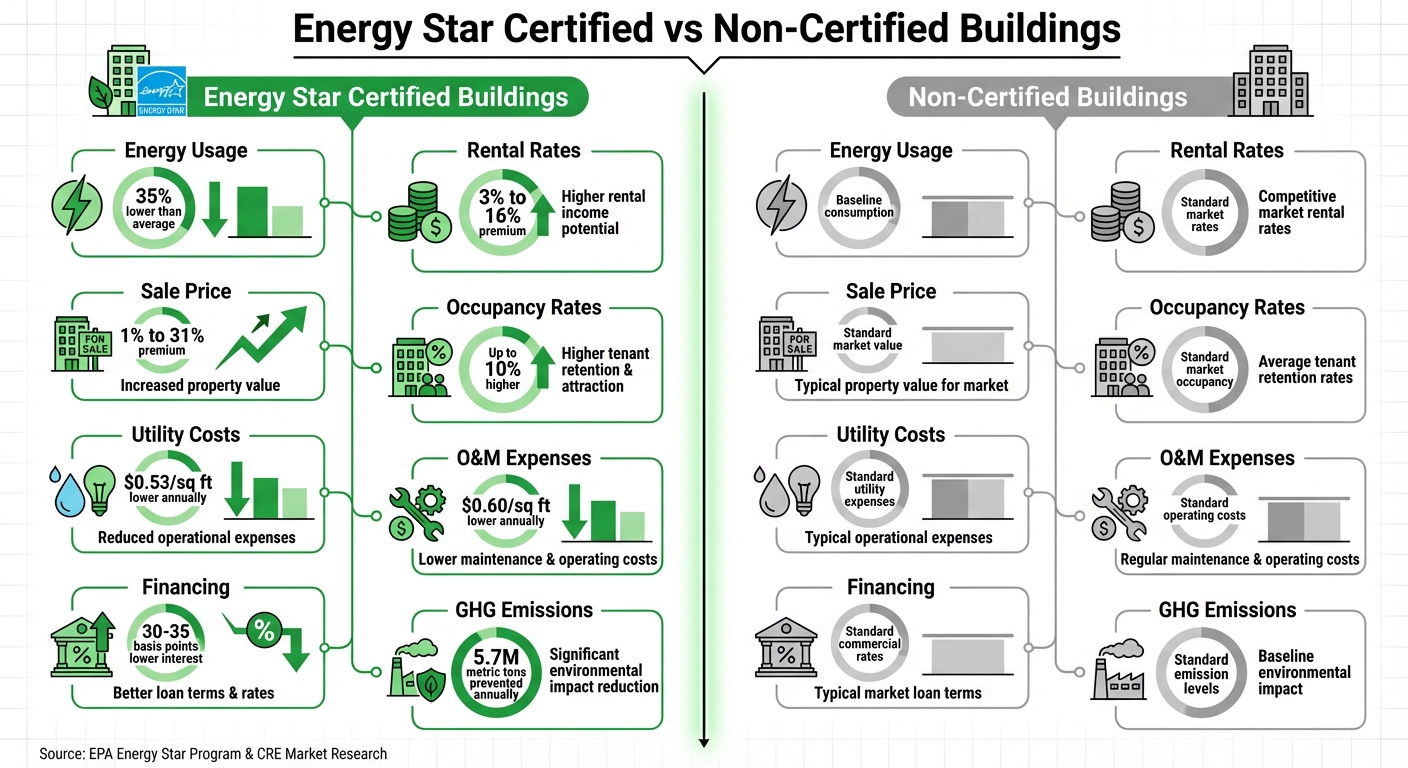
Energy Star Certified vs Non-Certified Buildings: Financial and Environmental Performance Comparison
Financial Benefits
Energy Star certification offers notable financial perks for building owners and operators. Certified buildings can save $0.53 per square foot annually on utility costs, along with $0.60 per square foot on operations and maintenance and $0.50 per square foot on janitorial expenses [8].
These cost savings extend to property value. Energy Star-certified buildings often achieve rental premiums of 3% to 16% and sale price premiums of 1% to 31% compared to non-certified properties [8]. Lenders also see these buildings as lower-risk investments, offering loans with interest rates that are 30 to 35 basis points lower than standard commercial rates [8]. Additionally, certified properties enjoy occupancy rates up to 10% higher, which helps minimize vacancy risks and ensures steadier cash flow [8]. Owners can further refine these projections by using scenario analysis for real estate portfolios to model different market conditions.
While the financial advantages are compelling, the certification also brings broader environmental and social benefits.
Environmental and Social Benefits
Energy Star-certified buildings are designed to operate more efficiently, using 35% less energy on average than typical buildings across the country [4]. This reduction in energy use has a significant environmental impact. In just one year, certified commercial buildings helped prevent over 5.7 million metric tons of greenhouse gas emissions [4]. Since the program began in 1992, it has contributed to avoiding nearly 2.7 billion metric tons of emissions [4].
The certification also aids in sustainability efforts. Tools like the Portfolio Manager enable buildings to track real estate portfolio performance across energy, water usage, waste, and materials - essential for meeting corporate climate goals and ESG (Environmental, Social, and Governance) reporting requirements [4]. With 98% of S&P 500 companies now publishing sustainability reports and two-thirds of Fortune 500 companies setting climate targets, Energy Star certification provides the data transparency that both investors and tenants now expect [8].
The impact of certification becomes even clearer when comparing certified and non-certified buildings.
Certified vs. Non-Certified Buildings
| Metric | Energy Star Certified Buildings | Non-Certified Buildings |
|---|---|---|
| Energy Usage | 35% lower than average [4] | Baseline consumption |
| Rental Rates | 3% to 16% premium [8] | Standard market rates |
| Sale Price | 1% to 31% premium [8] | Standard market value |
| Occupancy Rates | Up to 10% higher [8] | Standard market occupancy |
| Utility Costs | $0.53/sq ft lower annually [8] | Standard utility expenses |
| O&M Expenses | $0.60/sq ft lower annually [8] | Standard operating costs |
| Financing | 30–35 basis points lower interest [8] | Standard commercial rates |
| GHG Emissions | 5.7M metric tons prevented annually [4] | Standard emission levels |
2026 Certification Trends and What's Driving Them
New Regulations Driving Certification
Across the U.S., over 40 cities and multiple states are enforcing stricter energy and emissions regulations under "report and improve" policies. These rules come with hefty financial penalties for non-compliance, pushing building owners to prioritize energy efficiency [1][11].
A prime example is New York City's Local Law 97, which takes effect on May 1, 2025. This law requires buildings over 25,000 square feet to submit compliance reports. The stakes are high: one 2.3 million-square-foot office building in NYC faced more than $50,000 in annual penalties based on its 2019 emissions. By 2030, the fines for failing to improve will be even harsher [1]. Similarly, Seattle's Building Energy Performance Standards, set to roll out in 2026, will impose $10 per square foot annually on non-compliant properties [11].
"The era of voluntary energy efficiency is ending. Across the United States, cities and states are implementing building performance standards that mandate emissions reductions with substantial financial penalties for non-compliance." - CRE Insight Journal [1]
Adding to this, many jurisdictions are lowering the square footage threshold for mandatory reporting in 2026. This shift will include smaller commercial properties, requiring thousands more buildings to benchmark their energy use and possibly certify to avoid penalties [9][10].
Tenant and Investor Demand for Sustainable Buildings
Regulations aren't the only factor driving the move toward certified buildings - market forces are playing a big role too. Buyers are already lowering property values to account for potential fines and the costs of necessary retrofits under Building Performance Standards [1]. Energy Star certification has become a go-to strategy for mitigating regulatory risks, as buildings with high Energy Star scores are better equipped to meet emissions limits.
"Asset values are already being affected as buyers discount prices to account for potential fines." - CRE Insight Journal [1]
Institutional investors are also fueling this trend. As capital flows into secondary markets like Nashville, Charlotte, and Denver, national sustainability standards are raising demand for certified spaces in these areas [5]. Tenants, especially Fortune 500 companies and tech firms, are actively seeking Energy Star-certified buildings to align with their corporate ESG goals. In fact, nearly 40% of Fortune 500 companies now collaborate with the EPA through the Energy Star program [5].
Even financial institutions are taking note. In 2023, multifamily properties with Energy Star certifications showed delinquency rates 60% lower than their non-certified counterparts [5]. This translates into better financing terms and more stable cash flows for building owners.
Energy Star vs. Other Certifications
Among various certifications, Energy Star stands out for its clear focus on energy performance. Unlike LEED, which evaluates a broad range of sustainability factors like materials and indoor air quality, Energy Star zeroes in on actual energy usage, using a 1-100 percentile ranking based on 12 months of utility data [12]. Meanwhile, GRESB operates at a portfolio level, focusing on ESG reporting rather than certifying individual buildings [12].
Energy Star has become the backbone of compliance for most U.S. Building Performance Standards, with over 50 jurisdictions requiring its Portfolio Manager tool [12][5]. LEED and GRESB, on the other hand, remain voluntary options that serve as market differentiators rather than regulatory necessities.
| Metric | Energy Star | LEED | GRESB |
|---|---|---|---|
| Primary Focus | Operational Energy Performance [12] | Broad Sustainability (Design & Ops) [12] | Portfolio-level ESG Reporting [12] |
| Scoring Method | 1-100 percentile ranking [12] | Points-based (Certified, Silver, Gold, Platinum) [5] | Peer-based quintile ranking [12] |
| Data Requirement | 12 months of actual utility data [12] | Design specs + optional performance data [12] | Portfolio-wide management & asset data [13] |
| Regulatory Use | Foundation for most U.S. BPS laws [1] | Voluntary market differentiation [5] | Investor-driven disclosure [12] |
| Market Premium | 3-7% Rent Premium [12] | ~4% Rent Premium [5] | N/A (Portfolio level) |
Looking ahead, the EPA's upcoming "Energy Star NextGen" program in 2026 will add greenhouse gas reduction and renewable energy metrics to its existing efficiency framework [5]. This update positions Energy Star NextGen as both a compliance tool and a competitive advantage in an increasingly sustainability-focused market.
How to Get Energy Star Certified
Eligibility and Benchmarking Requirements
Before you apply for Energy Star certification, your building needs to meet three main criteria: over 50% of its gross floor area (excluding parking) must be an eligible property type, no more than 25% of the space can be ineligible, and the total parking area cannot exceed the building's gross floor area [14].
The size requirements depend on the property type. For most buildings, the minimum size is 5,000 square feet. However, offices, banks, and K–12 schools can qualify with just 1,000 square feet. Hospitals need at least 20,000 square feet and must have one staffed bed, while multifamily housing requires a minimum of 20 units. Additionally, most properties must operate at least 30 hours per week with at least one worker on-site during the primary shift [14].
Benchmarking begins with the EPA's free Portfolio Manager tool. You’ll need to input 12 consecutive months of energy data for all fuel types - electricity, gas, oil, steam, and others. The tool also collects property-specific details like square footage, operating hours, number of workers, and local climate data. Using this information, it generates your Energy Star score, ranging from 1 to 100. A score of 50 reflects median energy performance, while a score of 75 or higher places your building in the top 25% [24, 31, 27].
Once your building meets these benchmarks, you're ready to move on to the verification process.
Verification and Certification Steps
If your building scores 75 or higher, you can generate your application directly through Portfolio Manager. A licensed Professional Engineer (PE) or Registered Architect (RA) must verify the application during a site visit. They’ll confirm the accuracy of your property’s use details (like square footage), energy data, and adherence to indoor environment standards [26, 27].
The verification process typically costs around $1,500 for an average-sized building. Some organizations cut costs by using their own in-house licensed PE or RA, as long as they follow the official verification guidelines. You can also find qualified verifiers through the Energy Star online directory [15].
Once the application is verified and stamped, submit it to the EPA for annual certification. Starting in January 2026, there will be an 11-month waiting period between certifications, whether you’re applying for traditional or NextGen certification [27, 30]. Following these steps not only secures your certification but also helps improve energy efficiency and boosts your building’s market appeal.
Case Studies: Large Portfolios with Energy Star Certification
Portfolio-Wide Certification Approaches
Some of the biggest names in real estate are making waves by certifying hundreds of buildings at a time. Take Cushman & Wakefield, for example. They certified 289 buildings by creating an Energy & Sustainability Services team. This team provided weekly office hours and a centralized help desk, which helped ensure accurate data in Portfolio Manager and made the annual recertification process much smoother [17].
CBRE took a slightly different route, prioritizing employee education. They trained over 3,300 employees through the BOMA Energy Efficiency Program and even launched a "Climate Champion Award." This award celebrated 24 teams that improved their Energy Star scores by at least 10% in just one year, covering a portfolio of 173 certified properties [19].
Vornado Realty Trust went all in by benchmarking 100% of its assets using Portfolio Manager. They also invested $1.6 million in energy efficiency projects, expecting to save 500,000 kWh and $600,000 annually. On top of that, they actively worked with tenants to encourage energy-conscious behaviors that aligned with their broader sustainability goals [18].
These varied strategies highlight how different approaches can lead to measurable improvements across large portfolios.
Results and Performance Metrics
The results of these efforts speak for themselves. CBRE saw an 11% drop in weather-normalized source energy use intensity across its U.S. portfolio between 2021 and 2022 [19]. Cushman & Wakefield also made significant strides - 59 energy audits conducted in 2023 led to an average of 19% energy savings per building, helping them achieve a 33% reduction in greenhouse gas emissions compared to their 2019 baseline [17].
Empire State Realty Trust took things to a whole new level by earning the Energy Star NextGen certification in October 2025 for iconic properties like the Empire State Building and One Grand Central Place. Their energy upgrades cut energy use by 51% at the Empire State Building and by 41% across their entire commercial portfolio [20]. This achievement underscores how energy certifications can provide a competitive edge, from regulatory compliance to attracting tenants. Dana Robbins Schneider, Senior Vice President and Director of Energy and Sustainability at Empire State Realty Trust, summed it up perfectly:
"This NextGen certification recognizes our superior building performance which allows us to attract high-quality tenants who commit to energy reduction and subsequent cost savings" [20].
These numbers and achievements clearly show how portfolio-wide certification strategies are not just about meeting goals - they’re shaping the future of commercial real estate by aligning with market demands and regulatory shifts.
What's Next for Energy Star Certification and How CoreCast Helps
Expected Growth in Energy Star Certification
Across the U.S., new Building Performance Standards (BPS) are pushing Energy Star certification into the spotlight. Over 30 jurisdictions have already adopted or are working on BPS regulations that enforce emissions reductions, often backed by costly penalties for non-compliance [1]. For instance, New York City is projected to see significant non-compliance, with steep annual fines for buildings that fail to meet these standards [1].
Energy Star Portfolio Manager has become a cornerstone for most municipal and state energy benchmarking policies [1]. What was once a marketing tool has now evolved into a necessity for regulatory compliance, avoiding penalties, and protecting assets. As CRE Insight Journal puts it:
"ENERGY STAR certification isn't just about a label anymore. It's about regulatory compliance, penalty avoidance, and asset protection in an environment where building performance is becoming mandatory rather than voluntary." - CRE Insight Journal [1]
Looking ahead, Energy Star NextGen certification for 2025/2026 will introduce stricter requirements. Buildings will need a score of 75 or higher, meet specific direct greenhouse gas emissions intensity targets, and use at least 30% renewable energy [16]. Regulations are also shifting from focusing solely on total energy use to addressing direct emissions, such as on-site natural gas combustion for heating and cooking. This makes electrification and renewable energy adoption key priorities for the future [16]. As these changes take hold, platforms like CoreCast will be essential for maintaining compliance and optimizing performance.
Managing Certification and ESG Reporting with CoreCast
With these evolving regulations, having access to real-time data is more important than ever. CoreCast transforms Energy Star certification from a static achievement into a dynamic process for improving building performance. By offering equipment-level insights, CoreCast helps identify inefficiencies, such as equipment running during unoccupied hours or outdated HVAC and lighting systems. These inefficiencies typically account for about 30% of energy waste in commercial buildings [12]. Unlike traditional methods that rely on utility bill data with a 30–60 day delay, CoreCast provides real-time Energy Star score monitoring. This allows facility managers to address performance issues immediately, ensuring buildings remain eligible for certification [12].
CoreCast also automates data uploads to Energy Star Portfolio Manager via API and consolidates reporting for frameworks like GRESB and CDP. This eliminates manual data errors, which can cost $1–$3 per square foot annually, while ensuring compliance with mandates like NYC’s Local Law 97 and Boston's BERDO [12][13]. By integrating certification tracking, portfolio analysis, and ESG reporting into one platform, CoreCast gives real estate professionals a streamlined way to meet mandatory building performance standards.
For buildings scoring around 65 or higher, CoreCast pinpoints minimal capital projects to help them quickly reach certification thresholds [13]. The platform also simplifies the certification process by providing documentation and audit trails required for Professional Engineer (PE) or Registered Architect (RA) verification. This reduces staffing needs from one full-time equivalent (FTE) per 20–30 buildings to as few as one FTE per 40–60 buildings when automated tools like CoreCast are used [13].
Conclusion
Key Takeaways
Energy Star certification has become a critical factor for success in commercial real estate. Certified buildings not only save on operating expenses and utility costs but also command higher asset values, with notable sale price and rental premiums compared to properties without certification [3][7].
This certification also helps navigate the shifting regulatory environment. With numerous U.S. cities and states introducing mandatory energy benchmarking and building performance standards, Energy Star certification serves as a key compliance tool. Buildings scoring 75 or higher often meet initial regulatory requirements without needing additional upgrades [2][13].
The environmental benefits further strengthen the case. Certified buildings consistently outperform their peers in energy efficiency and emissions reduction [7]. As 98% of S&P 500 companies now publish sustainability reports to meet investor demands, Energy Star certification provides the measurable performance data needed for ESG reporting [3]. The label itself holds significant influence - 92% of Americans recognize and trust it, making it the nation’s most reliable environmental mark [3].
With upcoming NextGen requirements focusing on renewable energy and emissions reduction, maintaining certification is essential for staying competitive. These insights highlight actionable strategies for real estate professionals to adopt immediately.
Next Steps for Real Estate Professionals
Start with "Quick Wins" by targeting buildings that score 65 or higher and require minimal investment to achieve certification [13]. This approach helps build early success and demonstrates the process's practicality before tackling more complex properties. For portfolios facing challenges with tenant utility data, consider adding utility data sharing clauses to lease agreements, a tactic already proven effective by leading portfolio managers [13].
Set up portfolio-wide management systems by creating Portfolio Manager accounts for all properties and using automated data collection via APIs. This eliminates manual data entry errors and streamlines operations [13]. With Energy Star NextGen certification introducing requirements like 30% renewable energy use and stricter emissions targets, integrated platforms like CoreCast are increasingly necessary. These tools simplify data tracking, manage renewable energy credits (RECs), and ensure compliance with evolving regulations [16]. Companies prioritizing certification now will secure competitive advantages, while those delaying risk facing tighter deadlines, increased costs, and diminished market standing [13].
FAQs
What Energy Star score is needed for certification?
To earn ENERGY STAR certification, commercial buildings need a score of 75 or higher. This score indicates how the building's energy performance stacks up against similar buildings across the country.
How does Energy Star certification help with Local Law 97 and other BPS rules?
Energy Star certification supports building owners in aligning with Local Law 97 (LL97) and other Building Performance Standards (BPS) by showcasing strong energy efficiency and reduced greenhouse gas emissions. Buildings with this certification typically meet required performance benchmarks, helping owners avoid penalties - such as $268 for every excess metric ton of CO2. Additionally, it encourages effective energy management practices, aiding compliance efforts and contributing to long-term goals as cities work toward achieving net-zero emissions.
What are the fastest upgrades to improve a building’s Energy Star score?
Upgrading a building's lighting systems is one of the fastest ways to improve its Energy Star score. This change not only delivers immediate results but also offers a quick return on investment. Another effective approach is focusing on HVAC systems. By fine-tuning and making targeted upgrades, you can achieve noticeable improvements in energy efficiency. Together, these steps can make a big impact on your building’s performance.