
How IoT Sensors Track Market Trends in Real Estate

IoT sensors are transforming real estate by providing real-time data on building performance, occupancy, and energy use. This technology helps property managers make smarter decisions, optimize spaces, and improve tenant experiences. Key benefits include:
- Occupancy Tracking: Sensors monitor how spaces are used, helping reduce wasted space and cut costs.
- Energy Management: Smart meters and sensors lower energy expenses by up to 30% and improve building efficiency.
- Air Quality Monitoring: Better air quality increases productivity by 11% and attracts high-value tenants.
- Predictive Maintenance: Sensors detect equipment issues early, allowing AI to forecast property maintenance costs and reduce repairs by 10–30%.
- Market Insights: Combining IoT data with AI reveals trends, predicts market shifts, and helps set competitive pricing. This data also enables AI-driven rental income projections for more accurate financial planning.
IoT adoption is no longer optional. Platforms like CoreCast integrate sensor data into dashboards and reports, making it easier to manage properties and stay ahead in a competitive market.
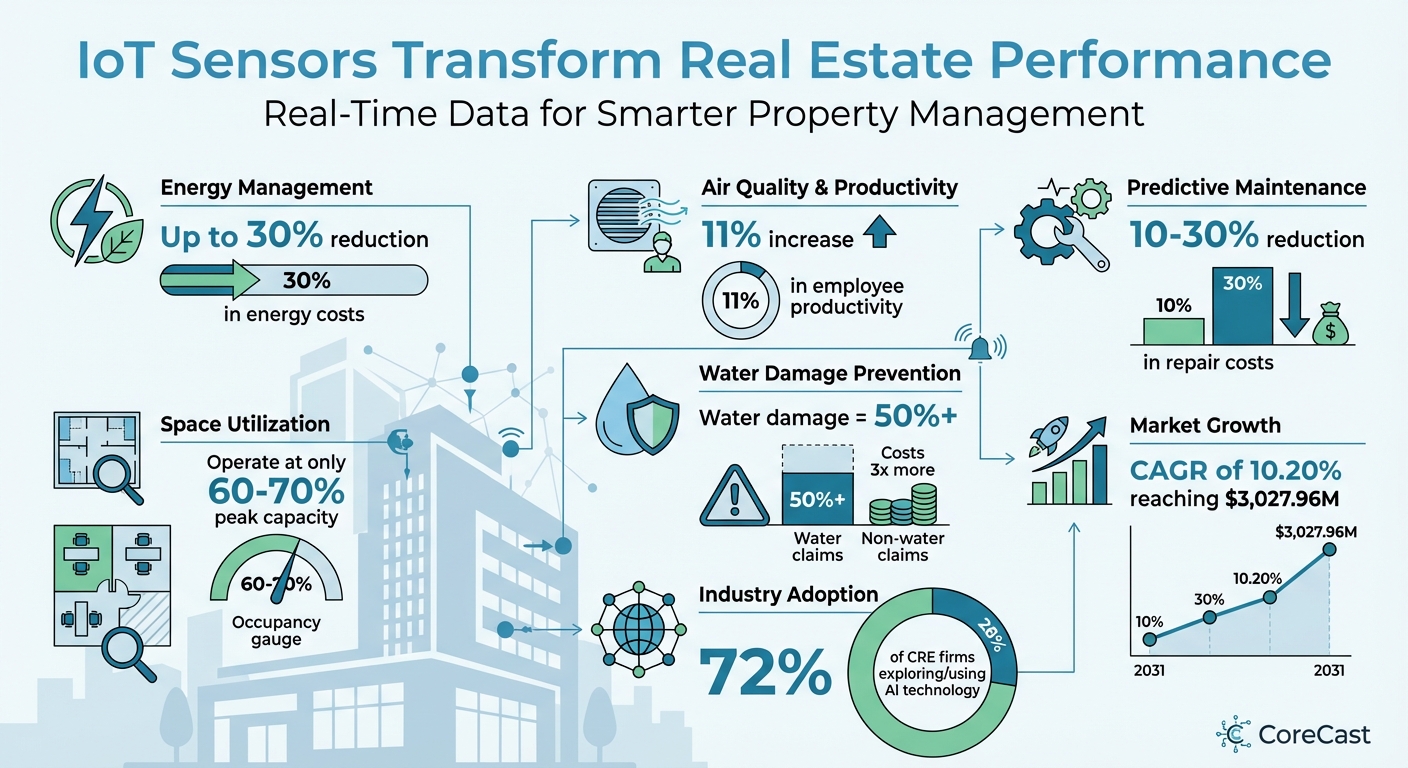
IoT Sensors in Real Estate: Key Benefits and Cost Savings
Transforming Building Monitoring: IoT & Sensors in Property Management - UpKeep
sbb-itb-99d029f
Types of IoT Sensors Used in Real Estate
Commercial real estate increasingly relies on different types of sensors to collect key performance data. These sensors help property managers make smarter decisions about space utilization, energy efficiency, and tenant comfort. By analyzing the real-time data these sensors provide, managers can better understand market trends and improve operations.
Occupancy and Space Utilization Sensors
These sensors reveal how people interact with and use spaces within a building. For example:
- Passive Infrared (PIR) sensors detect heat signatures, making them ideal for tracking occupancy in offices or meeting rooms.
- Ultrasonic sensors use sound waves to measure disruptions, even around obstacles, which works well in open-plan spaces.
- Optical sensors, like VuAI, use machine learning to achieve over 98% accuracy in occupancy detection [9].
- Bluetooth Low Energy (BLE) beacons and Wi‑Fi tracking systems monitor movement in shared spaces and amenities.
On average, buildings operate at only 60–70% peak capacity [10], leaving room for improving space usage. Marc Gittleman, Senior Executive Advisor at Rising Realty Partners, highlights the value of using technology for this purpose:
"Gittleman predicts that activating space with technology and analyzing group-level data will achieve greater value for an office property, spur innovative design solutions, contribute to employee satisfaction and serve to retain and attract tenants" [1].
These sensors also track dwell time (how long someone stays in a space), peak usage periods, and seasonal patterns. This information is critical for adapting to hybrid work trends and optimizing portfolios. Additionally, integrating occupancy data with HVAC systems can save 15–30% in energy costs within the first year [10]. Environmental conditions are also monitored to ensure spaces remain comfortable and healthy for tenants.
Environmental Sensors (Temperature, Humidity, Air Quality)
Environmental sensors focus on factors that affect tenant well-being and property value. These devices measure temperature, humidity, and indoor air quality (IAQ) by tracking CO₂, volatile organic compounds (VOCs), and particulate matter (PM2.5). For instance, CO₂ levels as low as 1,000 ppm can impair decision-making [6], while better air quality has been tied to an 11% boost in employee productivity [2].
A practical example comes from the Haworth Kerry Center furniture showroom in Shanghai. In December 2018, they used RESET™ certified sensors to monitor air quality, including VOCs, CO₂, and particulate matter, displaying the data in real-time to demonstrate compliance with global air standards. This approach not only validated their use of eco-friendly materials but also resonated with customers [1].
Similarly, Logicor implemented IoT sensors across its properties in April 2025, cutting CO₂ emissions by about 233 tons annually through optimized HVAC and lighting systems [8]. These sensors also support Environmental, Social, and Governance (ESG) reporting and certifications like WELL and RESET. With 52% of commercial real estate firms identifying IoT and AI as key to tenant preferences [5], real-time environmental monitoring has become a tool for attracting high-value tenants.
Energy and Resource Usage Sensors
Energy and resource sensors are vital for tracking consumption and preventing costly issues. Smart meters and submeters provide detailed insights into electricity, gas, and water use, while leak and flood detection sensors help prevent water damage, which accounts for over 50% of all commercial real estate insurance claims and costs three times more than non-water-related claims [6].
For example, Mortenson Properties saved $195,000 annually at its 280,000-square-foot headquarters by using Enertiv's IoT-enabled platform to optimize operations [6]. Smart building technologies can reduce energy costs by up to 30% [7], directly boosting Net Operating Income (NOI) and property value.
Other sensors, like vibration sensors and strain gauges, monitor infrastructure such as HVAC systems and elevators, predicting mechanical issues before they occur. Proactive maintenance can reduce costs by 10–30% [8]. As Comly Wilson, VP of Growth at Enertiv, puts it:
"Sustainability isn't getting funded anymore unless it pays for itself" [6].
Wireless moisture sensors in high-risk areas, like mechanical rooms and kitchens, further reduce insurance risks. Meanwhile, weather sensors on-site can adjust HVAC settings, saving about 1% in energy costs for every degree of temperature change. Together, these tools improve operational efficiency and help properties stand out in a competitive market.
How IoT Sensors Collect and Transmit Data
Understanding the way sensors gather and share information can help property managers make smarter, more informed decisions. The process typically involves three main steps: placing sensors where they can capture critical data, transmitting that data in real time, and turning raw information into actionable insights.
Deployment and Placement
The effectiveness of IoT sensors starts with proper placement, which depends on the type of data being collected. For example:
- Leak and flood sensors: Installed in mechanical rooms, tenant spaces, and near basement sump pumps.
- Temperature sensors: Positioned in electrical enclosures, server rooms, and HVAC systems.
- Air quality sensors: Placed in areas like conference rooms or other densely occupied spaces to monitor CO₂ and VOC levels.
- Occupancy sensors: Used at workstations, common areas, and conference rooms to track how spaces are being used in real time.
- Vibration sensors: Mounted directly on motors and mechanical equipment to monitor performance.
- Beacons: Found at entrances, retail aisles, and airport terminals to track movement and engagement.
To ensure smooth data collection and transmission, a strong network foundation is crucial. For example, dark fiber networks can provide reliable bandwidth control, supporting the continuous flow of data.
Once installed in their optimal locations, these sensors begin their job of capturing data around the clock.
Real-Time Data Capture and Transmission
After deployment, the next step is transmitting data quickly and reliably. Sensors use wireless technologies to send information in real time:
- Bluetooth Low Energy (BLE): Ideal for short-range needs, like wearables or indoor positioning.
- Wi-Fi: Handles high-bandwidth tasks, such as streaming video in office settings.
- Cellular networks (e.g., NB-IoT) and LoRaWAN: Designed for long-range communication with low power consumption, making them perfect for larger properties.
Data transmission relies on a layered communication model. Lightweight protocols like MQTT and CoAP are used for efficient communication, particularly in devices with limited resources. At the transport layer, TCP ensures reliable, connection-based data transfer, while UDP supports low-latency tasks that aren’t as critical. To secure this data, technologies like TLS (for TCP) and DTLS (for UDP) provide encryption, while IPSec adds another layer of security and authentication at the IP level.
Data Aggregation and Processing
Once collected, raw sensor data - whether it’s motion, temperature, or air quality readings - is sent to centralized databases or cloud platforms for processing. This involves filtering and calibrating the data before advanced machine learning systems take over to analyze it.
These systems can uncover patterns, detect anomalies, and even predict future needs. For instance, predictive algorithms can estimate maintenance requirements or occupancy trends weeks or months in advance. By transforming raw data into metrics like space utilization rates, energy consumption benchmarks, or equipment health scores, property managers can shift from reactive to proactive strategies. This change can lead to maintenance cost savings of 10% to 30% [8].
IoT solutions with open frameworks also make it easier to integrate with existing systems, such as lease management or accounting platforms, ensuring a seamless flow of information.
This processed data sets the stage for predictive analytics, which will be explored in the next section.
Analyzing IoT Data to Identify Market Trends
IoT data, once processed, becomes a powerful tool for property managers and investors to uncover trends and gain an edge in the market. By identifying patterns in tenant behavior, leveraging AI forecasting tools, and benchmarking against industry standards, they can make more informed decisions.
Recognizing Patterns and Trends
IoT sensors can uncover patterns that traditional reporting might miss. Take spatial analytics, for example - by tracking Wi‑Fi usage and GPS signals in public areas, property managers can see how many people use a space and for how long. This allows them to adjust amenities based on actual usage instead of assumptions [1]. Combining multiple data streams paints a fuller picture, like linking higher occupancy rates with increased energy use or spotting shifts in tenant preferences from conference room usage trends.
Machine learning takes this a step further by analyzing historical IoT data alongside external factors like economic trends and demographic changes. This enables accurate forecasting of property values and rental rates [11]. Right now, over 72% of commercial real estate firms are exploring or using AI technology [14][16], and more than 90% of industry experts agree that data analytics will play a central role in the future of real estate [16].
These tools open the door to AI-powered analysis that delivers actionable insights.
AI and Predictive Analytics
Once IoT data reveals hidden patterns, AI steps in to transform it into actionable insights by identifying correlations across thousands of data points in real time [12][13]. Predictive analytics combines historical and live IoT data to anticipate property values, rental yields, and market demand shifts before they happen [14]. For instance, machine learning can process real-time signals from IoT sensors to dynamically adjust property pricing, helping maximize revenue based on market saturation and buyer interest [14].
The numbers are staggering: the use of AI in real estate is expected to hit $1,335.89 billion by 2030, growing at a 35% annual rate [14]. AI also acts as an early warning system for underperforming assets, flagging issues like declining occupancy or tenant credit risks so managers can rebalance portfolios strategically [14]. Beyond that, AI can predict equipment failures - like HVAC systems or elevators - by analyzing sensor data, enabling proactive maintenance and avoiding costly breakdowns [8][13].
"AI is reshaping property management by enabling us to respond to tenant needs faster and more efficiently. At Propra, we've seen inquiry response times decrease significantly, allowing us to address tenant concerns almost instantly."
– Al-Karim Khimji, Co-founder & CEO, Propra [15]
Benchmarking Against Market Averages
AI-driven insights also enhance benchmarking by combining internal IoT data - like occupancy rates, HVAC usage, and foot traffic - with external market trends and economic indicators. This helps create dynamic pricing and valuation models [17]. For example, comparing real-time occupancy data to market averages can help property managers identify at-risk tenants and implement retention strategies early [17]. Predictive retention strategies have already boosted average tenant retention rates from 72% to 87%, while reducing tenant turnover from 28% to 13% [17].
AI's impact on efficiency is undeniable. By 2030, it’s expected to generate $34 billion in efficiency gains for the commercial real estate sector, with 81% of firms prioritizing data and technology investments by 2025 [17]. Additionally, sensor-based fault detection has prevented HVAC failures in 22 units, saving over $120,000 in potential losses [17]. Smart buildings powered by IoT insights not only optimize energy use but also create better tenant experiences, making them more attractive in today’s competitive market [4][11].
"Treating data and analytics as a core strategy isn't a nice to have anymore; it's required to thrive in today's market and keep profits growing."
– Kanda Soft [17]
To get the most out of benchmarking, property managers should focus on cleaning and integrating data from various sources like IoT platforms, CRMs, and property management software. Running "what-if" scenarios with predictive tools can help test pricing strategies or assess how economic shifts might impact performance [17]. Keeping predictive models updated with fresh data is also critical to ensure accuracy as markets and tenant behaviors evolve [17].
Integrating IoT Data with CoreCast

Integrating IoT data with CoreCast enhances how you monitor market trends and make strategic decisions. By gathering IoT data and spotting trends, CoreCast consolidates everything into a single platform, making it easier to shape your strategy. Acting as a comprehensive real estate intelligence tool, CoreCast combines IoT sensor data, portfolio analytics, and market insights, connecting fragmented data streams with asset management strategies.
Connecting IoT Sensors to CoreCast
CoreCast seamlessly integrates with property management systems, pulling in financial and operational data alongside IoT sensor feeds [18]. This setup streams data like occupancy, energy usage, and environmental metrics directly into your underwriting, pipeline tracking, and portfolio analysis tools. With automated validation and clear formatting, the platform ensures your data stays accurate and reliable across all IoT inputs, so dashboards display actionable insights.
CoreCast is available during its beta phase for $50 per user per month - a locked-in rate for early adopters until October 2026 [18]. This pricing eliminates the hassle of juggling multiple systems. Whether you're analyzing HVAC efficiency in office buildings or tracking retail foot traffic, CoreCast integrates these data points into your models, simplifying analysis and boosting efficiency.
Visualizing Insights Through Dashboards
CoreCast transforms raw data into intuitive visuals, making it easier to interpret asset performance. By overlaying IoT sensor data onto property maps, you can see how your assets stack up against competitors in real time. Instead of combing through spreadsheets, you can visualize occupancy trends, energy consumption, and space utilization directly on geographic maps. This added context helps pinpoint underperforming buildings or areas where demand is growing.
The platform's dashboards allow you to track multiple metrics at once, from real-time occupancy rates to historical energy data, while comparing them to market benchmarks. For example, you might notice declining foot traffic in specific areas or rising energy costs that hint at equipment inefficiencies. These insights let you address problems early, protecting your bottom line.
Automating Reports and Stakeholder Communication
CoreCast’s stakeholder center simplifies reporting with automated, branded reports that integrate IoT insights. Forget spending hours compiling data manually - CoreCast pulls live sensor metrics like occupancy rates, energy performance, and space utilization into reports tailored for investors, partners, or property owners. These reports maintain your branding while presenting complex data in clear, digestible formats.
With this automation, decision-makers stay updated without needing to piece together information from multiple sources. Whether you're preparing quarterly reports for investors or monthly updates for property owners, CoreCast ensures consistent communication, keeping everyone aligned with the latest IoT-informed market insights.
Conclusion
IoT sensors have shifted commercial real estate from a reactive approach to a forward-thinking, data-driven strategy. By gathering real-time information on occupancy, energy consumption, and environmental conditions, these sensors reveal crucial market patterns. However, the real challenge lies in transforming raw data into actionable insights. As mathematician Clive Humby famously said, "Like oil, data is valuable. But if unrefined it cannot really be used" [4].
This gap in data strategy is significant - only 25% of firms have well-developed approaches [2]. It highlights both the risks of lagging behind and the opportunities available to early adopters. With the IoT SaaS market for commercial real estate in the US and Japan expected to grow at a compound annual growth rate (CAGR) of 10.20% through 2031, reaching $3,027.96 million [3], those who embrace modern tools will gain a competitive edge. Meanwhile, others will remain stuck with outdated methods like fragmented spreadsheets and static reports.
Platforms such as CoreCast address this challenge by merging IoT sensor data, portfolio analytics, and market insights into one streamlined system. CoreCast’s pricing structure eliminates the need for costly custom solutions, which can exceed $50,000 [1]. The platform integrates maintenance alerts, occupancy metrics, and market benchmarks into a single dashboard, allowing users to create real estate investment reporting for stakeholders effortlessly. This kind of integration supports continuous monitoring, far surpassing the capabilities of traditional static reporting.
CoreCast demonstrates the potential of seamlessly integrating IoT data into real estate management. Real-time monitoring is no longer a luxury but an expectation. For example, buildings equipped with IoT sensors can enhance employee productivity by 11% through improved air quality [2]. Predictive maintenance, another key benefit, helps reduce emergency repair costs by identifying potential equipment failures early. These advantages significantly boost property performance and market competitiveness.
Adopting integrated IoT tools, like those offered by CoreCast, is no longer optional - it's essential for turning properties into intelligent assets. While IoT sensors provide the raw data, platforms that analyze and visualize this information will determine which firms lead the market. The real question isn’t whether to adopt these technologies - it’s how quickly you can implement them to capitalize on the opportunities they bring.
FAQs
How do IoT sensors stay privacy-safe while tracking occupancy?
IoT sensors are designed with privacy in mind, often opting for camera-free designs, local data processing, and anonymized data collection. These sensors can detect presence and movement without gathering any personally identifiable information (PII). By processing data locally, they minimize the chances of breaches, ensuring that only aggregated and non-identifiable data is shared. Additionally, clear communication with users and strict compliance with privacy regulations help maintain trust while still delivering reliable occupancy tracking.
What’s the fastest way to prove ROI from IoT in a building?
The fastest way to show ROI from IoT in a building is by highlighting measurable cost savings and improved operational efficiencies. For instance, energy savings of 15-25% can often be verified by comparing utility bills before and after implementation. Additionally, predictive maintenance reduces both downtime and repair expenses, keeping operations smooth.
IoT data also enhances space utilization and tenant satisfaction, which can lead to higher occupancy rates or increased income. Tools like CoreCast make it easier to analyze these insights, delivering faster, data-informed results.
How does CoreCast turn sensor data into pricing and demand insights?
CoreCast takes real-time sensor data - like occupancy rates, lease expirations, and market trends - and turns it into practical insights for pricing and demand. By analyzing these metrics, it helps real estate professionals manage their portfolios more effectively and adjust rental rates dynamically. This keeps them ahead of the competition and ensures they make well-informed decisions.