
IEQ Monitoring ROI: Financial Impact on CRE Portfolios

Indoor Environmental Quality (IEQ) monitoring is no longer just about comfort - it directly impacts the financial performance of commercial real estate (CRE). Here’s why it matters:
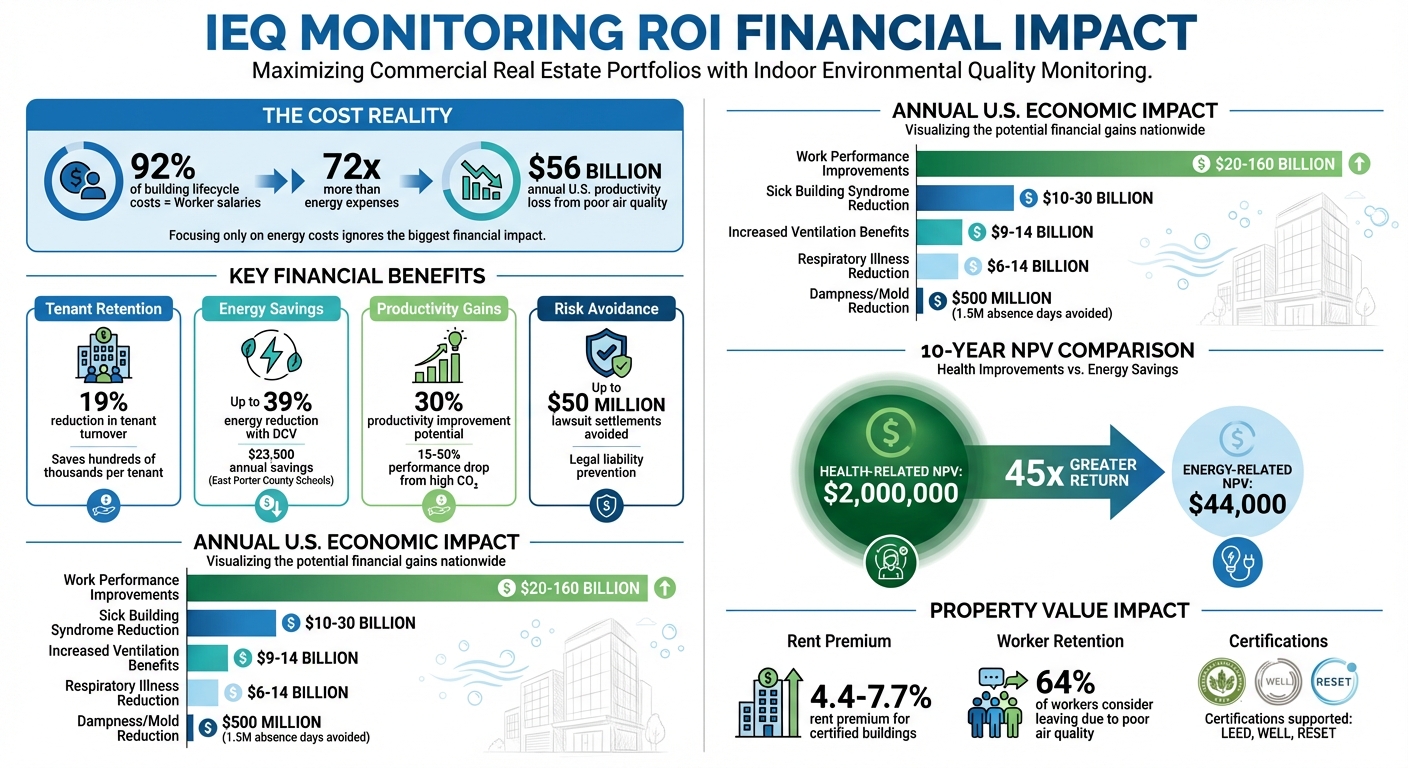
- Worker costs dominate building expenses: Salaries account for 92% of a building’s lifecycle costs, 72 times more than energy expenses. Poor air quality can reduce cognitive performance by 15–50% and costs U.S. businesses $56 billion annually in lost productivity.
- Tenant retention saves money: IEQ monitoring can reduce tenant turnover by 19%, saving hundreds of thousands of dollars per tenant in leasing costs, improvements, and vacancy losses.
- Energy savings add up: Smart systems like Demand Controlled Ventilation (DCV) cut energy use by up to 39%, avoiding waste in unused spaces.
- Boost property value: IEQ data supports certifications like LEED and WELL, which attract premium tenants and justify higher rents.
- Avoid legal risks: Poor air quality has led to lawsuits as high as $50 million. Monitoring helps prevent such liabilities.
IEQ monitoring delivers measurable returns through lower operating costs, improved tenant satisfaction, and higher property values. Systems like CoreCast integrate IEQ data with financial metrics, helping property managers act before issues escalate. The result? Better tenant experiences and stronger financial outcomes.
IEQ Monitoring ROI: Financial Impact Metrics for Commercial Real Estate
Financial Benefits of IEQ Monitoring
Energy Efficiency and Operating Cost Reductions
IEQ monitoring systems offer a smart way to track real estate portfolio performance and lower energy bills by using Demand Controlled Ventilation (DCV). This technology relies on CO₂ and occupancy sensors to adjust airflow based on real-time needs. For example, it avoids wasting energy ventilating empty conference rooms or offices after hours, instead focusing air changes where and when people are present. This targeted approach has been shown to cut energy use by up to 39% [3].
But the savings don’t stop at utilities. By continuously tracking indoor conditions, these systems help prevent issues like mold outbreaks or equipment failures, which can lead to expensive shutdowns. A great example comes from East Porter County Schools, where Craig Kenworthy implemented smart building monitoring. The district identified hidden energy waste using real-time data and managed to save $23,500 annually on utility costs [3]. Similarly, Paul Goodman, who owns 12 stores, saw savings within just two months of installing wireless IEQ and energy sensors:
"As an owner-operator of 12 stores, I've already seen cost savings in the first two months we've had sensors installed." - Paul Goodman [3]
These savings not only reduce operational costs but also contribute to tenant satisfaction and improved productivity.
Tenant Retention and Productivity Gains
Poor indoor air quality can be costly - tenant turnover alone can rack up expenses for improvement allowances, leasing commissions, and vacancy losses, often totaling hundreds of thousands of dollars per departure [2]. IEQ monitoring helps mitigate this risk by improving tenant satisfaction, which can lower the chances of tenant turnover by around 19% [2].
The impact on productivity is even more striking. Salaries for office workers make up 92% of a building's life-cycle costs, a figure that dwarfs energy expenses by a factor of 72. Optimized air quality can enhance productivity by 30%, addressing the 15–50% performance drops often linked to high CO₂ levels [1] [3]. Across U.S. office buildings, these improvements could deliver an annual economic benefit of $20 billion to $160 billion [1].
Better air quality also means fewer sick days. Reducing dampness and mold by 30% could prevent 1.5 million absences annually, saving businesses approximately $500 million. Overall, health-related savings from reduced symptoms of sick building syndrome are estimated at $10 billion to $30 billion [1].
Property Value and NOI Growth
IEQ monitoring doesn’t just cut costs - it can also boost property value. Continuous data collection supports certifications like LEED, WELL, and RESET, which attract high-value tenants and justify premium lease rates [3]. Verified air quality performance allows building owners to charge higher rents and achieve quicker occupancy, while lower operating expenses and increased revenue directly enhance net operating income.
There’s also a significant risk-reduction factor. One commercial property faced a $50 million settlement due to poor air quality control [3]. Real-time monitoring helps prevent such liabilities by ensuring compliance and avoiding safety violations. When integrated with property management systems, IEQ data can pinpoint specific HVAC issues by zone or tenant, enabling precise maintenance rather than costly, broad interventions [2].
"Allows us to benchmark real estate portfolios effectively to measure, compare, and analyze data, and run our business with a better focus on cost savings." - Marta Glinka, Head of Property Management [3]
From energy savings to tenant retention, productivity gains, and property value growth, IEQ monitoring delivers a compelling return on investment for building owners and managers alike.
sbb-itb-99d029f
Key Indoor Air Quality Metrics Every Facility Manager Should Know | Connected FM Podcast
Integrating IEQ Data for Portfolio Analysis
Commercial buildings often gather environmental data through sensors and Building Automation Systems, but this wealth of information doesn't reach its full potential until it's paired with tenant satisfaction and financial metrics. The real challenge is turning Indoor Environmental Quality (IEQ) data into practical insights. For example, when property managers can connect air quality complaints to lease renewal timelines, they can shift from simply addressing issues as they arise to managing their entire portfolio proactively. This shift transforms how properties are managed.
A major hurdle is the disconnect between historical tenant complaints and lease negotiations. Without centralized data, property managers might miss critical context. For instance, a tenant might have repeatedly reported HVAC issues over the past year, but this history often gets overlooked. As the Datagrid team explains:
"The property manager in Atlanta shouldn't have to call the one in Denver to learn that a tenant's corporate headquarters already complained about the same HVAC issue at three other locations" [2].
By integrating tenant health scoring - which includes arrears, lease terms, and maintenance records - with IEQ metrics, property managers can better identify tenants at risk of non-renewal. This matters because poor air quality is a big deal: 64% of workers have thought about leaving a job due to bad air quality [3]. Tracking these satisfaction gaps offers a critical early warning system.
ROI Calculation Methods
When calculating ROI for IEQ monitoring, traditional financial metrics like Net Present Value (NPV) and Internal Rate of Return (IRR) don't tell the whole story. Instead, the focus shifts to avoided costs - expenses you eliminate rather than revenue you directly generate.
One of the biggest avoided costs is tenant turnover. Losing a single tenant in a 10,000-square-foot office space can cost hundreds of thousands of dollars in tenant improvement allowances, leasing commissions, and vacancy-related losses. However, IEQ improvements that reduce turnover by 19% can significantly shorten the payback period [2]. For context, professional IoT-based indoor air quality (IAQ) monitoring starts at around $750 per month for facilities under 50,000 square feet [3]. That’s a small price compared to the cost of losing even one tenant.
Real-world examples repeatedly show how IEQ monitoring pays off. These savings don’t just stop - they accumulate year after year, boosting net operating income. By centralizing IEQ data, property managers can accurately measure avoided turnover costs and even optimize energy use.
Using CoreCast for IEQ Data Integration
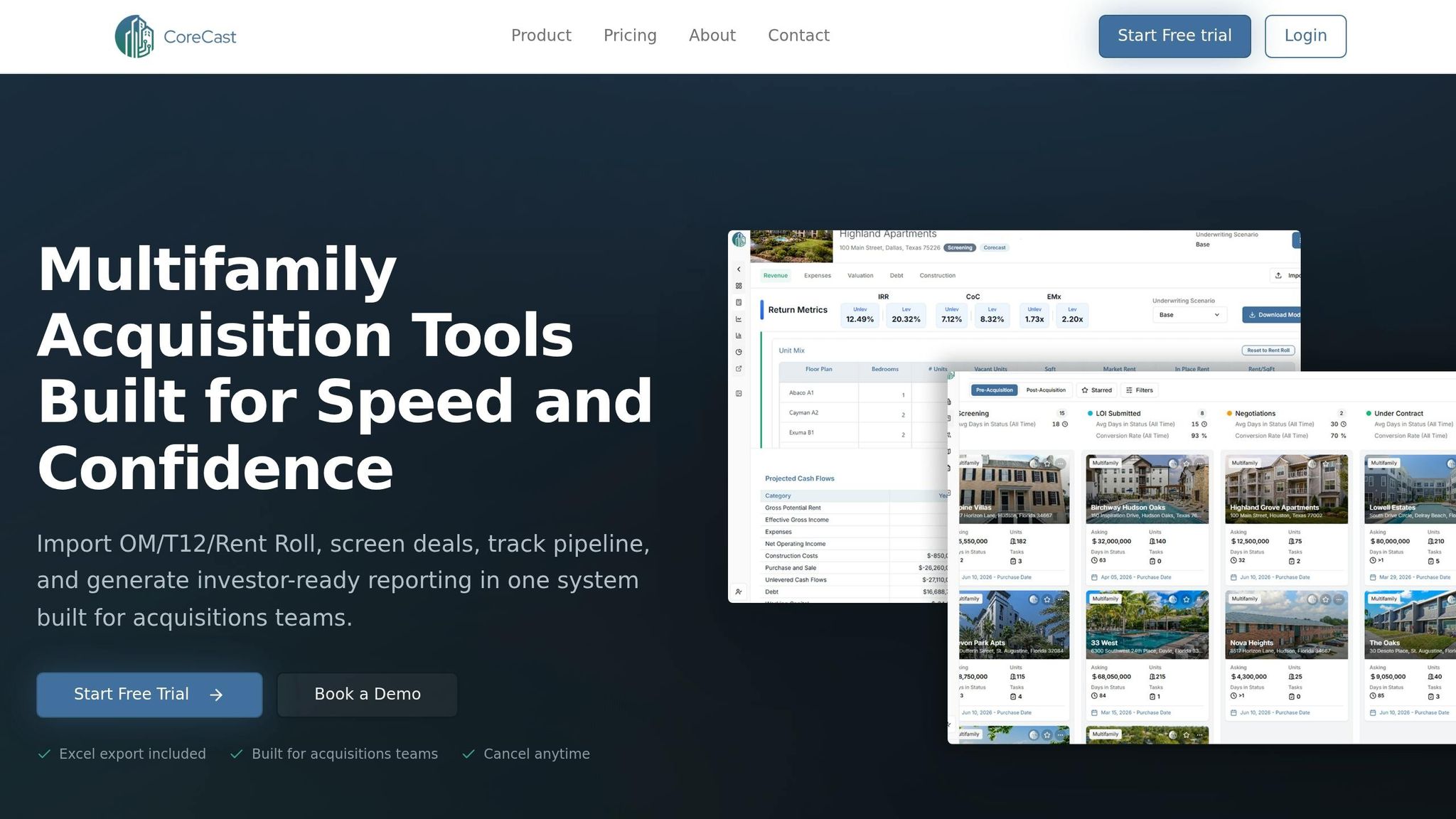
CoreCast simplifies the process of turning IEQ data into actionable insights. This real estate intelligence platform consolidates IEQ metrics with portfolio analysis tools, stakeholder reporting features, and forecasting capabilities. Instead of juggling multiple systems for property management, environmental monitoring, and tenant communication, CoreCast provides a single, unified view of portfolio health.
The platform integrates data from Building Automation Systems, property management tools, and work order histories. This allows property managers to track complaint patterns by tenant, building zone, and time period - not just tally up work orders. For instance, if CO₂ levels consistently exceed 1,000 ppm in conference rooms, CoreCast flags the issue before it escalates into a problem during lease negotiations.
CoreCast also offers portfolio-wide visibility. If a corporate tenant has thermal comfort complaints at their Denver headquarters, their property manager in Atlanta can access that information immediately. This kind of cross-portfolio insight ensures consistent service levels across locations, turning fragmented data into actionable strategies that improve tenant retention.
Additionally, CoreCast supports branded reports for stakeholders, helping property managers showcase their proactive approach to IEQ management. Verified air quality improvements, backed by continuous monitoring rather than periodic checks, provide the documentation needed for certifications like LEED, WELL, and RESET - credentials that can justify premium lease rates [3].
ROI Metrics Comparison for IEQ Monitoring
According to research from the International WELL Building Institute (IWBI), improvements in indoor environmental quality (IEQ) - such as better air quality, thermal comfort, and lighting - can result in a health-related Net Present Value (NPV) of $2 million over 10 years. To put this into perspective, that’s over 45 times higher than the energy-related NPV of $44,000 for the same measures [4]. This stark contrast shows that prioritizing health-related upgrades yields significantly greater returns compared to energy savings [1].
ROI Metrics Table
| ROI Metric | Financial Impact | Source |
|---|---|---|
| Health-related NPV | $2,000,000 over 10 years (vs. $44,000 for energy) | IWBI [4] |
| Property Value/Rent Premium | 4.4% to 7.7% increase for certified buildings | IWBI [4] |
| Productivity Gains | 2% to 10% increase in worker performance | Rocky Mountain Institute [1] |
| Sick Building Syndrome Reduction | $10 billion to $30 billion annual U.S. savings | LBNL [1] |
| Work Performance Improvements | $20 billion to $160 billion annual U.S. savings | LBNL [1] |
| Thermal Occupant Controls | $3.4 billion annual benefit vs. $0.4 billion cost | LBNL [1] |
| Increased Ventilation (32 cfm/person) | $9 billion to $14 billion annual economic benefit | LBNL [1] |
| Dampness/Mold Reduction | $0.5 billion annual value (1.5 million absence days avoided) | LBNL [1] |
One striking example is the economic impact of reducing dampness and mold. A 30% reduction could prevent 1.5 million absence days annually, translating into a $0.5 billion economic benefit [1]. Similarly, improving indoor environments could lead to annual savings of $6–14 billion from fewer respiratory illnesses and $1–4 billion from reduced allergies and asthma cases [1].
These figures highlight how IEQ monitoring not only enhances tenant well-being but also delivers measurable financial benefits. By leveraging these metrics, property owners can make smarter real estate investments that improve tenant satisfaction, boost productivity, and strengthen the long-term value of their assets.
Conclusion: Maximizing Returns with IEQ Monitoring
Investing in IEQ (Indoor Environmental Quality) monitoring makes financial sense. Even small improvements in air quality, thermal comfort, or lighting can lead to productivity boosts that often surpass traditional energy savings. Add to this the benefits of stronger tenant retention, and the return on investment for IEQ monitoring becomes hard to ignore.
The challenge for commercial real estate portfolios lies in transforming IEQ data into meaningful actions. Data alone doesn’t solve problems - it's the insights derived from it that matter. If property managers wait until lease renewal discussions to address tenants' environmental concerns, they risk missing critical opportunities to intervene early. A more proactive approach is essential.
This is where CoreCast’s intelligence platform steps in. By consolidating IEQ data with lease agreements, maintenance records, and tenant service workflows, CoreCast empowers property teams to identify potential tenant risks well before renewal deadlines. Automated alerts notify managers of issues like declining air quality or repeated HVAC problems, allowing them to address concerns before they escalate into complaints - or worse, tenant departures. This proactive strategy not only prevents costly turnover but also improves overall property performance.
The numbers speak for themselves: $20–160 billion in annual U.S. savings from improved work performance [1] and 30–40% fewer sick days [3]. But achieving these results takes more than just installing sensors. It requires a system that connects environmental performance directly to measurable financial outcomes. With the right tools, property managers can turn IEQ monitoring into a powerful driver of both tenant satisfaction and financial success.
FAQs
What IEQ metrics should I monitor first?
Indoor Environmental Quality (IEQ) covers four main areas: indoor air quality, thermal comfort, lighting quality, and acoustics. Each of these plays a crucial role in enhancing occupant well-being and optimizing building performance.
To make the biggest difference, start by addressing the metrics that matter most for your specific building. For example, improving air quality or refining temperature control can have an immediate and noticeable effect on tenant satisfaction and operational efficiency. Focusing on these priorities ensures targeted improvements where they count the most.
How do I calculate IEQ ROI for my building?
When determining the return on investment (ROI) for Indoor Environmental Quality (IEQ) improvements, follow these key steps:
- Track measurable improvements: Monitor changes in factors like air quality, comfort levels, lighting, and acoustics to assess the impact of upgrades.
- Quantify cost savings: Identify reductions in energy consumption, maintenance expenses, and health-related costs that result from better IEQ.
- Assess tenant retention: Keep an eye on tenant satisfaction rates and lease renewals, as improved IEQ often leads to happier, longer-term occupants.
- Estimate property value increase: Evaluate how enhancements in IEQ contribute to higher resale or market value for the property.
Finally, calculate ROI using this formula:
ROI = (Financial benefits ÷ Investment cost) × 100%
This equation helps you translate the tangible and intangible benefits of IEQ improvements into a clear financial perspective.
How does CoreCast tie IEQ data to leasing risk?
CoreCast bridges the gap between indoor environmental quality (IEQ) data and leasing risks by monitoring tenant complaints alongside crucial factors such as air quality and thermal comfort. By turning fragmented data into clear, actionable insights, it helps identify and address potential tenant dissatisfaction, ultimately lowering the chances of lease non-renewals.