
How AI Improves Construction Risk Assessment
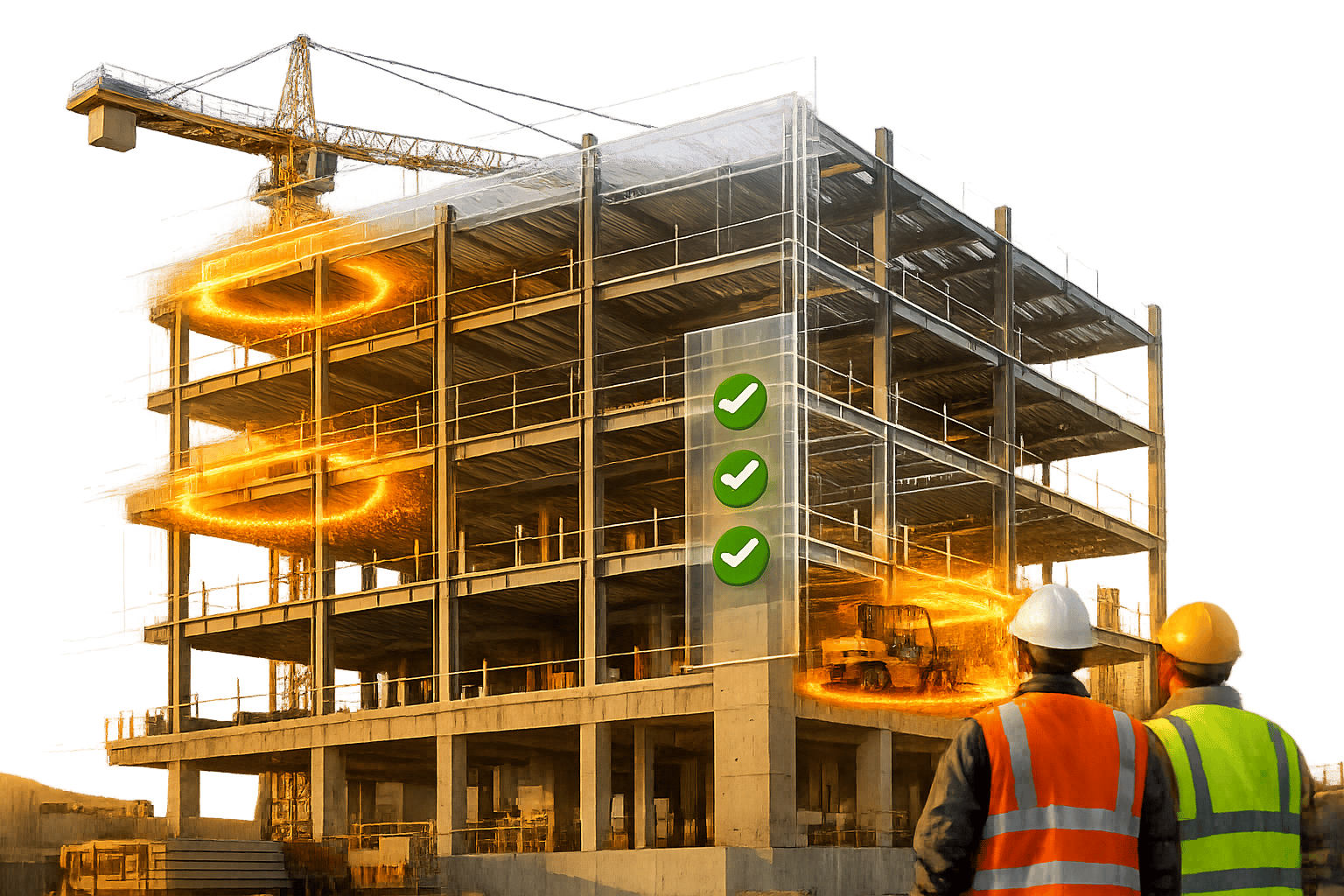
AI is revolutionizing construction risk assessment by replacing outdated, manual methods with faster, data-driven solutions. Here's what you need to know:
- AI tools save time by creating detailed risk assessments in minutes, compared to hours with manual processes.
- Better hazard detection: AI identifies 30%-40% more risks by analyzing historical data, real-time site conditions, and project specifics.
- Real-time monitoring: AI-powered systems use drones, cameras, and IoT sensors to flag safety issues like unstable scaffolding or PPE violations instantly.
- Predictive analytics: Machine learning predicts cost overruns, delays, and other risks before they escalate, enabling early intervention.
- Automated compliance: Natural Language Processing (NLP) scans contracts and permits to identify potential legal or regulatory issues quickly.
The result? Safer construction sites, fewer delays, and significant cost savings. AI transforms risk management into a proactive process, helping teams address problems before they occur.
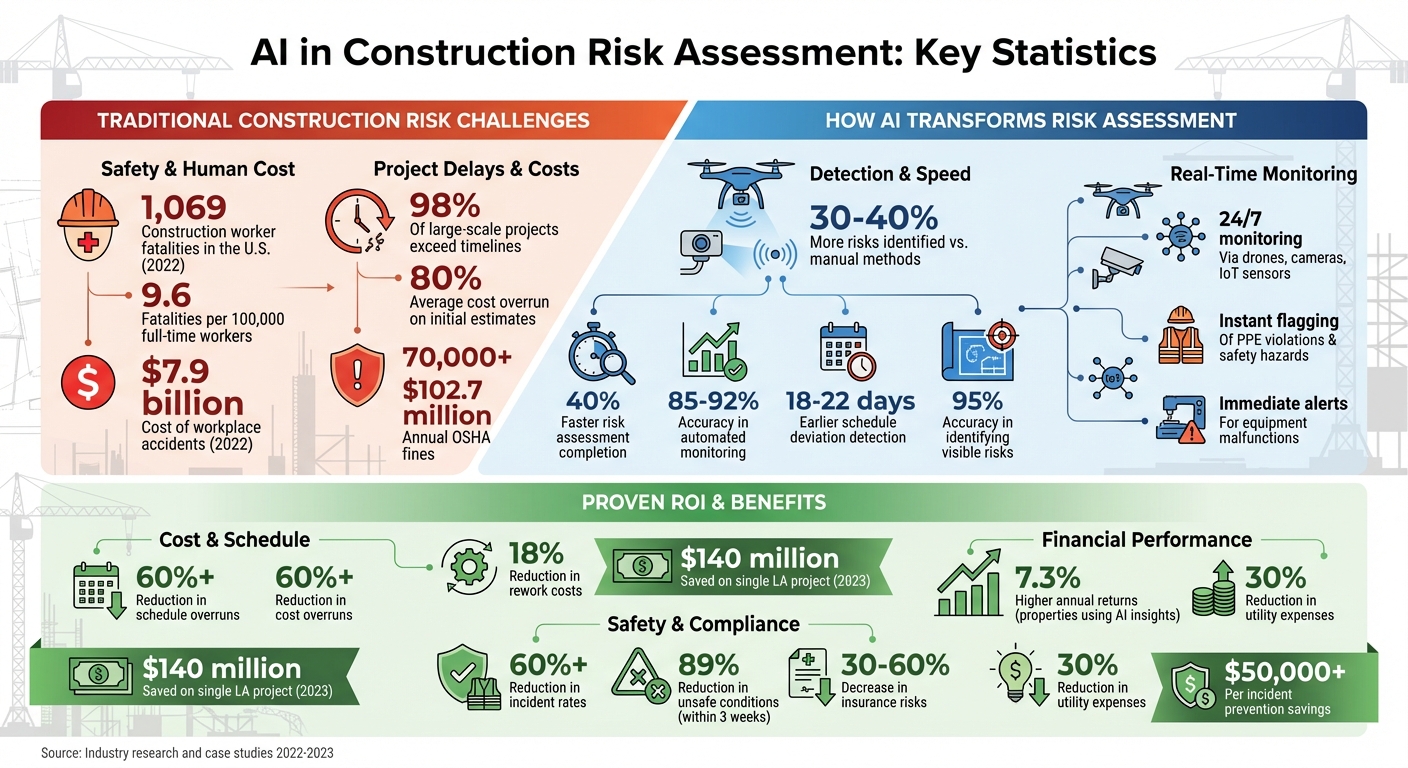
AI Impact on Construction Risk Management: Key Statistics and Benefits
Construction Risks and Traditional Assessment Problems
Common Construction Risks
Construction projects come with a host of challenges that can disrupt timelines, inflate budgets, and compromise safety. Safety risks are especially concerning, with hazards like falls, injuries from manual handling, excavation accidents, and exposure to dangerous materials such as silica dust. In 2022 alone, 1,069 construction workers in the U.S. lost their lives - a rate of 9.6 fatalities per 100,000 full-time workers [7].
Financial risks are another major issue. These include budget overruns, cash flow problems, and unfavorable payment terms like "pay-when-paid" clauses, which push financial risk onto subcontractors [4][3]. Schedule delays are also common, often caused by labor shortages, supply chain disruptions, extreme weather, and unrealistic deadlines. Material delays alone have cost the industry tens of billions of dollars in recent years [5].
Contractual and compliance risks add another layer of complexity. These include burdensome indemnification clauses, penalties for missed deadlines, environmental regulations, and complicated permitting processes [4][3]. For projects where less than 90% of the design is complete, experts recommend a contingency of at least 15% to account for potential risks [4]. Additionally, project complexity can lead to problems, especially when dealing with incomplete designs, difficult site conditions like brownfields or urban areas, or technical demands that exceed a contractor’s expertise [4].
These varied risks highlight the limitations of traditional risk assessment methods.
Problems with Traditional Methods
Despite the high stakes, traditional risk assessment approaches often fall short in addressing the complexities of modern construction projects. One common issue is the tendency for site managers to recycle outdated risk assessments with only minor adjustments. This practice reduces safety documentation to a formality rather than a practical tool. Workers, meanwhile, often tune out during toolbox talks because the content doesn’t align with the realities of their work environment [1].
Manual assessments also fail to account for critical details, such as underground utilities, the structural stability of nearby elements, specific silica dust exposure thresholds, or the correct disposal methods for hazardous materials [1].
Another major problem is fragmented data. Traditional methods rely on disconnected systems, where financial records, field operations, and procurement data remain isolated [3][5]. Without a unified view, decisions are often made based on incomplete or inconsistent information. Additionally, static risk matrices and subjective judgment cannot adequately predict sudden issues like weather shifts or equipment malfunctions [3]. Errors in data collection and human biases further obscure critical patterns, such as task interdependencies or supply chain vulnerabilities [3][2].
This reactive approach means risks are often addressed only after incidents occur, rather than being proactively mitigated. Conventional methods lack the ability to leverage predictive insights, leaving teams unprepared for emerging threats [6]. Moreover, the sheer volume of unstructured data generated by modern projects - daily logs, inspection reports, RFIs, and complex contracts - makes it nearly impossible for humans to process and analyze quickly enough to identify potential risks [3]. These shortcomings underscore the growing need for AI-driven solutions that can pinpoint site-specific hazards with greater precision.
sbb-itb-99d029f
AI Revolution: Transforming Construction Risk Management with Sai Kothapalli
How AI Improves Construction Risk Assessment
Artificial intelligence is reshaping construction risk assessment by automating tedious tasks and providing more detailed and efficient results. Traditional methods, which often rely on static templates, struggle with fragmented information, human error, and reactive decision-making. AI shifts the focus to dynamic, data-driven analysis, addressing these shortcomings head-on.
AI's impact is evident in three key areas: real-time hazard detection, predictive analytics, and automated document review. These advanced technologies process data faster and with greater accuracy than human teams alone, creating safer and more efficient construction environments.
Real-Time Hazard Detection with AI
AI-powered computer vision systems, often integrated with cameras and drones, monitor construction sites continuously. These tools identify safety risks as they arise, such as workers not wearing personal protective equipment (PPE), unstable scaffolding, or unsafe equipment use [8][3].
By processing visual data in real time, these systems flag issues immediately, helping prevent accidents. Considering that construction accounts for over 20% of worker fatalities in the U.S. and OSHA issues more than 70,000 citations annually - with fines totaling $102.7 million per year - this technology offers both safety and financial advantages [8].
"AI processes this data quickly, providing clear insights and alerts to prevent risks... catching what the human eye might miss." - HSI [8]
In addition to cameras, IoT sensors play a critical role by providing constant updates on environmental conditions and machinery health. For example, sensors can detect abnormal vibrations in equipment or weather conditions that might compromise structural safety. When such risks are identified, AI systems issue immediate alerts [3]. This combination of visual monitoring and sensor data creates a robust, 24/7 safety net.
While real-time detection focuses on immediate hazards, predictive analytics takes a broader view, ensuring long-term project stability.
Predictive Analytics for Cost and Schedule Control
Machine learning algorithms analyze historical project data, resource usage, and procurement trends to predict potential cost overruns or scheduling delays before they become significant issues [3][2]. Unlike traditional static risk matrices, which often rely on subjective input, these systems identify specific patterns - such as how a delay in material procurement might disrupt later phases of construction - and alert teams early enough to intervene.
Digital twins further enhance this process by allowing project managers to simulate various scenarios, like labor shortages or supply chain disruptions. For instance, if a simulation predicts a two-week delay in a critical task, teams can adjust other activities to keep the overall timeline on track [3][2].
These predictive tools not only help optimize schedules but also complement AI's ability to streamline document review and maintain compliance.
AI-Powered Document Review and Compliance Monitoring
Natural Language Processing (NLP) tools scan project-related documents - contracts, permits, inspection logs, and more - to uncover compliance risks and potential vulnerabilities [3]. These tools can quickly analyze thousands of pages, flagging non-standard clauses, recurring quality issues, or terms that could lead to disputes.
This automation eliminates the delays associated with manual document reviews. Instead of spending days poring over contracts to identify problematic language or indemnification terms, AI highlights these issues instantly. It also monitors regulatory requirements across jurisdictions, ensuring projects adhere to permitting processes and environmental standards [3].
Generative AI and large language models (LLMs) take this one step further by automating the creation of Risk Assessments and Method Statements (RAMS). These systems generate site-specific hazards, risk ratings, and control measures based on inputs like task, location, and trade [1]. Although the responsibility for "suitable and sufficient" risk assessments remains with employers, AI significantly boosts the speed and quality of initial documentation [1]. This efficiency mirrors how custom reporting transforms real estate workflows by automating manual data entry.
Using CoreCast for AI-Driven Construction Risk Management
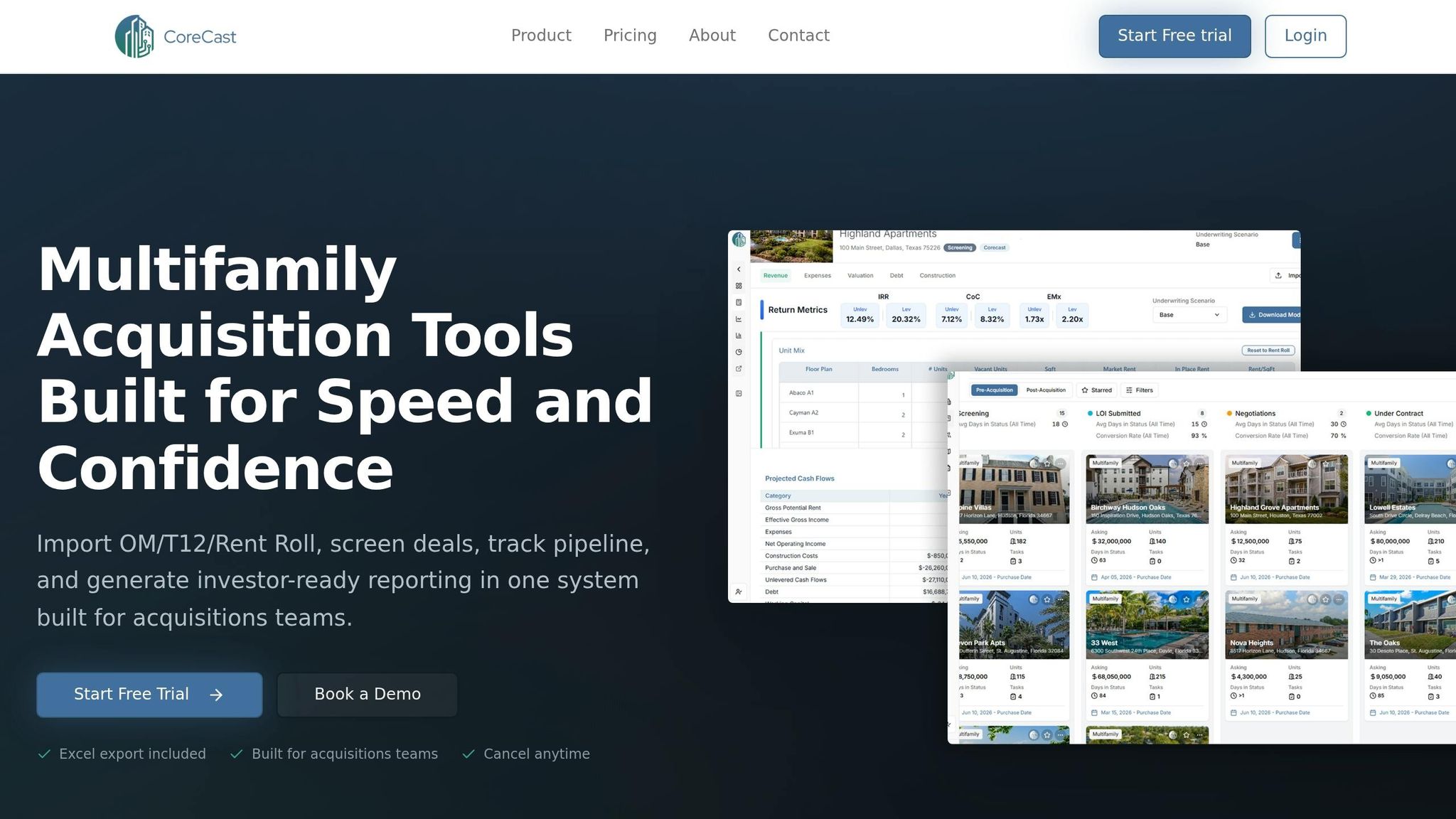
CoreCast equips real estate professionals with AI-powered tools to assess and manage risks effectively using a property investment risk analyzer tool. Acting as a comprehensive real estate intelligence platform, it consolidates key data - such as property specifics, demographic trends, environmental hazards, and construction metrics - into a single, user-friendly dashboard.
The platform’s machine learning algorithms deliver customized risk alerts at every stage of a project. For instance, when reviewing a general contractor's bid, CoreCast identifies cost items that fall outside standard ranges, flagging potential pricing irregularities before contracts are signed. For scheduling, it leverages Monte Carlo simulations to predict timeline risks, enabling teams to assess potential delays and their ripple effects on project completion [10]. These features, along with others, highlight how CoreCast enhances risk management.
How CoreCast Supports Risk Management
CoreCast incorporates geospatial tools that merge environmental, infrastructure, and demographic data to identify location-specific risks. It evaluates factors such as flood risks, zoning compliance, and structural vulnerabilities tied to specific sites. Properties that utilize these insights have reported 7.3% higher annual returns [9], underscoring the financial advantages of thorough risk analysis.
The platform’s dynamic stress testing allows teams to model scenarios like material cost surges or labor shortages without needing to manually adjust models. By integrating IoT sensors and real-time data feeds, CoreCast detects subtle performance shifts that could signal equipment malfunctions or structural concerns. These predictive insights can help prevent incidents that might otherwise cost $50,000 or more, while also cutting utility expenses by up to 30% [9].
"In real estate, the art of the deal is increasingly becoming the science of the data" - Edward Glaeser [9]
CoreCast also streamlines compliance through automated features that apply standardized assumptions and maintain detailed audit trails. This ensures consistent risk evaluation across multiple projects, reducing regulatory challenges and improving decision-making. Beyond risk management, CoreCast also enhances construction workflows.
Improving Construction Workflows with CoreCast
The platform’s Underwriter module enables analysts to create detailed models in just minutes, simplifying the due diligence process. Meanwhile, its pipeline tracker ensures seamless project progression through various deal stages, maintaining visibility into risk factors throughout the lifecycle. Teams can also view properties alongside their competitive landscape on an integrated map, offering valuable spatial insights for informed decision-making.
Benefits and ROI of AI-Driven Risk Assessment
AI is transforming risk assessment in construction, delivering measurable financial and operational benefits. For instance, projects using AI-driven operational risk scoring have seen over 60% reductions in both schedule and cost overruns [11]. This is especially significant when you consider that 98% of large-scale construction projects globally exceed their timelines, with costs averaging 80% above initial estimates [12]. These improvements can result in millions of dollars saved per project.
But the advantages go beyond keeping projects on track. AI adoption has been linked to a 60%+ reduction in incident rates [11]. Additionally, insurance risks can decrease by 30% to 60% when underwriters incorporate real-time operational data into their evaluations [11]. On top of that, project managers report completing risk assessments 40% faster [12], allowing them to focus more on on-site management rather than administrative tasks. These time and safety gains translate directly into financial savings and faster, more informed decision-making through integrated platforms.
Better Safety and Compliance
AI-driven risk assessments rely on extensive databases of historical incidents and regulatory standards to improve hazard identification. This systematic approach helps construction firms significantly reduce workplace incidents - some report over 60% fewer incidents with AI-powered safety monitoring [11].
Moreover, AI can generate task-specific Risk Assessments and Method Statements in minutes. These documents include precise control measures and real-time regulatory updates, ensuring compliance as site conditions evolve [1].
Cost and Time Savings
The financial and time-saving potential of AI is best understood through real-world examples. In 2023, a $2 billion development in Los Angeles nearly failed due to underestimated groundwater levels. An AI platform analyzed hydrological data, permits, and pump logistics, enabling a real-time redesign of the foundation and renegotiation of supplier contracts. This intervention saved $140 million and prevented an 11-month delay [12].
Similarly, a Texas highway project avoided a three-month delay by using predictive analytics to flag a potential cement shortage weeks in advance. The team rerouted deliveries proactively, sidestepping the issue entirely [12]. Meanwhile, a Singaporean construction firm used computer vision to compare daily site progress with 3D models, identifying deviations early and reducing rework costs by 18% [12].
These examples highlight how AI enables early problem detection and intervention, delivering cost and time savings that quickly justify its investment.
Better Decision-Making
AI also enhances decision-making by providing real-time and predictive insights that help construction teams stay ahead of potential disruptions. Predictive analytics can identify patterns in historical and live data, forecasting issues like procurement delays or task dependencies before they become critical. Digital twins allow managers to simulate scenarios - such as the effects of a two-week material delay - and create data-backed contingency plans without interrupting ongoing work.
Natural Language Processing tools can review thousands of pages of contracts, inspection reports, and RFIs to uncover hidden risks that might be missed during manual reviews [3]. At the same time, IoT devices, drones, and wearables provide real-time updates on equipment failures, weather conditions, or safety violations, enabling immediate action.
"Construction risk management has long been in need of holistic quantifiable metrics for excellence, and in the current age of data, Construction Risk AI is changing how we approach risk in construction."
– Rose Hall, Founder & CEO, Rose Hall Business Ventures [11]
AI supports better decision-making by serving as a powerful tool for analysis and insight. However, it’s essential to remember that site managers remain responsible for final safety documentation - a task that AI can streamline but not replace. Without these tools, compiling such documentation could take hours, if not longer.
Future Trends in AI for Construction Risk Management
AI is transforming construction risk management, moving from reactive solutions to predictive and real-time strategies that tackle problems before they arise. The next wave of tools promises to make risk assessment faster, more precise, and increasingly autonomous.
One standout development is the rise of autonomous tools for site monitoring. Autonomous drone systems are already reshaping how sites are managed. Companies like Skydio and Percepto offer "drone-in-a-box" platforms that can operate daily without human piloting, capturing high-resolution images around the clock. While these systems cost between $2,000 and $4,000 per month per site [13], they provide continuous oversight that traditional inspections simply can't match. For instance, automated monitoring can identify schedule deviations 18 to 22 days earlier than conventional reporting methods [13], with accuracy rates of 85% to 92% when compared to contractor-reported data [13].
Wearable IoT devices are also becoming more advanced. AI can now process data from wearables and site sensors to issue real-time alerts for risks like heat stress, falls, or proximity to heavy machinery. Early adopters of AI-driven safety tools have reported an 89% reduction in unsafe conditions within just three weeks [14]. These tools also boast 95% accuracy in identifying visible risks [14]. James Pipe, Chief Product Officer at DroneDeploy, highlights the potential:
"With Safety AI, your most seasoned safety managers can monitor safety practice on every project, every day" [14].
These advancements in wearables are setting the stage for broader system integration. By merging AI with Building Information Modeling (BIM) and Enterprise Resource Planning (ERP) systems, companies can create unified risk dashboards that consolidate all project data. Digital twins, for example, allow managers to simulate scenarios - like labor shortages or material delays - without affecting ongoing work. Meanwhile, Natural Language Processing (NLP) is becoming adept at scanning contracts, RFIs, and inspection logs to uncover hidden legal or financial risks that might escape manual review. This integration builds on earlier successes in real-time hazard detection and predictive analytics.
The future also points toward autonomous decision-support systems capable of adjusting logistics or schedules in response to real-time site data. These systems will take over the heavy lifting of data analysis, freeing managers to focus on proactive problem-solving. With workplace accidents costing the construction industry nearly $7.9 billion in 2022 [14], the case for adopting these technologies is both financial and safety-driven.
Conclusion
AI is transforming how construction risk assessment is handled, addressing the limitations of traditional methods. Manual processes often depend on reused templates and subjective judgments, which can overlook critical hazards. In contrast, AI-powered tools produce site-specific documentation in minutes and identify 30% to 40% more risks than manual evaluations [1]. This shift allows teams to move from reactive to proactive risk management, catching potential issues before they escalate into costly delays or safety problems.
Projects leveraging AI-driven risk management report over a 60% reduction in schedule and cost overruns, with insurance risks decreasing by 30% to 60% [11]. These advancements are reshaping the way construction projects are managed and safeguarded.
Real-time monitoring through IoT sensors and drones, paired with predictive analytics, enables project managers to tackle emerging risks immediately, avoiding the lengthy delays that manual processes often entail. As Rose Hall, Founder & CEO of Rose Hall Business Ventures, explains:
"Construction risk management has long been in need of holistic quantifiable metrics for excellence, and in the current age of data, Construction Risk AI is changing how we approach risk in construction" [11].
Beyond improving safety, these innovations provide real estate professionals with sharper investment insights. For those managing construction projects, CoreCast offers a unified approach to risk management. It integrates risk data with portfolio analysis, pipeline tracking, and stakeholder reporting, allowing teams to link construction risk insights directly to investment decisions and operational strategies - all within a single platform.
As AI, BIM, and real-time data continue to converge, the construction industry is moving toward fully integrated digital ecosystems. Organizations that embrace these tools today are better equipped to manage risks, lower costs, and enhance safety across their projects and portfolios.
FAQs
What data is needed to start using AI for construction risk assessment?
To apply AI in construction risk assessment, you'll need a variety of data inputs. These include risk frequency, site-specific hazards, project details, historical project data, bid documents, and operational metrics. With this information, AI tools can analyze patterns and predict potential risks more effectively.
How accurate are AI safety alerts from cameras, drones, and IoT sensors?
AI-powered safety alerts from cameras, drones, and IoT sensors excel at spotting visible safety risks. By processing real-time data, these systems can identify hazards aligned with OSHA standards and rank them based on their severity. This automated approach not only simplifies risk assessment but also ensures that the most urgent issues receive immediate attention.
How can CoreCast fit into our existing construction and investment workflows?
CoreCast fits smoothly into construction and investment workflows by providing AI-driven tools for risk assessment, underwriting, and compliance. By pulling together scattered data, it allows for more accurate portfolio analysis and helps identify risks early in the process. CoreCast's features, such as real-time monitoring, automation, and stakeholder reporting, cut down on errors, enhance decision-making, and simplify operations. This ensures teams can stay on track, handle risks effectively, and adjust to shifting conditions with improved efficiency.