
How Supply Chain Resilience Impacts Real Estate Recovery

The real estate sector’s recovery hinges on solving supply chain challenges. Labor shortages, material delays, and rising costs are slowing projects and increasing risks. Key takeaways include:
- Labor Gaps: The U.S. construction industry needs 499,000 more workers by 2026. Trucking alone is short 78,000 drivers.
- Rising Costs: Material prices for aluminum, copper, and cement have surged by up to 1,390% since 2019.
- Delays: Supply chain disruptions cause cascading delays, increasing project timelines and costs.
- Tariffs: New tariffs on steel, aluminum, and cement imports (up to 50%) are straining budgets further.
To recover, companies must rethink supplier relationships, diversify sourcing, and use digital tools for real-time tracking. Platforms like CoreCast centralize supply chain data, helping firms detect risks early and improve timelines. Building resilience isn’t just about managing today’s problems - it’s about ensuring smoother operations for the future.
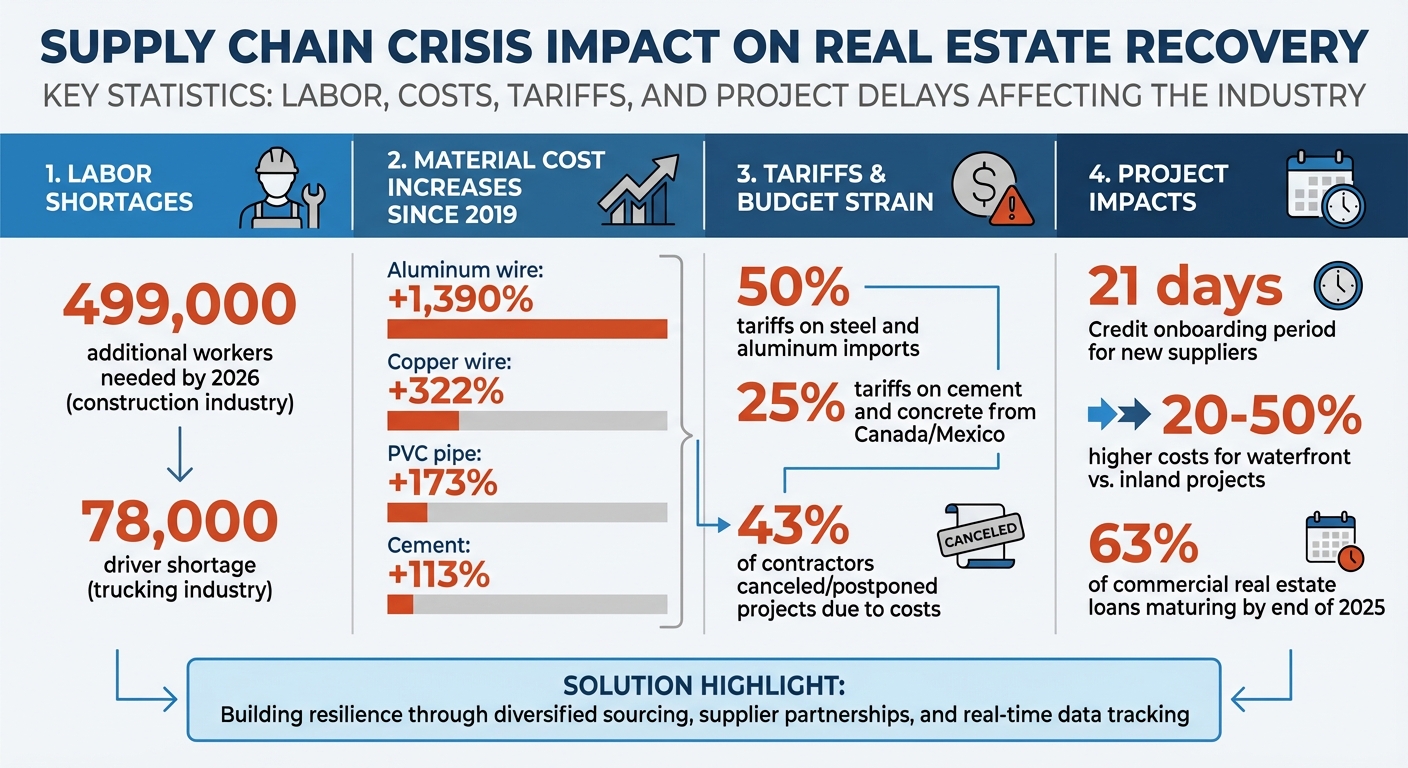
Supply Chain Crisis Impact on Real Estate: Key Statistics and Challenges
How Supply Chain Is Changing the Real Estate Landscape
sbb-itb-99d029f
The Supply Chain Crisis in Real Estate
The real estate industry is grappling with a wave of disruptions that are reshaping how projects are built and financed. After the pandemic, the surge in demand for household materials overwhelmed ports and warehouses. At the same time, travel restrictions disrupted imports and exports, creating significant delays [1][4]. The trucking industry’s ongoing driver shortage only adds to the delays, causing bottlenecks that impact every stage of construction [1][4]. The sector’s reliance on "just-in-time" manufacturing has proven ill-suited for handling the breakdown of global supply chains [1][4].
Material Shortages and Labor Gaps
The statistics paint a grim picture. By 2026, the construction industry will need an additional 499,000 workers to meet growing demand [3]. This labor shortage is driving up costs even further, compounding the challenges of rising material prices [3]. Ken Pinto, Founder of Kenzai USA, summed it up:
We neither have the labor nor the materials to support an additional one million homes per year – unless we do things differently [3].
Material shortages are just as pressing. Domestic cement production is already maxed out, and stringent environmental regulations make building new plants nearly impossible [3]. The conflict in Ukraine has also driven up raw material costs for items like stainless steel. Meanwhile, aggressive tariffs imposed in 2025 - 50% on steel and aluminum and 25% on cement and concrete imports from Canada and Mexico - have further strained budgets [1][3]. Between late 2025 and early 2026, 43% of general contractors reported having to cancel, postpone, or scale back at least one project due to skyrocketing material costs [3].
Cost Inflation and Market Instability
The volatility of material prices has made budgeting a nightmare. Since 2019, the cost of aluminum wire has soared 1,390%, copper wire is up 322%, PVC pipe has increased 173%, and cement prices have risen 113% [3].
This unpredictability is a problem in itself, requiring robust scenario analysis to navigate market uncertainties. Chad Griffiths, Partner at NAI Commercial, explained:
Just the unpredictability of tariffs alone compresses margins and shakes confidence [5].
The issues go beyond raw materials. Delays in credit approvals, known as "time-to-terms", can stretch up to three weeks, causing significant disruptions to project timelines [6]. Remote construction sites face even more hurdles, particularly with "last-mile" delivery challenges. Premium materials often sit idle - or worse, get damaged - if shipments don’t align with available labor [6]. Waterfront construction projects are feeling the pinch even more, with costs running 20% to 50% higher than inland projects due to specialized engineering needs and stricter environmental regulations [6].
These rising costs and logistical setbacks are setting the stage for even more disruptions, which will be explored further in the next section.
How Supply Chain Problems Affect Real Estate Recovery
Supply chain disruptions create a ripple effect that slows down market recovery. When materials arrive late or costs spiral, the impact goes far beyond a single construction site, creating instability across the market.
Delayed Construction Projects
Construction delays often start at the supplier level. Slow procurement processes - like the 21-day credit onboarding period for new suppliers - can hold up material orders [6]. Unlike manufacturing, construction doesn't rely on centralized stockpiles. Instead, materials are sourced specifically for each project, leaving schedules vulnerable to supplier setbacks [7]. This becomes especially problematic when long-lead items like electrical switchgear, HVAC systems, or façade components are delayed. Missing production windows for these items can push project timelines back by months [7].
On-site delays only make things worse. When one shipment is late, certain trades can't proceed, creating a domino effect. This often leads to "trade stacking", where multiple crews are forced to work in the same space later on. The result? Reduced productivity, higher risks of rework, and overall inefficiency [7]. Many of these issues stem from disruptions at Tier-2 or Tier-3 suppliers, which are rarely monitored by project teams, leaving projects exposed to unmanaged risks [7].
In residential construction, delays in finishing materials - like appliances or garage doors - can prevent homes from passing final inspections. Without these, homes remain unlivable, delaying move-ins and the transition from construction loans to permanent financing [9]. This leaves homeowners stuck paying for temporary housing and additional loan interest. Meanwhile, builders face extra costs from rescheduling subcontractors and storing delayed materials [9].
While these delays are frustrating, rising costs are adding even more pressure to the industry.
Rising Costs and Stalled Investments
Climbing costs are forcing tough decisions across the real estate sector, slowing down new developments and reducing inventory.
Uncertainty around pricing is as damaging as the increases themselves. Ted Konigsberg, President of Infinity Commercial Real Estate, highlights this issue:
Fixed-price bids are almost impossible. Between material costs and delays, few developers can confidently underwrite a schedule or a budget [5].
Developers are feeling squeezed. With 63% of commercial real estate loans maturing by the end of 2025, many investors are focusing on refinancing rather than launching new projects [5]. Rising interest rates are also driving up the cost of extended project debt, further cutting into returns [1][6].
Even when developers find ways to save on materials, those savings are often canceled out by rising labor costs. In some trades, labor costs are now increasing faster than material prices. Ken Pinto, Founder of Kenzai USA, explained:
Labor scarcity, in both quantity and quality, will offset lower material pricing if not addressed head-on [3].
The financial strain is forcing companies to rethink their strategies. Some are turning to sale leasebacks to free up equity for supply chain adjustments, like nearshoring [8]. Others are pausing new projects until conditions improve. Strengthening supply chains will be key to easing these financial pressures and supporting recovery efforts.
How to Build Supply Chain Resilience
Building resilience into your supply chain means creating systems that can handle disruptions without bringing operations to a standstill. This involves reducing reliance on single points of failure and preparing for unexpected challenges.
Working with Suppliers
Strengthening supplier relationships is a crucial step. Treating suppliers as long-term partners rather than transactional vendors can make a big difference. Supplier Relationship Management (SRM) focuses on fostering partnerships that share risks and generate mutual benefits [10][1]. Start by categorizing your suppliers into tiers - Strategic, Important, Tactical, and Commodity. This ensures you allocate your time and resources effectively. For example, strategic suppliers might need monthly check-ins, while commodity vendors can be reviewed annually [2].
Dual sourcing is another key strategy. It’s not enough to have a backup supplier on paper - both suppliers must be actively engaged. As David Chen, Senior Procurement Analyst at SpecLens, aptly puts it:
A backup supplier you've never actually ordered from is not a backup: it's an unvalidated hypothesis [13].
The "active-active" model addresses this by splitting orders between two suppliers, often in a 70/30 ratio. This approach keeps the secondary supplier ready to scale up when needed. While dual sourcing can increase costs by 5-15%, it reduces the risk of stockouts by 60-80% - a worthwhile trade-off for critical items like HVAC systems or electrical switchgear [2].
Financial support can also bolster supplier stability. Offering programs like supply chain finance or receivables financing helps suppliers weather economic downturns, ensuring their reliability when you need them most [10]. Additionally, pre-qualifying alternative materials - such as regional substitutes or hempcrete - can save time and resources during shortages [10][1].
Using Digital Tools for Real-Time Data
Real-time data is the backbone of a resilient supply chain. Without it, managing operations is like flying blind. Tools like integrated ERP systems and digital twins provide real-time inventory tracking, automated reorder points, and disruption simulations. These tools can reduce forecast errors by 20-30%, improving overall inventory management [2][12].
For real estate professionals juggling multiple projects, platforms like CoreCast (https://corecastre.com) centralize supply chain data. This simplifies tracking pipeline stages, analyzing portfolio performance, and forecasting based on current market conditions - all in one place. Such visibility helps identify bottlenecks before they escalate into major delays.
Automated alerts can further enhance responsiveness. Set up notifications for inventory dips below safety thresholds or deliveries delayed by more than 48 hours [12]. Integrating external data - like weather updates, port congestion reports, and commodity prices - keeps you ahead of potential disruptions [2][10]. The faster you’re aware of a problem, the quicker you can act.
Diversifying and Localizing Procurement
Rethinking where and how you source materials is another way to mitigate supply chain risks. Over-reliance on a single supplier or region makes your operations vulnerable. Nearshoring - sourcing materials closer to home - can significantly cut lead times, often by 60-75% [2]. By 2026, it’s projected that 69% of supply chains serving the U.S. will be based in the Americas, up from 59% [11]. This shift reduces exposure to geopolitical issues and lengthy shipping times.
Building relationships with geographically diverse suppliers adds another layer of protection. For critical projects, consider moving away from just-in-time models. Instead, batching and warehousing - buying materials in bulk when prices are favorable and storing them - locks in costs and ensures availability. While this requires upfront investment and storage, it eliminates delays caused by supply shortages [1].
To further enhance resilience, conduct a 90-day audit to identify single-source dependencies and evaluate the potential revenue impact if key suppliers fail [13]. Maintain a pre-approved supplier list to reduce activation times from months to just 2-4 weeks [13]. Interestingly, while 80% of companies claim their supply chains are resilient, only 5% have a comprehensive strategy in place [13]. Diversifying procurement can help close this gap, ensuring real estate projects face fewer disruptions and recover more quickly when challenges arise.
Measuring Resilience for Faster Recovery
Tracking resilience metrics ensures that your strategies are effective. By focusing on the right data points, real estate professionals can pinpoint vulnerabilities, accelerate recovery during disruptions, and steadily improve project outcomes. These insights directly shape recovery strategies and inform the adoption of digital tools.
Key Metrics for Supply Chain Resilience
Start with the fundamentals. Two critical metrics to monitor are supplier concentration - where no single supplier should account for more than 30% of category spend - and days of safety stock, with a recommended minimum of 14 days for essential materials like structural steel or HVAC units. These metrics act as buffers, cushioning against supply chain shocks [12].
Equally important are time to detect disruptions and time to activate contingency plans. Top-performing operations aim to identify issues within 24 hours and implement solutions within 48 hours [12]. Another key practice is dual-sourcing, ensuring that over 80% of critical items have alternative suppliers. This increases flexibility and shortens recovery times when disruptions occur [12].
The stakes are high: supply chain disruptions can cost an average company 45% of its annual profits over a decade [2]. Tracking essential pipeline metrics is more than a best practice - it’s a financial necessity. As the ECOSIRE Research and Development Team puts it:
Resilience is not the opposite of efficiency - it is the insurance policy that allows efficiency to function under stress [12].
By defining these metrics, you create a foundation for leveraging digital tools to make data-driven decisions.
Using CoreCast for Data-Driven Decisions
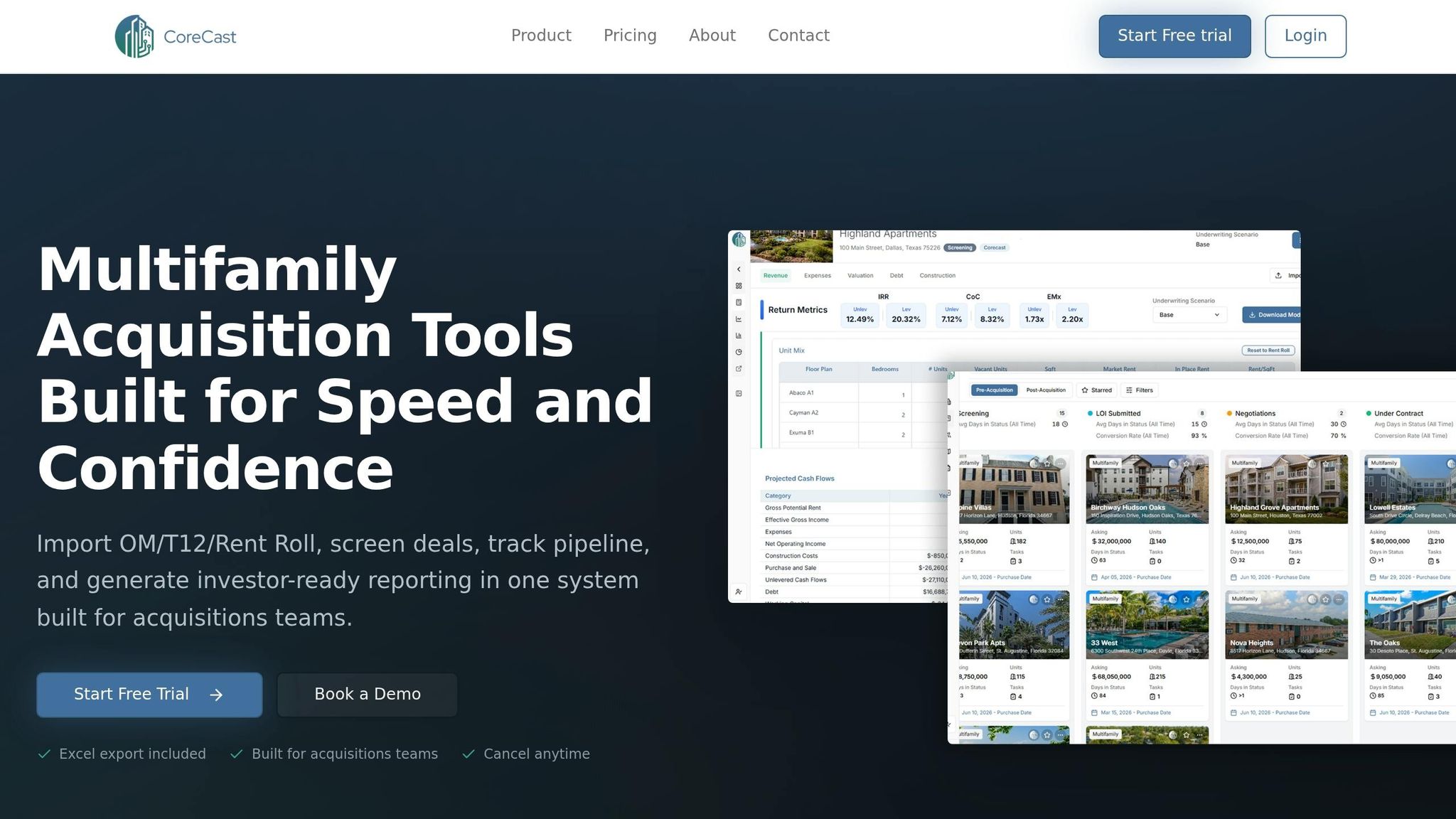
Real-time platforms like CoreCast (https://corecastre.com) revolutionize how disruptions are tracked and addressed. CoreCast integrates supply chain metrics, project timelines, and market trends into a single, easy-to-navigate dashboard, automating the detection of bottlenecks and delivering actionable insights.
With predictive analytics, CoreCast uses historical data and market signals to forecast demand. This helps procurement teams avoid over-ordering or stockouts, reducing uncertainty. Its AI-driven tools flag potential supply risks, recommend cost-effective alternatives, and provide the lead time needed to adjust plans.
For real estate professionals juggling multiple projects, CoreCast offers portfolio analysis and pipeline tracking features. These tools provide a clear view of operations, highlighting projects at risk due to supplier delays and enabling performance comparisons across assets. This level of visibility ensures that recovery timelines stay on track and decisions are backed by reliable data.
Conclusion
Building resilience in the supply chain isn’t just about solving immediate problems - it’s about creating a solid foundation for long-term growth in real estate and construction. With challenges like material shortages, labor gaps, rising costs, and unpredictable trade routes, companies that embrace strategies like diversified procurement, strong supplier relationships, and real-time data analysis are better positioned to recover quickly and seize new opportunities.
A shift from "just-in-time" to "just-in-case" inventory models, along with nearshoring and localized sourcing, is helping reduce reliance on unstable supply chains. As Chad Griffiths, Partner at NAI Commercial, explains:
More than one source, more than one route, more than one plan. The companies building that into both their supply chains and real estate are going to come out ahead [5].
Digital tools are also playing a big role in strengthening supply chain resilience. Platforms like CoreCast (https://corecastre.com) bring together supply metrics, project timelines, and portfolio performance into a single dashboard. This kind of real-time insight helps firms detect disruptions early and act quickly, turning reactive responses into proactive strategies that protect profits and keep projects on track.
On top of that, optimizing logistics can reduce overall costs by as much as 20% [14]. Companies that prioritize resilience, adopt advanced technology, and build strong supplier partnerships won’t just weather future challenges - they’ll come out stronger and more competitive. These strategies are key to driving recovery in the market and helping real estate professionals maintain momentum, even in uncertain times.
FAQs
What should I do first to reduce supply chain risk on a project?
The foundation of navigating supply chain challenges lies in having a solid contingency plan. This means pinpointing possible risks, setting up backup sourcing strategies - such as dual-sourcing or nearshoring - and outlining clear steps to handle disruptions. Taking the time to document these plans and practice them ensures your team can respond quickly and keep projects on track, even when unexpected issues arise.
Which supply chain resilience metrics matter most for real estate?
Key metrics for building a resilient supply chain in real estate include supplier diversification, safety stock levels, and supply chain visibility. Diversifying suppliers minimizes dependence on a single source, while maintaining safety stock ensures operations can continue even during disruptions. Supply chain visibility offers real-time data, enabling quicker and more informed decisions.
Additional strategies like nearshoring and dual sourcing further reduce risks, making the supply chain more adaptable. These approaches are especially important for the recovery of industrial and logistics-focused real estate sectors.
How can CoreCast help spot delays and cost risks earlier?
CoreCast helps spot delays and cost risks early by delivering real-time insights and thorough data analysis across the supply chain and various project stages. This means users can identify potential disruptions ahead of time, protecting both construction schedules and budgets. With its integrated tools, CoreCast provides a clear, detailed view, enabling professionals to tackle problems before they grow into larger challenges.