
Best Practices for Tenant Data Integration in Real Estate

To manage properties effectively, real estate professionals need integrated tenant data. Fragmented systems - where leases, payments, and maintenance requests are stored separately - waste time and create blind spots. Here's why integration matters:
- 78% of firms struggle with data silos (Deloitte, 2024).
- Integrated platforms improve lease renewals by 20–30% and vacancy rates by 15% (Yardi, 2023).
- 65% of professionals report a 10% ROI boost with data integration tools (CBRE, 2025).
Centralizing tenant data allows teams to forecast cash flow, predict turnover, and make faster decisions. For example, firms using platforms like CoreCast have reduced lease processing times and saved millions annually. Key steps include:
- Audit Current Tools: Identify gaps in your systems and standardize data formats.
- Map Data Sources: Link internal systems (PMS, CRM) and external databases (CoStar, Yardi Matrix).
- Centralize Data: Use a single platform to unify and standardize tenant information.
- Secure Integration: Opt for API-based connections for real-time updates and better security.
- Leverage Data: Automate processes like forecasting, reporting, and pipeline tracking.
Integrated data not only streamlines operations but also enhances decision-making, helping firms stay competitive while improving portfolio performance.
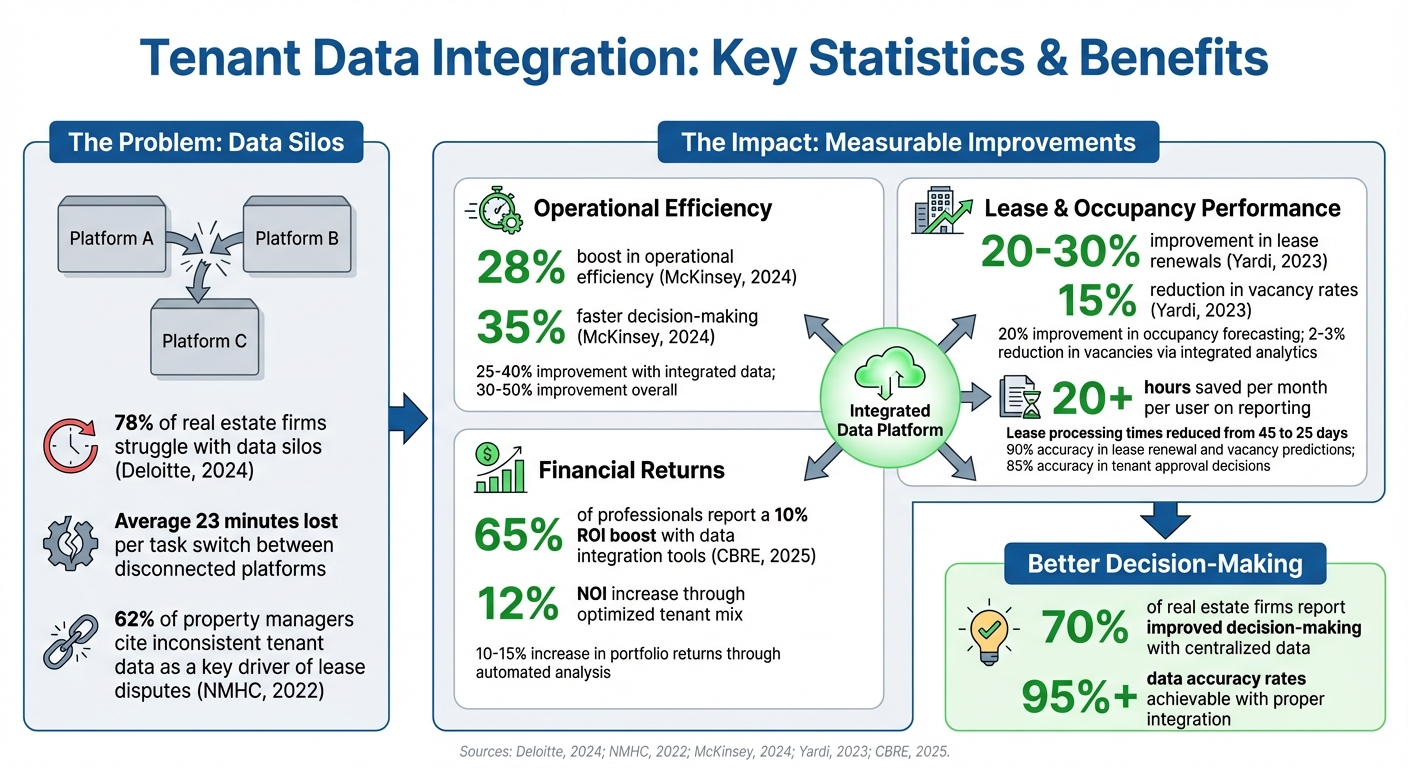
Tenant Data Integration Impact: Key Statistics and ROI for Real Estate Firms
Ep. 18- PropTech Playbook: Data Monetization & How Property Owners Take Back Control w/ Bill Douglas
sbb-itb-99d029f
Evaluate Your Current Data Systems
Start by taking a close look at the tools you're currently using to manage data. Real estate teams often rely on a mix of spreadsheets, property management systems (PMS), email threads, and PDFs to track tenant information. This patchwork approach leads to disconnected data, creating blind spots that can seriously hinder decision-making. When platforms aren't connected, establishing a single, reliable source of truth for key details like lease terms, occupancy rates, or rent schedules becomes almost impossible [1][6].
The downside of this fragmentation goes beyond just inefficiency. According to research, it takes an average of 23 minutes for a professional to fully refocus after switching between tools or platforms [1]. If your team is constantly jumping between a PMS, accounting software, and Excel spreadsheets, they're losing valuable hours every week. On top of that, manual data entry increases the likelihood of errors, which can affect underwriting accuracy and lead to missed deadlines [1][6].
Review Existing Data Management Tools
Conducting a detailed audit of your current systems is the first step toward effective tenant data integration. Begin by cataloging every platform your team uses to manage tenant information. For instance, financial records might be stored in accounting software, while leasing documents are often saved as PDFs in folder structures organized by property, tenant, or lease amendments [6].
Spreadsheets and outdated databases often fail to maintain data consistency. For example, one person might log a lease expiration date as "12/31/2026", while another enters "12-31-26" or "December 31, 2026." Without standardized field definitions and formats, your data becomes unreliable for reporting. Avoid storing rent as a single figure; instead, include the complete rent schedule - start dates, end dates, and escalation periods - to ensure accurate cash flow forecasting [6].
To identify gaps, create a Data Gap Matrix. List every field your integration platform requires and check whether your current tools capture that information. Are you tracking CAM caps, renewal notice deadlines, or the cumulative effects of lease amendments in your spreadsheets? If not, you're missing critical data to benchmark real estate portfolios effectively [8]. Also, watch for "shadow systems", where team members have devised manual workarounds to address limitations in your official tools [1][6].
Once you've audited your tools and noted the gaps, map out where each data point originates.
Identify Your Data Sources
After reviewing your tools, the next step is to map out both internal and external data sources to build a unified, automated data structure. Tenant data typically comes from a mix of sources. Internal sources include Property Management Systems, CRM platforms, financial records, and lease documents stored as PDFs. External sources might involve commercial real estate databases like CoStar, Reonomy, and Yardi Matrix, government data from the U.S. Census and Bureau of Labor Statistics, or brokerage market reports from firms like Moody's and Catylist [6].
Trace your workflows from start to finish - from listing properties and processing applications to move-outs and deposit reconciliations. This helps you pinpoint where manual data entry occurs and where information gets siloed [7]. Use universal identifiers, such as consistent property and tenant IDs, to connect data across systems. For example, this allows you to link a tenant's payment history in your PMS to their original application in your CRM or tie lease terms in legal documents to rent schedules in your accounting software [6].
It's also essential to document every lease amendment, capturing changes in rent, size, or renewal terms. Many systems only store the original lease terms, ignoring subsequent modifications. Your database should reflect the cumulative impact of all changes to maintain accuracy. Standardize field definitions across all platforms - terms like "Expiration Date" or "Monthly Rent" should look identical everywhere - so you can generate reliable reports without needing to clean up data first [6]. Assign specific team members to monitor key dates (e.g., 180, 90, and 30 days before a lease expires) to ensure accountability [6].
Centralize Tenant Data in One Platform
Once you've mapped out your data sources, the next step is consolidating them into a single platform. Why? Because fragmented systems often lead to inconsistent data - where different teams rely on conflicting information [9]. This misalignment doesn't just slow things down; it can damage stakeholder trust and result in costly mistakes, especially in underwriting and portfolio analysis.
Why Centralization Matters
Centralizing tenant data eliminates the constant back-and-forth between systems, which can drain productivity. By reducing manual data transfers, it also minimizes errors. In fact, a 2022 NMHC study found that 62% of property managers identified inconsistent tenant data as a key driver of lease disputes [10]. With a centralized platform, everyone operates from a single, accurate source of information. According to McKinsey's 2024 Real Estate Digital Report, organizations using these platforms see a 28% boost in operational efficiency and make decisions 35% faster [5].
But the benefits go beyond efficiency. Centralization enables better decision-making by breaking down silos and supporting unified reporting. For example, real estate firms can analyze occupancy rates and revenue per square foot across their entire portfolio in real time. This allows them to quickly identify underperforming assets or prioritize tenant renewals without waiting for manual reports [2]. This kind of visibility is particularly important when institutional investors require transparent and consistent reporting to assess operational performance [1].
Using CoreCast for Tenant Data Integration
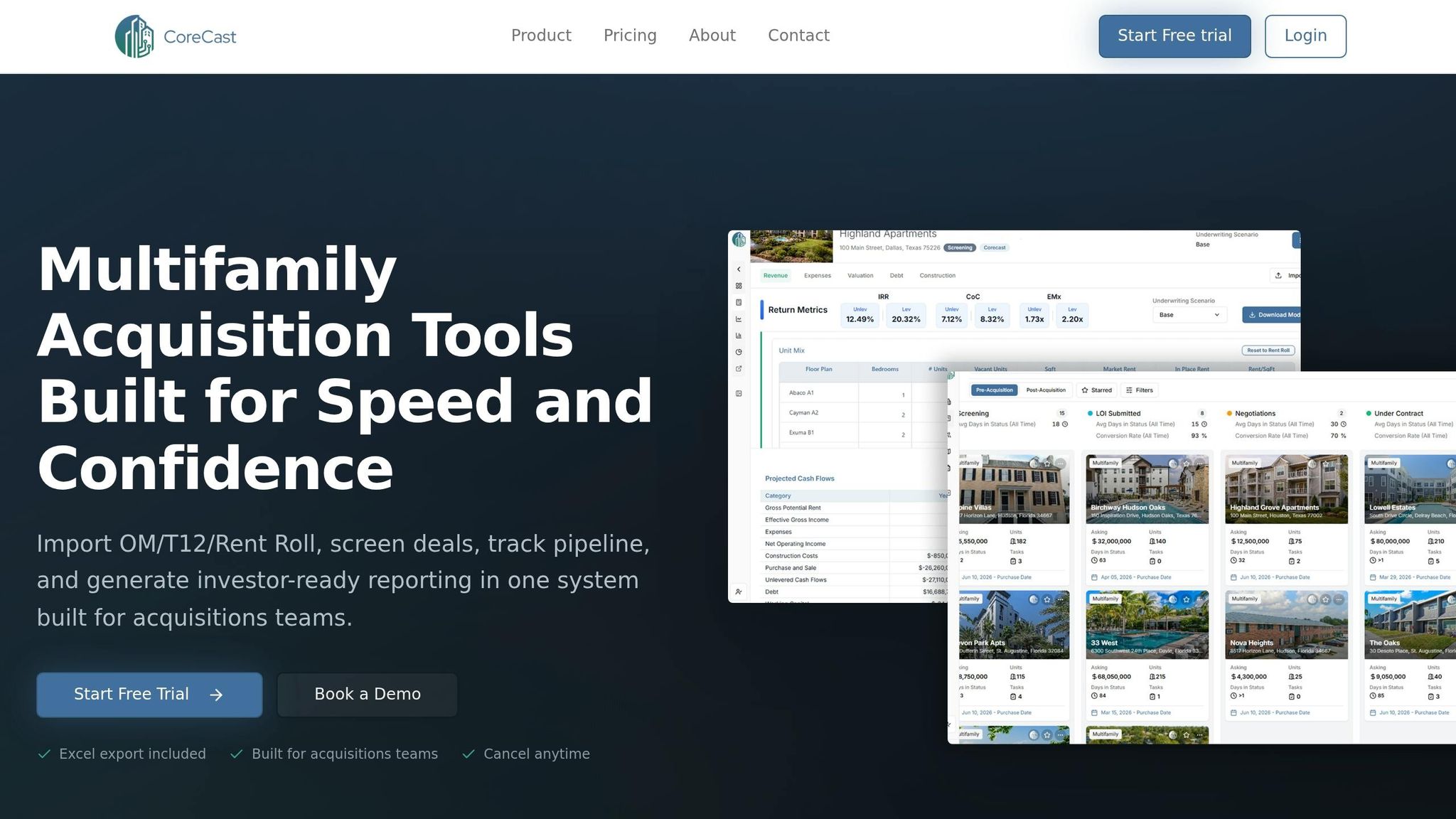
CoreCast simplifies tenant data integration by pulling information from property management systems, financial tools, and market databases - without the need to replace your existing PMS. It consolidates and standardizes data from multiple sources into a live operating dashboard, ensuring all departments work from the same real-time information [9].
The platform offers advanced tenant analytics, tracking lease performance, occupancy trends, and revenue contributions across different asset classes and risk profiles. You can view properties and competitors on an integrated map, monitor deals as they move through pipeline stages, and conduct comprehensive portfolio analyses - all from one interface. By parsing uploaded rent rolls to update financial models and trigger dashboard changes, CoreCast eliminates the manual reconciliation process that used to take analysts days to complete [1].
For stakeholder communication, CoreCast generates branded reports directly from your centralized data. Instead of manually compiling investor updates, you can create reports on lease statuses, portfolio summaries, and performance forecasts with just a few clicks. This ensures consistent messaging and professional presentations [9]. By streamlining reporting and providing accurate, timely updates, CoreCast helps firms build trust and credibility with investors and lenders. This centralized approach not only improves operational efficiency but also lays the groundwork for secure data management and insightful analytics in real estate operations.
Implement Secure Data Integration Methods
Once your tenant data is centralized, the next step is ensuring secure and efficient connections between your various data sources. This step is crucial for maintaining both the accuracy and security of your unified data. The approach you choose will directly affect how well your data remains protected and how smoothly your systems operate. Real estate firms often rely on one of three methods: manual integration, automated API connections, or a hybrid model that combines elements of both.
Integration Methods and Tools
Each method comes with its own set of advantages and challenges, particularly in terms of compatibility, security, and efficiency. Manual integration can handle any data format - whether it’s spreadsheets, PDFs, or older systems - but it’s prone to human error. Automated API integration, on the other hand, offers strong security through encrypted connections and authentication tokens, making it perfect for firms that need real-time data updates across multiple properties. The hybrid approach combines the strengths of both, accommodating legacy systems while still offering modern security features.
| Integration Method | Compatibility | Security Features | Best Use Case |
|---|---|---|---|
| Manual Integration | High (supports any format) | Low (vulnerable to human error) | Small-scale operations or one-time data analysis |
| Automated (API) | Medium (requires modern systems) | High (encrypted, secure tokens) | Firms needing real-time updates across platforms |
| Hybrid Approach | High (supports legacy and modern) | High | Firms managing both historical and real-time data |
Whenever possible, prioritize API-based integrations. These connections allow for real-time updates and eliminate the manual errors that often compromise tenant databases. For older systems that don’t support APIs, consider scheduling batch imports during off-peak hours to minimize disruptions while keeping your data up to date. Once your integration methods are in place, the next focus should be on maintaining data accuracy and enforcing robust security measures.
Maintain Data Accuracy and Security
Secure integration isn’t just about protecting data - it’s also about ensuring its accuracy. Start by implementing uniform data standards across all sources. This includes using consistent naming conventions, standardizing date formats (e.g., MM/DD/YYYY for U.S. operations), and aligning currency symbols (e.g., $). Without these standards, errors can creep in and compromise your analytics.
Implement role-based access control (RBAC) to limit data access based on job roles. This ensures that each user only has access to the information they need, reducing the risk of unauthorized changes or breaches. Before rolling out any integration system-wide, test it in a controlled environment. This step helps catch potential issues early and prevents widespread data corruption.
Run validation checks to cross-verify property details with trusted sources, and flag any missing or inconsistent fields before they’re added to your database. To further reduce errors, consider using universal identifiers like Placekey to link property records across different systems. This approach minimizes the chances of mismatched or duplicate entries, enabling more accurate portfolio analysis.
Use Integrated Data for Analysis and Automation
Integrated tenant data can transform operations, offering actionable insights and streamlining processes. This approach improves efficiency by 25–40% and reduces vacancies by 2–3% [2][3].
Generate Insights from Your Data
When tenant data is integrated, it enhances key processes like tenant screening, rent adjustments, and forecasting. For instance, during screening, platforms can analyze credit scores, eviction history, income verification, and employment stability all at once. This comprehensive analysis flags high-risk applicants, potentially reducing vacancy turnover by up to 20%. By combining historical lease data with predictive scoring models, approval decisions can achieve around 85% accuracy.
For rent adjustments, integrated data on market comparables, tenant payment history, and occupancy trends supports market-based pricing strategies. These strategies help balance occupancy and revenue. Quarterly pricing reviews, using regression models and inflation-adjusted data, ensure rents are optimized without compromising occupancy rates.
Predictive analytics also play a crucial role in forecasting. By using scenario analysis for real estate portfolios to analyze multi-year tenant data, platforms can predict lease renewals and vacancies with up to 90% accuracy. Machine learning models applied to this data can forecast portfolio vacancy rates just as effectively. Additionally, correlating tenant mix with net operating income (NOI) growth provides actionable insights - like achieving a 12% NOI increase by diversifying retail tenants. These insights enable proactive portfolio management, setting the stage for automating critical real estate processes.
Automate Real Estate Processes
Once insights are generated, automation can take over, simplifying tasks like portfolio analysis, pipeline tracking, and stakeholder reporting. Automated portfolio analysis aggregates real-time tenant metrics to calculate key indicators such as occupancy and NOI variance. Dashboards can create heatmaps of underperforming assets, guiding rebalancing efforts that can increase returns by 10–15%.
Pipeline tracking automation keeps a close eye on deal stages, from initial prospecting to lease signing. By auto-updating probabilities based on applicant quality scores and market comparables, tools like CoreCast reduce deal cycle times from 45 to 25 days. Features like map-based competitive views and alerts for qualified tenants further streamline the process.
For stakeholder reporting, CoreCast automates the creation of branded, personalized reports. For example, weekly PDF summaries detailing tenant mix impacts on internal rate of return (IRR) can be sent to limited partners. Customizable templates with charts showcasing rent roll forecasts and risk-adjusted returns save over 20 hours per month per user. These reports also ensure compliance with U.S. GAAP formats. By shifting from manual reporting to automated insights, teams can focus their energy on strategic initiatives rather than spending time maintaining spreadsheets.
Test, Monitor, and Improve Your Integrations
Once you've integrated third-party tools securely, the next step is ensuring they remain reliable over time. This involves thorough testing and continuous monitoring to catch and address issues before they disrupt operations or compromise data quality. A solid validation process is key to keeping your integrations running smoothly.
Integration Testing Checklist
Testing your integrations requires a detailed approach to ensure everything works as intended. Here are the key areas to focus on:
- Data Format Validation: Confirm that elements like date formats (MM/DD/YYYY), currency symbols ($), and measurement units (square feet) are consistent across all connected systems.
- Integrity and Uniqueness: Check for duplicate tenant records and ensure required fields, like lease end dates, are properly populated.
- API Connectivity: Measure response times for tenant data synchronization and watch for failed API calls or unusual spikes in volume, which could indicate issues.
- Cross-System Sync: Compare tenant data between your source system and CoreCast to confirm that all records match perfectly.
- Security and Access: Verify that role-based permissions are correctly configured, ensuring only authorized personnel can access sensitive tenant information.
Here’s a quick breakdown of these test types:
| Test Type | Key Checks | Expected Outcomes |
|---|---|---|
| Data Format Validation | Ensure date formats, currency symbols, and measurement units (e.g., sq ft) are consistent. | Uniform data presentation across all platforms. |
| Integrity & Uniqueness | Identify duplicate records and verify required fields are populated. | A clean database with no redundant or incomplete data. |
| API Connectivity | Monitor for failed API calls, response delays, or volume spikes. | Stable, real-time data flow without disruptions. |
| Cross-System Sync | Compare data between systems to ensure everything matches. | 100% parity between integrated platforms. |
| Security & Access | Check that permissions limit access to sensitive data appropriately. | Sensitive data remains secure and accessible only to authorized users. |
Testing doesn’t stop at implementation. Once validations are complete, it’s time to focus on monitoring and optimizing performance.
Monitor and Optimize Performance
Ongoing monitoring is crucial for catching problems before they escalate. Here’s what to keep an eye on:
- API Response Times: Track these weekly to identify slowdowns that might point to infrastructure issues or data bottlenecks.
- Failed Synchronization Attempts: Set up alerts for any sync failures so your team can address them immediately.
- Data Accuracy Metrics: Perform monthly checks by comparing sample records between systems. If discrepancies arise, they could signal synchronization issues.
- User Feedback: Pay attention to reports from your team about workflow challenges or inaccuracies in reporting. Often, they’ll spot issues before system logs reflect them.
When issues arise, document them thoroughly in an audit trail. Include timestamps and resolutions to create a historical record. This not only helps prevent recurring problems but also provides valuable insights for refining your integrations in the future.
Conclusion
Bringing tenant data together in one place can completely change how real estate professionals work. When you streamline how data is handled, decisions not only get made faster but are also much smarter.
Moving away from scattered spreadsheets and isolated tools to a single, unified platform wipes out inefficiencies. It also gives you a clear, real-time picture of your entire portfolio, making it possible to manage issues proactively rather than scrambling to respond after problems arise.
The financial benefits are hard to ignore. Research shows that integrated platforms can improve operational efficiency by 30–50%. Additionally, 70% of real estate firms report better decision-making when they centralize their data, and accurate integration can improve occupancy forecasting by 20% [11][4]. These kinds of improvements are what separate reactive management from a forward-thinking strategy.
To make this work for your business, start with a clear plan for integration. Begin by auditing your current data sources, then test an integration on a smaller part of your portfolio using CoreCast’s tools. Track your results using specific benchmarks, like achieving data accuracy rates above 95% or speeding up workflows noticeably. Once you see what works, expand the integration and keep monitoring performance to address any issues early.
When tenant data connects seamlessly with underwriting, pipeline tracking, portfolio analysis, and reporting - all within CoreCast - you’re setting your business up to spot opportunities faster, reduce risks sooner, and showcase the kind of governance that attracts institutional investors.
FAQs
What tenant data fields should we standardize first?
Standardizing tenant data fields like satisfaction scores, lease renewal rates, vacancy rates, feedback, maintenance response times, and demographic details is essential. Why? Because these metrics are the backbone of improving tenant retention, streamlining operations, and boosting portfolio performance.
When data is consistent across systems, it provides clearer insights, making decision-making more effective and efficient. It's about creating a unified approach that helps identify trends, address issues proactively, and optimize overall property management.
How do we connect legacy systems that don’t support APIs?
To link legacy systems that lack API support, consider using custom data pipelines or middleware solutions. These approaches can handle the extraction, transformation, and loading (ETL) of data from older platforms into newer systems. Additionally, implementing multi-tenant integration management can simplify data sharing while minimizing technical debt. This strategy ensures a seamless flow of information without the need for a full system replacement.
How do we measure ROI from tenant data integration?
ROI from integrating tenant data is assessed by how well it helps cut vacancy and turnover costs, boosts lease renewal rates, fine-tunes rent pricing, and streamlines operations. Together, these elements directly contribute to higher profits and an improved net operating income (NOI).