
How Population Growth Affects Mixed-Use Housing
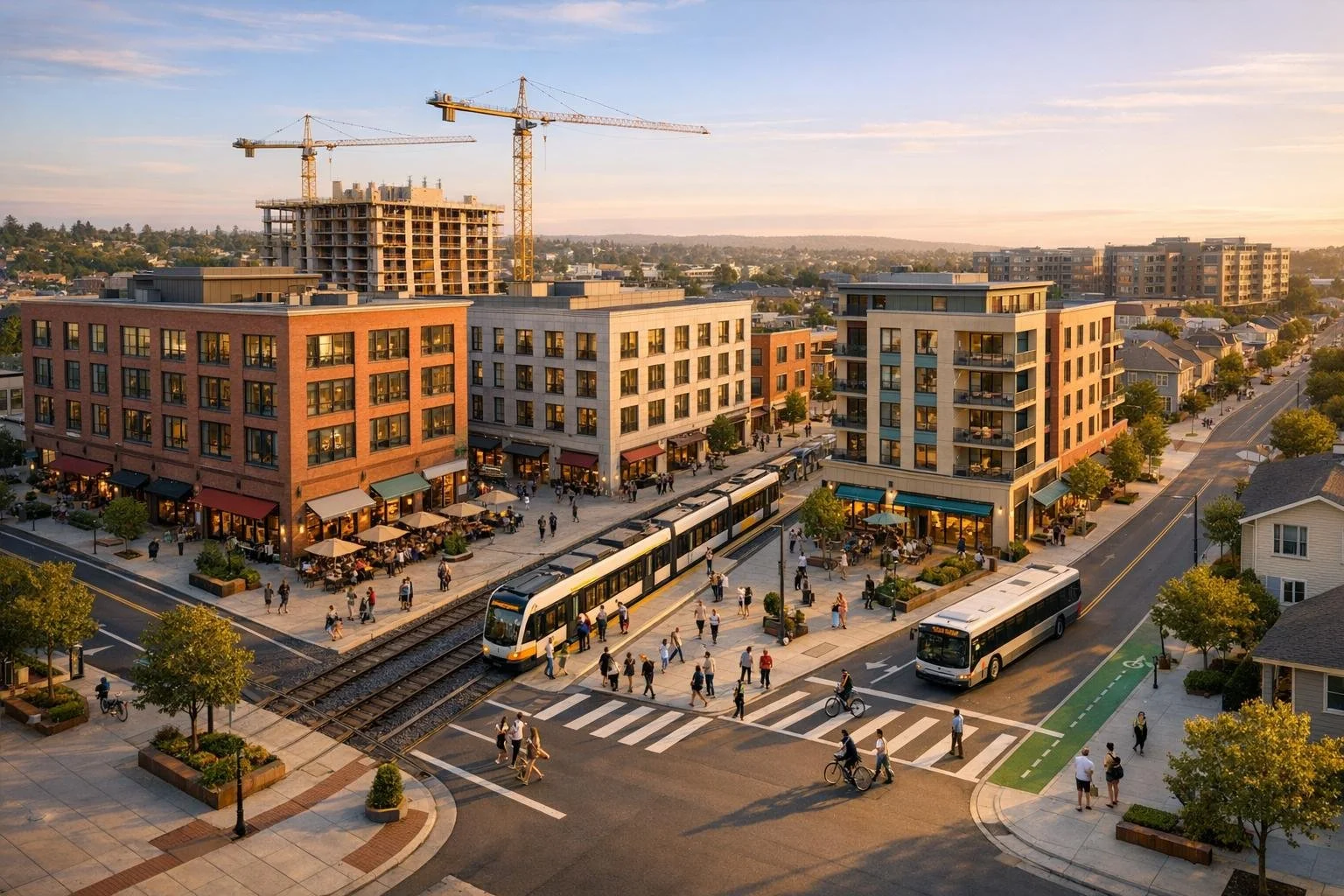
Population growth is reshaping urban housing markets, driving demand for mixed-use developments that combine residential, commercial, and recreational spaces. These projects address housing shortages, create walkable neighborhoods, and reduce reliance on cars. Key trends include shrinking household sizes, rising single-person households, and increased rental demand among older adults. Migration to metro areas, job growth, and demographic shifts like aging populations are fueling this demand.
Developers must navigate challenges like zoning laws, rising costs, and limited land supply while leveraging population data to identify opportunities. Successful strategies include building near transit hubs, using flexible designs, and integrating sustainable features. Tools like CoreCast help analyze population trends, enabling precise site selection and project planning. Mixed-use developments are critical to meeting urban housing needs while enhancing community living.
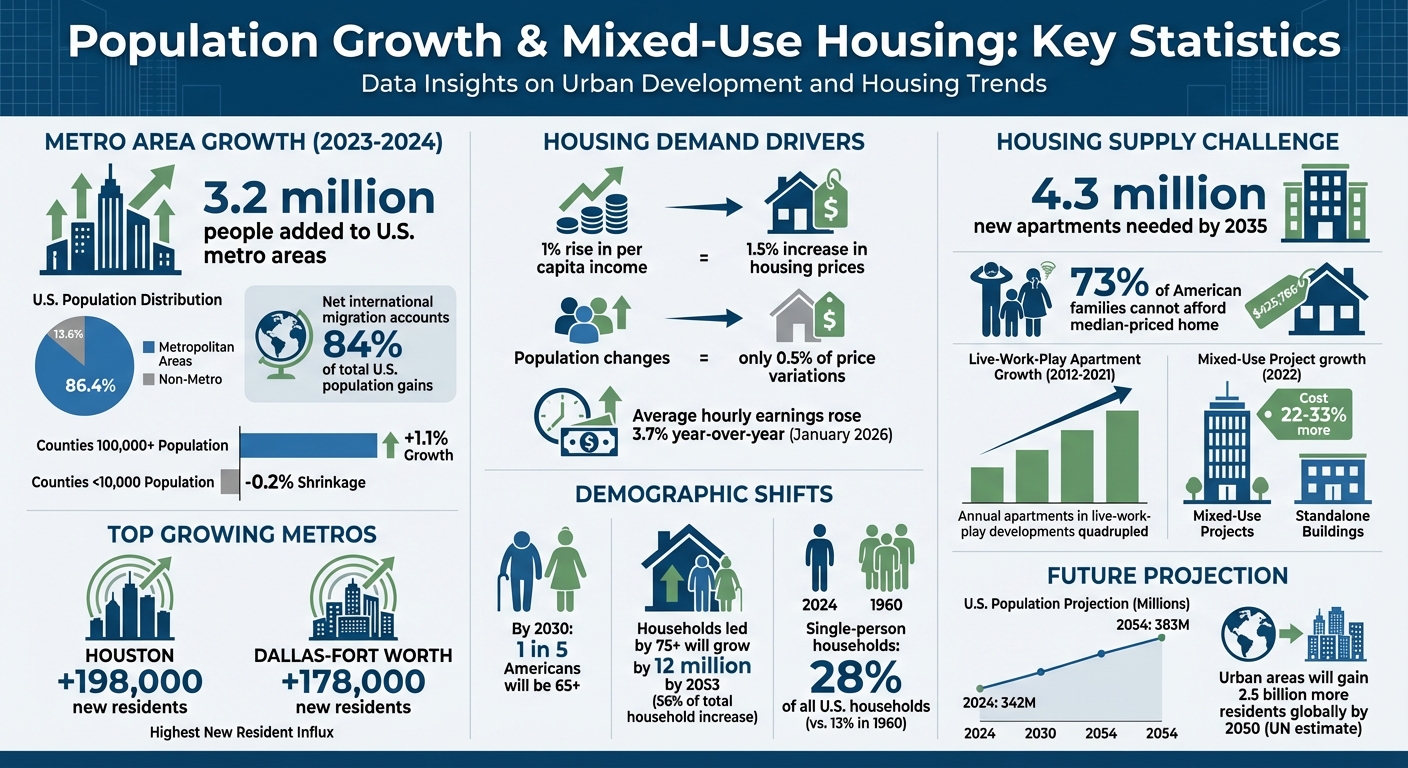
Key Population Growth Statistics Driving Mixed-Use Housing Demand in U.S. Metro Areas
How can we balance population growth with urban agglomerations?
sbb-itb-99d029f
What Drives Population Growth
Understanding what fuels population growth is key to predicting housing demand. Between 2023 and 2024, U.S. metro areas grew by nearly 3.2 million people, with 86.4% of the total U.S. population now living in metropolitan areas [5][6]. This growth is driven by three main factors: urban migration, economic opportunities, and demographic shifts.
Migration to Urban Areas
Urban migration significantly impacts housing markets. Major cities like New York, Los Angeles, and Chicago, which saw population declines during the pandemic, are now experiencing growth again [5]. Net international migration accounts for 84% of total U.S. population gains, making it the leading factor in metro area expansion [7]. Kristie Wilder, a U.S. Census Bureau demographer, explains:
"Increasingly, population growth in metro areas is being shaped by international migration. While births continue to contribute to overall growth, rising net international migration is offsetting the ongoing net domestic outmigration we see in many of these areas" [6].
In 2024, counties with populations over 100,000 grew by an average of 1.1%, while smaller counties with fewer than 10,000 residents shrank by 0.2% [6]. This urban concentration is driving demand for higher-density housing, such as mixed-use developments that combine residential and commercial spaces.
Job Markets and Economic Expansion
Economic opportunities remain a primary reason people relocate. In January 2026 alone, the U.S. added 130,000 jobs, with notable gains in sectors like health care (82,000 jobs), social assistance (42,000 jobs), and construction (33,000 jobs). This job growth helped metros like Houston and Dallas-Fort Worth attract nearly 198,000 and 178,000 new residents, respectively [6][9].
Interestingly, per capita income growth has a greater impact on housing demand than population growth itself. A 1% rise in per capita income leads to a 1.5% increase in housing prices, while population changes account for just 0.5% of price variations [10]. As of January 2026, average hourly earnings rose 3.7% year-over-year, outpacing inflation and boosting purchasing power [9]. However, restrictive immigration policies pose a challenge. With foreign-born workers forming a large share of the construction workforce, labor shortages could drive up building costs and slow housing supply in high-demand areas [7].
Changes in Population Composition
Shifts in demographics are changing the types of housing people need. One of the most notable changes is the aging population. By 2030, all Baby Boomers will be over 65, meaning one in five Americans will have reached retirement age [11]. Households led by individuals aged 75 or older are expected to grow by nearly 12 million by 2053, representing 56% of the total increase in U.S. households [8].
Younger generations are influencing housing demand in different ways. Single-person households now make up 28% of all U.S. households, compared to just 13% in 1960 [11]. Other factors, like state policies, are also shaping migration patterns. For example, after the 2022 Dobbs decision, around 36,000 people moved out of states with health care bans each quarter, especially younger, single-person households [7]. Climate change is another factor, with some people moving back to the "Snow Belt" as extreme heat days rise in the Sun Belt [7].
These shifts highlight the increasing need for flexible housing solutions, such as mixed-use developments that cater to diverse needs. Demographic trends like these emphasize the importance of detailed population analysis in planning future housing strategies.
How Population Growth Affects Mixed-Use Housing
As urban migration continues to rise, mixed-use housing developers are navigating new challenges shaped by population growth. This section dives into how these demographic shifts influence design, pricing, and urban planning, while cities adapt to meet increasing demands.
Growing Demand for Combined Living and Commercial Spaces
City dwellers are prioritizing convenience over space. Many first-time buyers, often in their mid-to-late 30s, now prefer living close to work, schools, and essential services rather than opting for larger homes in distant suburbs. This trend fuels the need for walkable neighborhoods where everything - from shopping to dining - is just steps away [13]. Such developments encourage "internal trip capture", where residents can live, work, and socialize within the same area [1][4].
The concept of "24/7 cities" has emerged alongside these preferences. Instead of deserted streets after business hours, people now seek vibrant neighborhoods that stay active day and night [1]. Jay Smith, Principal and Design Director at Duda|Paine, highlights the impact of this shift:
"By co-locating office, residential and mixed-use functions, designers can provide flexibility for individual working needs while transforming the commute and reducing car travel by facilitating walkability" [1].
Between 2012 and 2021, the annual number of apartments built in live-work-play developments quadrupled, underscoring the rapid growth of this demand [14]. However, meeting this need comes with its own set of challenges, particularly in managing supply and costs.
Limited Supply and Rising Costs
While demand for mixed-use housing surges, developers face significant obstacles. The U.S. needs 4.3 million new apartments by 2035, yet regulatory barriers and escalating costs make it difficult to meet this target [11]. Traditional zoning laws, which often separate residential and commercial uses, remain a major hurdle for these developments.
Land prices are another challenge, pushing up costs for both developers and residents. Office spaces in mixed-use projects are particularly expensive, with rental rates 22% to 33% higher than standalone buildings [12]. This trend affects affordability across the board - 73% of American families cannot afford the median-priced single-family home, which currently stands at $425,786 [14]. Matt Childers, Regional Vice President of Land Operations at Dream Finders Homes, explains:
"Decades of large-lot, single-use zoning have unintentionally locked in inefficiencies that limit supply and drive prices higher" [13].
To address these issues, cities are revising zoning laws and adopting new urban planning strategies.
Changes in Zoning Laws and Urban Planning
Municipalities are taking steps to modernize outdated regulations, making it easier for developers to meet the growing demand for mixed-use housing. Form-based zoning, which focuses on building design and walkability rather than separating land uses, is becoming more common [4]. This approach streamlines the approval process for mixed-use projects, while Planned Unit Development (PUD) models offer additional flexibility to cater to diverse community needs [4].
Transit-Oriented Developments (TODs) are another key strategy. These projects cluster high-density housing around public transit hubs to reduce reliance on cars [4][2]. A notable example is The Republic in Austin, Texas - a 48-story office and retail tower designed with a 60-foot setback for a public plaza and ground-floor retail on all sides. This design supports a future light rail system, addressing the city's growing population and transit needs [1].
Cities are also embracing adaptive reuse, transforming underutilized spaces like parking lots, brownfields, and aging shopping malls into mixed-use developments [1]. These efforts not only maximize land use but also help meet the increasing demand for urban housing and amenities. One thing is clear: as population growth reshapes urban living, mixed-use housing will remain at the forefront of these transformations.
How to Analyze Population Data for Development Planning
Analyzing population data is essential for shaping mixed-use development projects. Key metrics help developers understand market demand for residential and commercial spaces, ensuring projects align with community needs. By leveraging advanced tools, developers can identify high-potential sites with precision.
Population Metrics to Monitor
When evaluating mixed-use opportunities, real estate professionals should focus on four main categories of population data.
Migration patterns - both domestic and international - are a major factor in determining housing needs. For instance, international migrant families seeking emergency assistance in Massachusetts averaged 1,556 annually between 2020 and 2024, a sharp increase from 613 per year between 2015 and 2019 [17]. Such shifts highlight urgent housing needs that developers must address.
Demographics provide critical insights into what types of housing are needed. Age groups, in particular, can signal whether a market requires smaller apartments for young professionals or larger homes for families. The U.S. population is expected to grow from 342 million in 2024 to 383 million by 2054, but this growth will vary significantly across age groups [15]. Metro Boston, for example, has identified the need to attract young workers to meet the demand for over 200,000 new housing units by 2050 [16].
Household growth and average household size are equally important. Smaller households typically require more units but less square footage, while larger families need different layouts and amenities. Birth and death rates also offer a baseline for long-term community planning, helping forecast needs for schools, healthcare, and other services [15][17].
Look beyond local boundaries. Population growth in nearby areas often has a greater cumulative effect on land development than local trends alone [19]. For a comprehensive view, analyze demographic shifts in surrounding cities and suburbs. This approach ensures developments are tailored to regional demand.
| Metric Category | Key Indicators | Impact on Mixed-Use Housing |
|---|---|---|
| Demographics | Age groups, sex, household size | Guides unit types (studio vs. family-sized) and commercial offerings |
| Migration | Domestic and international migration trends | Predicts overall housing demand and immediate needs |
| Vital Statistics | Birth and death rates | Helps plan for schools, healthcare, and long-term community stability |
| Economic | Income levels, labor force participation | Shapes rent pricing and the balance of luxury vs. affordable options |
Using Technology to Analyze Population Trends
Modern technology simplifies the process of turning raw population data into actionable strategies. Platforms like CoreCast integrate demographic trends, zoning updates, and market conditions into one system, enabling developers to evaluate mixed-use projects with greater accuracy. These tools merge population forecasts with project tracking, helping developers adjust strategies in real-time and identify high-return opportunities.
Scenario-based modeling is especially useful for planning in uncertain conditions. For example, the Metropolitan Area Planning Council (MAPC) and UMass Donahue Institute created four housing demand scenarios for Massachusetts, comparing "Status Quo" projections with more optimistic "Stronger Region" scenarios that assume higher growth and migration rates [16]. This approach allows developers to prepare for multiple outcomes rather than relying on a single prediction.
Advanced platforms also help developers spot trends in migration, birth rates, and economic changes. Mapping tools track zoning updates, revealing areas where cities are allowing multifamily or mixed-use developments - prime opportunities for new projects [15]. CoreCast’s competitive landscape mapping feature provides a clear view of how demographic shifts and infrastructure projects affect specific properties.
Predictive analytics go a step further, identifying "food and healthcare deserts" that represent high-demand areas for mixed-use developments with essential services [15]. By combining these insights with population growth data, developers can target locations where demand is high and competition is low.
Case Study: Population Growth and Mixed-Use Development
Real-world examples highlight the importance of accurate population analysis in successful mixed-use projects. Take Austin, Texas, where the population has nearly doubled since 2000, creating an urgent need for affordable housing and integrated commercial spaces [15]. To address these challenges, the city launched "Project Connect", a multi-billion-dollar plan to expand light rail and bus services. Austin Energy also upgraded its grid and invested in renewable energy to meet the growing power needs of new residents [15].
Developers who recognized Austin’s growth early secured prime sites near planned transit hubs, positioning their projects for long-term success. This example underscores the importance of evaluating infrastructure capacity alongside population metrics.
Montgomery County offers another lesson. A study of mixed-use trends in this area, home to 1.05 million residents, found that 88% of mixed-use square footage was concentrated in five urban hubs between 2010 and 2020 [18]. By tracking population density and economic growth, planners recommended focusing development in these established centers rather than spreading it across less-demanded areas.
These examples show how population data, paired with infrastructure and economic insights, can guide developers in creating projects that meet both market needs and community priorities.
Practical Steps for Real Estate Professionals
Choosing Locations Based on Population Data
To identify areas where housing demand is poised to grow, examine migration patterns, birth rates, and regional economic trends. These factors can reveal opportunities before markets become saturated [15]. Look for regions with strong job growth, enhanced infrastructure, and increasing household formations, as these tend to sustain both residential and commercial demand.
Prioritize walkable downtowns and main streets with transit access, often referred to as "Centers" [3]. These areas typically have the infrastructure to support higher density, which can simplify permitting and reduce construction timelines. Assess whether local roads, public transportation, and utilities can handle population growth without causing congestion or service disruptions [15].
Additionally, explore underdeveloped areas and Opportunity Zones for early entry into emerging markets [15]. Ensure that any planned growth is supported by infrastructure upgrades, such as better transit systems and utilities, to accommodate future needs.
Once you've identified high-demand areas, focus on tailoring designs to meet the specific needs of the local community.
Designing Mixed-Use Spaces to Match Local Demand
After pinpointing promising locations, the next step is creating spaces that cater to residents' daily needs. The goal is to design neighborhoods where essential amenities - like coffee shops, gyms, and retail stores - are within a 5- to 10-minute walk [20]. This "step out and go" lifestyle is increasingly important to today’s buyers and can drive both demand and profitability.
Mixed-density planning is key. Combine housing types such as townhomes, duplexes, and compact single-family homes within one community [13]. Matt Childers, Regional Vice President of Land Operations at Dream Finders Homes, explains:
"Mixed‑density planning expands access by creating multiple entry points, offering buyers lower‑priced options while allowing them to remain in the same community as their needs evolve" [13].
When deciding between vertical and horizontal integration, consider land costs and density goals. In urban areas, maximize land by stacking retail, office, and residential spaces in a single building [12][20]. In suburban settings, horizontal layouts with separate but coordinated buildings often make more sense. Notably, office spaces in mixed-use developments can achieve rental rates 22% to 33% higher than standalone offices [12].
Focus on attainability rather than size. Modern buyers value livability, flexibility, and proximity to services more than large floor plans [13]. Include features like studio spaces for remote work and shared "third spaces" such as coworking zones, quiet areas, and outdoor terraces [1]. As Jay Smith, Principal and Design Director at Duda|Paine, puts it:
"One of the most critical factors in designing mixed‑use developments and offices is providing options... creating multiple places to go about the day's tasks within any environment" [1].
Incorporate sustainable and climate-conscious design to enhance property value and lower operational costs [15]. Energy-efficient rentals, for example, attract 20% more tenant interest compared to traditional units [20]. Use green building practices, install low-flow fixtures, and design natural outdoor spaces to manage stormwater and reduce heat islands effectively.
Using CoreCast for Data Analysis and Reporting
CoreCast makes it easier to turn population data into actionable strategies. The platform offers real-time insights into construction and infrastructure projects tied to population growth trends [15]. It helps you visualize migration patterns, economic shifts, and other key data to pinpoint high-demand areas.
With CoreCast, you can develop strategic project pipelines that prioritize the types of developments - like multifamily housing, retail, or mixed-use spaces - most needed in specific regions [15]. Its mapping feature lets you view your properties in the context of local competition, making it easier to assess how demographic changes and infrastructure projects impact site viability. The platform supports all asset classes, tracks project stages, and provides comprehensive portfolio analysis in one system.
CoreCast’s reporting tools simplify communication with stakeholders. Create custom reports that highlight population trends, market demand, and project performance, then share them with investors, lenders, or municipal partners. This transparency builds trust and speeds up decision-making, which is especially important for complex mixed-use projects requiring collaboration between public and private entities.
Conclusion
Main Takeaways from Population Analysis
Urban population growth is driving cities to become denser, making mixed-use developments an effective response to housing shortages. These projects combine residential, office, and retail spaces in walkable areas, helping reduce reliance on cars and fostering more sustainable living environments [1][21]. A key benefit is "internal trip capture", where residents become on-site customers, boosting both profitability and the vibrancy of the community [4][22].
However, zoning laws often present obstacles, requiring developers to navigate regulations or advocate for changes [4]. Incorporating eco-friendly design elements is another hallmark of successful projects. For instance, the NCR Global Headquarters in Atlanta conserves 35% more water than standard office buildings, showcasing how sustainability can attract tenants and enhance project appeal [1].
How Technology Supports Better Decisions
Technology is a game-changer for addressing urban development challenges. Data-driven tools enable precise forecasting of population trends, traffic patterns, and resource needs [23]. Platforms like CoreCast simplify the process by integrating demographic, geographic, and economic data. This allows developers to plan pipelines, map competitors, and manage projects comprehensively - all from one system. By consolidating tools, decision-making becomes faster and more informed.
Advanced analytics also enable scenario planning, where computational models predict various urban growth outcomes before construction even begins [22]. With the United Nations estimating that urban areas will gain 2.5 billion more residents by 2050 [23], these tools are becoming essential for creating projects that stand the test of time.
Preparing for Future Population Changes
Adapting to shifting demographics is key to staying ahead. Future-proof designs should allow for flexibility, evolving alongside economic and social changes [22]. Modular buildings, for example, can be reconfigured to meet new community needs over time. Developers should also embrace digital transformation tools like Urban Digital Twins, GIS, and IoT sensors. These technologies can simulate different development scenarios and monitor real-time metrics, such as energy use or transportation flows [22][23].
Community engagement is equally important. Involving residents early in the planning process ensures that projects align with local needs and gain public support [22]. As Sarah Lee aptly puts it:
"Mixed-use development is no longer simply about co-locating different functions together - it's about creating integrated communities" [22].
FAQs
Why does population growth boost mixed-use housing demand?
Population growth naturally leads to a greater need for mixed-use housing as urban areas expand and household numbers rise. This creates a higher demand for residential spaces that blend seamlessly with commercial areas and essential amenities, catering to the increasing population. Mixed-use developments offer a practical solution, providing housing while tackling the challenges of urban density.
What population metrics are most important for site selection?
Key factors to consider for site selection include net international migration, natural increase (the difference between births and deaths), and overall population trends in metro areas. These metrics play a crucial role in shaping residential demand and the overall energy of a community.
How can developers reduce zoning and cost risks?
Developers looking to minimize zoning and cost risks can benefit from advocating for zoning changes, like upzonings, which allow for increased density and can help lower overall costs. Incorporating mixed-use and form-based zoning strategies can also make development processes more predictable and reduce delays.
To take it a step further, tools like CoreCast can be incredibly useful. They enable developers to analyze zoning regulations, demographic trends, and market conditions. This kind of data-driven insight helps streamline planning, cut down on uncertainties, and make smarter decisions - especially for mixed-use housing projects.