
LEED vs BREEAM: Key Differences

LEED and BREEAM are two of the most recognized green building certification systems globally. Both help evaluate a building's performance in areas like energy use, water efficiency, and materials management. Here's what you need to know:
- LEED (Leadership in Energy and Environmental Design): More popular globally, especially in the U.S., Asia, and the Middle East. It uses a point-based system (110 points) with four certification levels: Certified, Silver, Gold, and Platinum.
- BREEAM (Building Research Establishment Environmental Assessment Method): Predominantly used in Europe, especially the UK. It relies on a weighted percentage system with five levels: Pass, Good, Very Good, Excellent, and Outstanding.
- Process: LEED allows project teams to handle documentation, while BREEAM requires licensed third-party assessors for evidence collection and verification.
- Focus: LEED emphasizes energy efficiency and carbon reduction. BREEAM takes a broader approach, assessing areas like health, pollution, and management.
Both systems offer financial benefits. For example, green-certified buildings in London saw 12.3% rental premiums in 2025, while uncertified properties risked valuation drops of 8% to 15% by 2030. Your choice depends on your project's location, goals, and budget.
Quick Comparison
| Feature | LEED | BREEAM |
|---|---|---|
| Scoring | Point-based (110 points) | Weighted percentage system |
| Certification Levels | 4: Certified, Silver, Gold, Platinum | 5: Pass, Good, Very Good, Excellent, Outstanding |
| Main Markets | U.S., Asia, Middle East | UK, Europe |
| Assessment | Team-driven documentation | Licensed third-party assessors |
| Focus | Energy efficiency, carbon reduction | Broader environmental and social impact |
Both systems offer valuable tools for meeting sustainability goals, but their suitability depends on your project's specific needs and location.
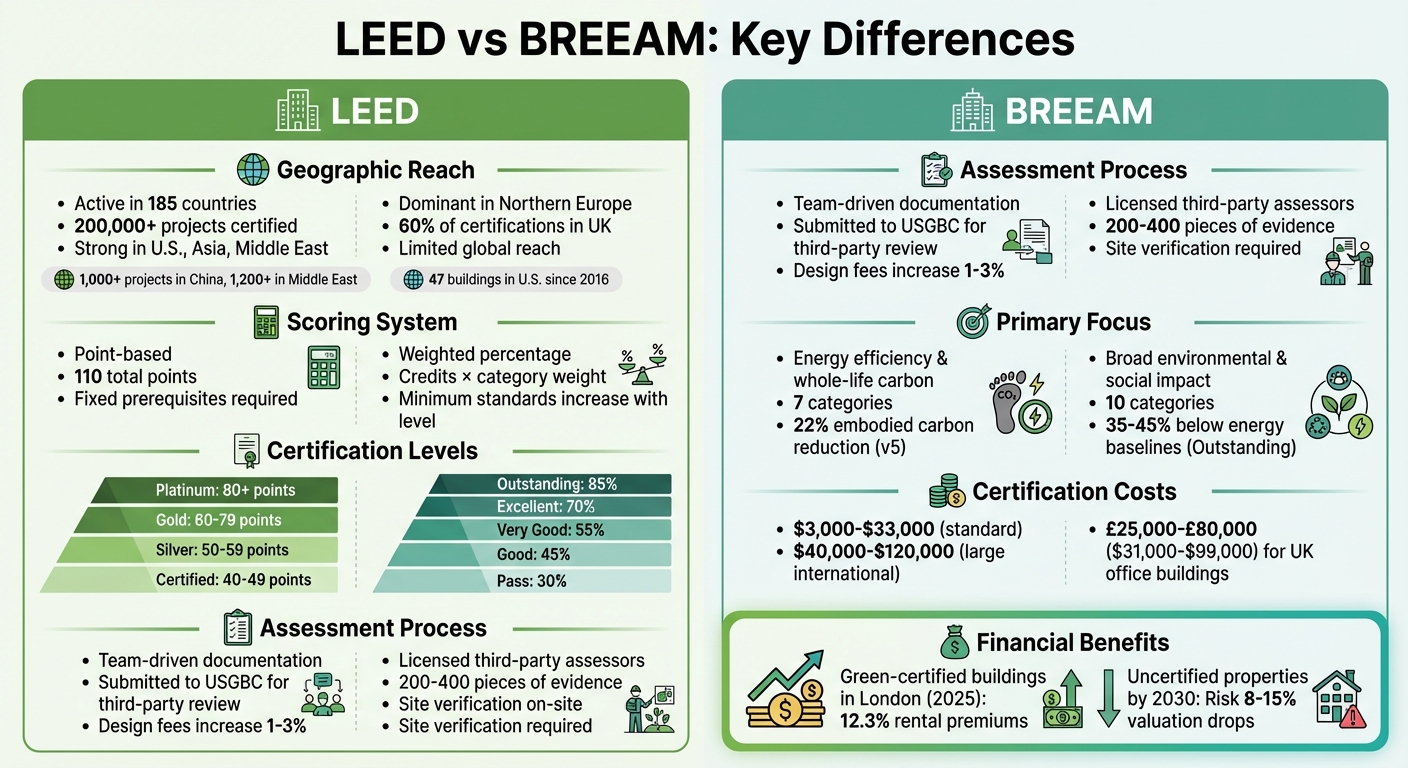
LEED vs BREEAM Green Building Certification Comparison Chart
Geographic Coverage and Applicability
LEED: Global Reach with Local Adaptations
LEED is active in 185 countries, with over 200,000 projects certified worldwide by the end of 2025 [1]. Its strongest footholds are in the Americas, Asia-Pacific, and Southern Europe, where it’s a key player in commercial real estate, where owners benchmark real estate portfolios to measure sustainability performance. Notably, in China, more than 1,000 developments have earned LEED certification, while the Middle East boasts over 1,200 certified projects [3].
One of LEED’s standout features is its ability to adapt to local needs through Regional Priority credits. These credits reward projects for addressing environmental challenges specific to their locations. For instance, a project in Phoenix might gain points for water-saving measures, while a Seattle development could focus on managing stormwater. This requires robust real estate data management to track environmental metrics accurately. This adaptability ensures LEED remains practical and relevant across varying climates and regulatory landscapes. While LEED’s flexibility allows it to thrive globally, it contrasts with BREEAM’s approach, which emphasizes tailored national schemes.
"LEED is the clear worldwide leader everywhere except the UK, and that fact alone drastically increases that certification's visibility." - Erik Dolan-Del Vecchio, Freelance Writer, VTS [3]
BREEAM: Strong in Europe, Limited Elsewhere
BREEAM dominates in Northern Europe, particularly in the Netherlands, Germany, and Scandinavia, with the UK accounting for about 60% of its certifications [1][2].
Its localized approach relies on national schemes tailored to specific countries, including the Netherlands, Spain, Norway, Germany, and Sweden. For regions without dedicated schemes, the BREEAM International New Construction program steps in [3]. In the UK, buildings rated as BREEAM Outstanding often achieve operational energy performance levels 35% to 45% below the Building Regulations Part L 2021 baselines [1].
However, this regional focus has limited BREEAM’s growth in emerging markets. Since its introduction to the U.S. in 2016, only 47 buildings across 15 states have achieved BREEAM ratings [3].
sbb-itb-99d029f
Understanding BREEAM, WELL & LEED
Certification Levels and Scoring Systems
Understanding how scoring works is crucial when evaluating the outcomes of different certification systems.
LEED: Point-Based 4-Tier System
LEED operates on a 110-point scale, where projects earn points by meeting criteria across various sustainability categories. Before accumulating points, projects must first meet all mandatory prerequisites, which establish a baseline for sustainability. LEED offers four certification levels: Certified (40-49 points), Silver (50-59 points), Gold (60-79 points), and Platinum (80+ points) [3][4].
The latest version, LEED v5 (introduced in 2024), emphasizes whole-life carbon assessments. Projects aiming for Gold or Platinum certification are now required to complete these assessments. Early data indicates that LEED v5 projects have achieved a 22% reduction in embodied carbon compared to those certified under LEED v4.1 [1]. This shift highlights the system's evolving focus on carbon reduction.
On the other hand, BREEAM employs a distinct approach to scoring and certification.
BREEAM: Weighted Percentage 5-Tier System
BREEAM uses a weighted percentage system that evaluates performance across ten categories: energy, water, materials, waste, pollution, land use, ecology, health and wellbeing, management, and transport [1]. Each category is assigned a specific weight, and credits earned in these areas are multiplied by the weight to calculate a final score. BREEAM offers five certification levels: Pass (30%), Good (45%), Very Good (55%), Excellent (70%), and Outstanding (85%) [3][4].
Unlike LEED's fixed prerequisites, BREEAM employs minimum standards that increase in stringency as the certification level rises [5][1]. For example, achieving a Pass rating requires meeting only basic standards, while an Outstanding rating demands exceptional performance across nearly all categories.
Comparison Table: LEED vs. BREEAM Scoring
| Feature | LEED | BREEAM |
|---|---|---|
| Scoring Method | Point-based (110 total points) | Weighted percentage (credits × category weight) |
| Certification Tiers | 4 levels: Certified, Silver, Gold, Platinum | 5 levels: Pass, Good, Very Good, Excellent, Outstanding |
| Point Thresholds | Certified: 40-49, Silver: 50-59, Gold: 60-79, Platinum: 80+ | Pass: 30%, Good: 45%, Very Good: 55%, Excellent: 70%, Outstanding: 85% |
| Mandatory Elements | Prerequisites (must meet all for any level) | Minimum standards (increase with higher ratings) |
| Primary Focus | Energy efficiency and whole-life carbon (v5) | Broad environmental and social impact across 10 categories |
This table highlights the contrasting approaches of LEED and BREEAM, from their scoring methodologies to their certification criteria. Each system reflects different priorities and strategies for driving sustainability.
Assessment Processes and Documentation
When it comes to certifications like LEED and BREEAM, the way assessments are conducted and documented plays a big role in setting them apart. LEED places the responsibility on the project team, while BREEAM brings licensed third-party assessors into the mix.
LEED: Third-Party Review and Submission
LEED follows a process where the design team - made up of architects, engineers, and consultants - takes charge of gathering evidence, performing calculations, and submitting documentation directly to the U.S. Green Building Council (USGBC) for review [3]. Unlike BREEAM, LEED does not involve licensed assessors in verifying or collecting this information.
This method allows teams more flexibility in design, but it can also be demanding. Teams often spend extra time on detailed calculations and comprehensive plans to meet USGBC's requirements. The work involved in preparing documentation can increase professional design fees by 1% to 3% [1]. Additionally, because the process requires navigating credit-by-credit requirements independently, it can be both time-intensive and complex. In contrast, BREEAM’s reliance on third-party assessors shifts much of this burden off the design team.
BREEAM: Licensed Assessors and Site Verification
BREEAM takes a more structured approach by incorporating licensed third-party assessors throughout the certification process [3]. These assessors handle evidence collection, conduct site visits, and submit their findings to BRE Global for quality assurance [3].
A typical BREEAM assessment involves compiling between 200 and 400 pieces of documentary evidence [1]. While this might seem daunting, the involvement of licensed assessors can ease the administrative load for the design team [3]. An added layer of accountability comes from BREEAM’s post-construction site verification phase, which ensures the building aligns with its sustainable design goals [1].
For a standard office building in the UK, BREEAM assessment fees range from £25,000 to £80,000, excluding the time spent by the design team. However, digital tools like real-time CRE analytics and BIM-based pre-assessment software can automate 40% to 60% of the evidence collection process, cutting assessor time by 25% to 35% [1]. While BREEAM’s process is more rigid, it offers clear guidelines and reduces ambiguity about what’s required.
Core Focus Areas and Weighting Criteria
After examining the geographic and scoring differences, it's clear that LEED and BREEAM also diverge significantly in their primary goals and how they assign weight to various criteria. LEED emphasizes energy efficiency and carbon reduction, while BREEAM takes a broader look at both environmental and social impacts. These differences play a key role in how each system evaluates and certifies projects, particularly in commercial real estate portfolio management. Here's how their priorities stack up:
LEED: Spotlight on Energy and Indoor Environmental Quality
LEED places a strong focus on the Energy and Atmosphere category. Under LEED v5, projects aiming for Gold or Platinum certification must measure both embodied and operational carbon, with an average 22% reduction compared to the benchmarks set by LEED v4.1 [1].
LEED v5 includes seven main categories:
- Location and Transportation
- Sustainable Sites
- Water Efficiency
- Energy and Atmosphere
- Materials and Resources
- Indoor Environmental Quality
- Innovation [1]
Among these, Indoor Environmental Quality stands out, with credits awarded for improving air quality, ensuring thermal comfort, and maximizing daylight exposure.
"LEED v5's restructuring around carbon performance represents the most significant evolution in the system's history." - Sustainability Atlas [1]
BREEAM: A Wider Lens on Environmental and Social Impact
On the other hand, BREEAM adopts a more expansive evaluation, covering ten distinct categories:
- Management
- Health and Wellbeing
- Energy
- Transport
- Water
- Materials
- Waste
- Land Use and Ecology
- Pollution
- Innovation [1]
Unlike LEED, BREEAM includes standalone categories such as Management and Pollution, which LEED incorporates into broader areas like Sustainable Sites [6][1]. BREEAM's scoring system balances environmental, social, and economic factors, with dedicated categories like Social and Economic Wellbeing and Governance - elements absent from LEED's framework [7].
This broader focus has led to BREEAM being described as more "academic and rigorous" in its assessments [3]. For example, buildings rated BREEAM Outstanding in the UK typically achieve operational energy performance that is 35–45% below the baselines set by Building Regulations Part L 2021 [1].
The difference in focus is evident in real-world examples. Take Pinterest Headquarters: it earned a LEED Platinum rating (85/110 or 77%) with perfect scores in water efficiency and indoor environmental quality. However, under BREEAM, it received only a "Good" rating (47.2%), reflecting BREEAM's greater emphasis on areas like social and economic wellbeing [7].
Suitability for Different Project Types
LEED: Adaptable for a Variety of Building Types
LEED is widely recognized for its ability to accommodate a broad range of building types and industries, making it a popular choice for developers aiming for global acknowledgment. In the U.S. alone, more than 40,000 buildings have been certified under LEED, whereas BREEAM has only recently begun gaining traction in this market [3].
LEED’s framework is designed to be versatile, allowing design teams to customize solutions to meet specific project goals. This adaptability spans across its rating systems, such as Building Design and Construction (BD+C), Interior Design + Construction (ID+C), Operations and Maintenance (O+M), Neighborhood Development (ND), and Residential. From data centers to warehouses or even mixed-use neighborhoods, LEED provides a structure that can be tailored to meet diverse needs. For instance, in 2025, Hines achieved a 31% reduction in whole-life carbon at just a 2.8% increase in cost by implementing LEED v5 Platinum [1].
LEED also aligns well with federal, state, and local incentives, adding financial appeal for U.S.-based projects. Certification costs generally range between $3,000 and $33,000, depending on the project’s size. For larger international projects, fees can climb to $40,000–$120,000 [3][1]. In contrast, BREEAM remains more focused on the European market and its regulatory landscape, making it essential to compare commercial real estate markets before selecting a certification standard.
BREEAM: Tailored for European Construction Standards
BREEAM’s strength lies in its seamless integration with UK and European regulations, which has solidified its position as the leading certification system in these regions.
"BREEAM is such a part of UK building certification that it's largely embedded into the regulations" [3].
This system is particularly effective for existing buildings and refurbishments, with specialized schemes like BREEAM In-Use offering targeted solutions. Between 2023 and 2025, registrations for BREEAM In-Use in the UK surged by 340%, highlighting a growing emphasis on operational performance rather than just design-phase certification [1]. A notable example comes from Landsec, which reported in 2025 that its portfolio of BREEAM Excellent and Outstanding properties achieved an impressive 92% occupancy rate - far exceeding the 84% rate for comparable non-certified buildings , a metric often tracked using portfolio analytics tools with custom reporting [1].
BREEAM’s assessments are conducted by licensed professionals, ensuring thorough evaluations but often at the expense of design flexibility [3]. For a typical office building in the UK, assessment fees range from £25,000 to £80,000 ($31,000 to $99,000), not including the time required for design team documentation [1]. This makes BREEAM a strong choice for European projects, especially those requiring detailed environmental assessments or incorporating strategies like natural ventilation and thermal mass [3].
Key Takeaways for Real Estate Professionals
When choosing between LEED and BREEAM certifications, real estate professionals need to align their decisions with project goals and regional demands. Here's what stands out:
Geographic location matters. LEED is widely recognized in the U.S., Middle East, and Asia, making it a go-to choice for projects in these regions or for attracting international investors. On the other hand, BREEAM is more suitable for projects in the UK and Europe, where it aligns with local regulations like MEES.
The assessment process varies. LEED allows design teams to handle documentation themselves, which is then submitted to the USGBC for third-party review. BREEAM, however, requires on-site verification by a licensed independent assessor. Sustainability consultant Eszter Gulacsy explains:
"LEED is simpler in its approach while BREEAM is more academic and rigorous" [3].
Budget planning is essential. LEED certification costs typically range from $3,000 to $33,000, while BREEAM fees average between $11,000 and $26,000 [3]. However, total compliance costs for both can account for 1.5% to 2.5% of total construction costs [1]. The investment can pay off: in central London, green-certified office buildings saw rental premiums averaging 12.3% in 2025, while uncertified commercial properties could face valuation discounts of 8% to 15% by 2030 [1].
Focus on operational performance. Long-term value depends on how the building performs after certification. A 2024 analysis found that only 46% of LEED Gold buildings achieved top-half energy performance compared to their peers [1]. Real-time asset benchmarking and regular evaluations at 12 and 24 months can ensure the building meets performance expectations and retains its certification value [1].
FAQs
Which certification is better for my project location?
The best certification often depends on where your project is located and what the market demands. LEED is highly regarded across North America, making it a strong choice for projects in the United States or Canada. On the other hand, BREEAM, which started in the UK, is more prevalent in Europe but is steadily gaining attention worldwide. In the U.S., LEED tends to be the go-to option, as it aligns well with local standards and enjoys broader acceptance in the market.
How do LEED and BREEAM affect total project costs?
LEED and BREEAM certifications usually account for about 2% of total construction costs. Surveys focused on LEED projects suggest that certification-related expenses can range from 0.5% to 2% of the overall construction budget. These costs typically cover consulting fees, certification charges, and other related investments. For many, this is considered a reasonable expense, given the environmental and health advantages these certifications are designed to deliver.
Can LEED or BREEAM improve rent and resale value?
Earning a LEED or BREEAM certification can boost both rental income and resale value. Why? These certifications indicate a property’s strong energy efficiency, lower operational costs, and commitment to environmental responsibility.
Certified buildings often attract tenants who prioritize sustainability, leading to higher demand and reduced vacancy rates. Additionally, properties with these credentials can command premium prices in the market. While the exact financial benefits depend on the project and local market trends, these certifications are widely recognized as a smart move for long-term profitability.