
How AI Powers Personalization in Real Estate Platforms

AI is transforming real estate platforms by offering personalized property recommendations, market insights, and tailored user experiences. By analyzing user behavior, preferences, and data patterns, AI tools go beyond basic filters to deliver smarter, predictive results. Here’s a quick breakdown of what AI brings to real estate:
- Property Recommendations: AI tracks browsing habits, like time spent on photos or floor plans, to suggest properties that match both stated and hidden preferences.
- Market Forecasting: Predictive analytics identify trends and opportunities by analyzing massive datasets, including sales history, neighborhood stats, and economic factors.
- Real-Time Personalization: Systems adjust search parameters dynamically, such as expanding budget ranges or emphasizing specific features based on user activity.
- Automated Tools: AI simplifies tasks for agents, like generating personalized reports, managing leads, and optimizing real estate social media ads.
- Efficiency Gains: Agents using AI see up to a 40% boost in revenue, with properties selling faster and marketing ROI significantly improved.
AI tools like CoreCast and Zillow’s Zestimate are leading this shift, enabling professionals to deliver tailored experiences and streamline decision-making. Whether it’s matching buyers with their ideal home or forecasting market changes, AI is reshaping how real estate operates.
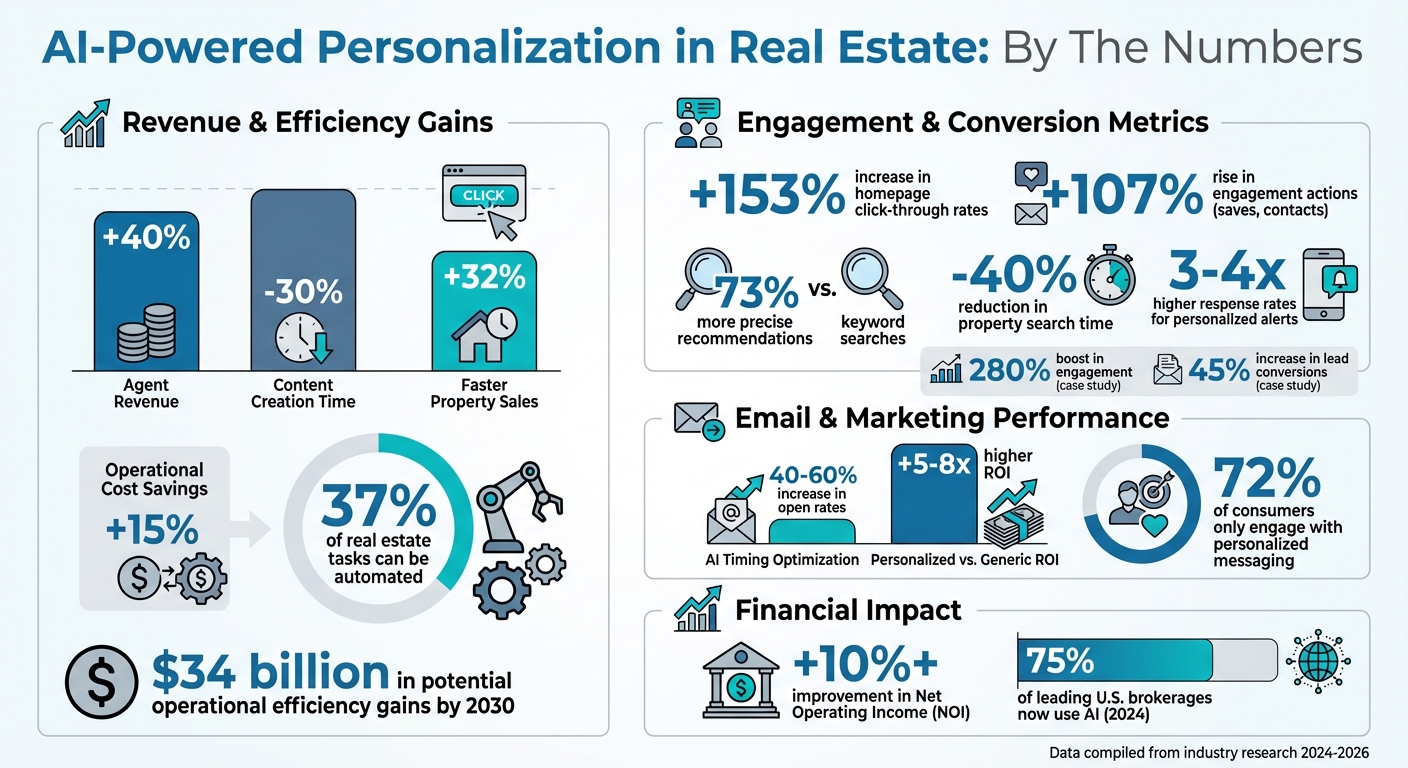
AI Impact on Real Estate: Key Performance Metrics and Benefits
Realtor CRM + AI: How to Automate + Personalize Everything
sbb-itb-99d029f
AI-Powered Property Matching and Recommendations
Modern AI algorithms take property searches to a whole new level by analyzing subtle browsing behaviors and demographic data to uncover preferences you might not even realize you have. Traditional filters like “3-bed, 2-bath” are giving way to systems that track micro-behaviors - things like zooming in on property photos, the amount of time spent on floor plans versus exterior shots, or the order in which you view listing details. These insights go beyond what you explicitly state, revealing deeper patterns of interest that basic filters might miss [5].
These systems combine collaborative filtering with content-based analysis to generate recommendations. For example, if you view two listings back-to-back, the system interprets this as a signal that these properties share something in common. As Gautam Narula, a Machine Learning Engineer at Compass, puts it:
"A user viewing two listings in quick succession offers some evidence that they are similar to each other. When aggregated over the behavior of lots of users, anonymized listing browsing data offer an informative similarity signal" [6].
Using this data, the platform creates "interest clusters" based on your recent activity to retrieve and rank properties that align with your preferences. This process allows for real-time adjustments, ensuring recommendations evolve as your interests do.
Real-Time Behavioral Analysis
Real-time behavioral analysis takes property matching to another level by dynamically adapting to your shifting preferences. AI systems can adjust search parameters on the fly. For instance, if you consistently check out listings that exceed your stated budget, the system might automatically expand its price range to include properties just above your limit [5].
This approach delivers measurable results. In August 2019, Compass introduced features like "Similar Homes" and personalized homepage recommendations, spearheaded by Machine Learning Engineers Gautam Narula and Samuel Weiss. These updates led to dramatic improvements: a 153% increase in homepage click-through rates and a 107% rise in engagement actions, such as saving properties or contacting agents [6]. The technology also distinguishes between casual browsers and serious buyers, noting that those with purchase intent often spend more time exploring local amenities or school ratings [5].
Customized Property Suggestions
AI doesn’t stop at real-time analysis - it also refines property suggestions by blending explicit criteria with behavioral cues. By combining data like budget, location, and square footage with less obvious signals, these systems deliver highly tailored recommendations. Natural Language Processing (NLP) takes this further, enabling searches based on lifestyle-oriented phrases like “cozy with space for a bike” or “quiet area near a coffee shop.” The AI understands the meaning behind terms like “character property” or “walking distance” and adjusts results accordingly [5].
For commercial real estate professionals, the technology identifies high-potential opportunities by analyzing factors like geographic proximity and relationship history using a commercial real estate market comparison tool, helping agents focus their efforts where they’re most likely to close deals.
The results speak for themselves: AI-powered recommendations are 73% more precise than traditional keyword searches, cutting search time by 40% [5]. These systems can even uncover hidden preferences. As Gombos Atila Robert observed, the algorithm revealed an unexpected preference for properties with unique character features - something that might have gone unnoticed otherwise [5].
Predictive Analytics for Market Insights and Forecasting
AI doesn't just stop at offering tailored property suggestions - it also dives deep into predicting market trends, providing a powerful edge for strategic decisions. By analyzing massive datasets - like property details, location attributes, historical sales, neighborhood stats, and macroeconomic factors - AI transforms raw data into insights that professionals can act on. This goes beyond traditional appraisals that depend heavily on past data and human judgment. Instead, AI models detect real-time shifts in demand and pricing, offering a much clearer picture of the market’s direction [7][4].
One standout feature of this technology is its ability to spot what experts call "invisible variables." These are subtle patterns buried in the data that hint at future opportunities others might miss [7]. Some platforms even source primary data to achieve near-perfect accuracy [8]. This level of precision means professionals can identify high-growth opportunities before they become obvious to everyone else.
AI also taps into sentiment analysis, tracking public opinion and news trends to flag early signs of changing market conditions [4]. By turning complex market data into digestible insights, these tools help investors evaluate deals and understand neighborhood trends - no endless spreadsheets required.
Portfolio Optimization with Predictive Models
When it comes to portfolio management, predictive models are changing the game. By forecasting performance and spotting risks before they appear, AI-powered tools are helping real estate funds allocate capital more effectively. Machine learning algorithms and neural networks are being used to maximize returns while managing risks across different markets [4]. These advanced systems even take into account spatial dependencies, ensuring local market dynamics are accurately reflected in the analysis [9].
For rental property managers, these models are invaluable. They can predict potential income, occupancy rates, and expense trends based on current market conditions [4]. Managing multiple assets? AI simplifies this too, offering automated tracking and real-time recommendations on whether to buy, hold, or sell properties [4]. This evolution toward what some call "agentic AI" is turning these tools into must-haves for decision-making in the industry [9].
Deal Pipeline Forecasting
AI is also reshaping deal pipeline management, making it faster and more efficient. Predictive tools can pinpoint which buyers are most likely to show interest in specific properties, automate follow-ups, and even generate Comparative Market Analyses on demand [4][7][2]. Some platforms go a step further by tracking client home anniversaries, creating opportunities for timely check-ins that strengthen relationships and uncover future listing possibilities [2]. These capabilities allow professionals to stay ahead of market shifts and act quickly as dynamics change.
Dynamic Content and Recommendation Engines
AI-powered recommendation engines analyze detailed user behaviors - like how long someone lingers on a kitchen photo or which neighborhoods they explore - to provide highly tailored property suggestions[5]. These systems go beyond basic filtering, offering recommendations that align closely with individual preferences, building on earlier property-matching advancements.
The key lies in semantic analysis, which interprets search intent. For instance, if someone searches for "remote working", the engine might highlight homes with features such as dedicated office spaces or strong internet connectivity[5]. This level of personalization also supports the integration of spatial insights through interactive maps.
Visual Personalization with Integrated Maps
Taking personalization a step further, integrated maps add a spatial layer to recommendations. These maps track user interactions, such as the neighborhoods they browse or the amenities they focus on. This data helps AI uncover preferences - like a preference for areas with tree-lined streets or proximity to public transit[9].
In February 2026, CoStar Group introduced Homes AI on Homes.com, blending Matterport's 3D digital twins with proprietary data on schools and neighborhoods. This platform allows users to engage in natural, conversational searches using voice or text. Andy Florance, Founder and CEO of CoStar Group, described the shift:
"Home shopping is no longer constrained by rigid filters and disjointed online experiences. Instead, it has become dynamic, consultative, and deeply personalized – mirroring the way people naturally research and evaluate a home."[10]
Automated Content Generation
AI-driven content automation complements these visual tools by streamlining user engagement. Instead of manually creating multiple versions of reports or campaigns, AI generates dynamic content tailored to individual browsing habits and preferences[3]. This capability is part of a broader personalization strategy that reshapes how professionals interact with clients.
For example, in August 2025, Marcus, a solo agent in Austin, Texas, used automated segmentation and personalized alerts to manage 800 contacts. By targeting preferences like school districts and kitchen layouts, he achieved a 280% boost in engagement and a 45% increase in lead conversions[3].
AI also reduces the time spent on crafting personalized materials by 30%, while delivering a return on investment 5 to 8 times higher than generic campaigns. Predictive algorithms further optimize timing, analyzing user activity to increase email open rates by 40–60%[3]. These tools enable professionals to scale personalized experiences with remarkable efficiency.
CoreCast's AI-Driven Personalization Features

CoreCast takes AI-powered personalization to the next level by creating a unified real estate workflow. It brings together underwriting, pipeline tracking, portfolio analysis, and stakeholder engagement into one comprehensive platform. By doing so, it eliminates the need for professionals to juggle multiple systems, reducing manual data entry and accelerating decision-making throughout the investment process.
The platform's AI tools embrace the industry's move toward anticipatory AI - a shift from merely automating tasks to providing actionable, predictive insights. These tools suggest the next-best actions, enabling users to stay ahead in a competitive market. Shayan Hamidi, Founder and CEO of Rechat, aptly describes this transformation:
"After years of testing, the industry moved from experimenting with automation to operating with AI as an integral partner."[11]
By 2026, it's expected that most top-performing agents will rely entirely on AI-integrated systems[11].
Integrated Mapping and Competitive Insights
CoreCast’s integrated mapping tools add a spatial intelligence layer to its features, addressing the "spatial dependence" unique to real estate. Users can view properties alongside competitive data on a single map, analyzing how factors like nearby developments or transit access influence valuations. This geospatial insight works seamlessly with underwriting and portfolio analysis tools, offering a detailed view of market positioning - all without switching between separate applications. This integration enhances portfolio analysis by providing a broader and more detailed understanding of the competitive landscape.
AI for Advanced Portfolio Analysis
CoreCast employs Natural Language Processing (NLP) to extract and organize data from property brochures and lease documents. This automation populates underwriting models instantly, saving hours of manual work and ensuring consistency across financial projections. Users can quickly test multiple asset management scenarios - adjusting rent levels, holding periods, or capital investments - within minutes instead of days. Reports from industry leaders highlight that AI has reduced tasks that once took 10 hours to just two minutes[11], with agents experiencing productivity boosts of up to 40%[11].
The platform also standardizes underwriting using tailored financial models. Additionally, its key stakeholder center allows users to create branded reports that adapt dynamically based on engagement metrics, simplifying communication with investors and partners.
Future AI-Driven Automation
Looking ahead, CoreCast aims to refine decision-making even further with AI agents for real estate tasks. These agents will handle workflows such as collecting lease data, scheduling inspections, and reconciling tenant expenses. Upcoming updates will also introduce advanced predictive analytics for deal pipeline forecasting, helping professionals anticipate market trends and focus on high-priority opportunities. These developments align with the growing industry trend of using AI copilots for continuous portfolio adjustments and scenario-driven decision-making[12].
Measuring the Impact of AI Personalization
Understanding the value of AI personalization requires a close look at the right metrics. For real estate professionals, engagement metrics like open rates, click-through rates, and response rates are key indicators of success. For example, just optimizing the timing of emails with AI can boost open rates by an impressive 40–60% [3]. Beyond engagement, conversion metrics such as lead conversion rates, lead quality scores, and conversion velocity (how quickly leads progress through the pipeline) are essential for evaluating performance [3][13].
Financial outcomes are just as important. Metrics like revenue growth, marketing ROI, and net operating income (NOI) provide a clear picture of the bottom-line impact. McKinsey research reveals that real estate firms using AI see NOI improvements exceeding 10% [13]. Additionally, properties marketed with AI tools sell 32% faster than those using traditional methods [13]. These metrics not only highlight AI's effectiveness but also pave the way for more precise testing and real-time performance tracking.
A/B Testing for Personalization Effectiveness
A/B testing is a powerful way to measure how well AI-driven personalization performs compared to traditional methods. By comparing AI-generated features with manual approaches, businesses can identify what drives better results. For instance, testing AI-suggested property matches against user-defined search criteria can show which method generates more engagement. Redfin's AI matchmaking tool is a great example - data shows that users are more likely to click on properties suggested by AI than those they manually select [1].
Silent A/B testing is another approach, helping refine AI models before they’re fully implemented. This method minimizes errors like hallucinations while improving the model's reasoning [14]. By tracking whether users interact more with AI-suggested content than with standard options, businesses can determine if personalization algorithms are truly enhancing the user experience.
Analytics Dashboards for Continuous Improvement
After A/B testing, advanced analytics dashboards take personalization measurement to the next level. These dashboards turn raw data into actionable insights, offering real-time views of sales, marketing, and inventory performance. They continuously improve AI-driven insights by analyzing real-world results [16][18].
To maximize their effectiveness, dashboards should focus on four main areas:
- User engagement: Metrics like lead quality scores and behavioral scoring.
- Conversion: Data points such as sales velocity and the ratio of listings to client meetings.
- Financial impact: Insights into marketing ROI and NOI improvements.
- Operational efficiency: Metrics like time saved on research and valuation accuracy [15][17][13].
Features like heat maps and behavioral scoring provide a deeper understanding of how users interact with personalized content. These tools can highlight the property types or features that generate the most interest [18]. According to the 2024 New Delta Media Survey, 75% of leading U.S. brokerages now use AI, and those leveraging advanced dashboards report operational cost savings of up to 15% [17].
However, even the most sophisticated AI tools depend on clean, well-organized data. Without robust data governance, inaccurate or incomplete data can derail efforts and compromise results [15][13].
Conclusion
AI-driven personalization is reshaping real estate workflows, delivering measurable benefits in efficiency, decision-making, and client engagement. For example, AI-powered personalization has been shown to increase revenue by 40% and cut content creation time by 30% [3]. Personalized property alerts also see response rates that are 3–4 times higher than generic notifications [3]. Additionally, AI could automate 37% of tasks in the real estate sector, potentially achieving $34 billion in operational efficiency gains by 2030 [19].
As Edward Glaeser aptly puts it:
"In real estate, the art of the deal is increasingly becoming the science of the data" [20].
This shift from intuition-based strategies to data-driven approaches underscores AI's growing role in property matching and market forecasting. Tools like predictive analytics, behavioral segmentation, and geospatial intelligence allow real estate professionals to craft tailored experiences that resonate with clients. With 72% of consumers indicating they only engage with personalized messaging [3], the competitive edge of AI becomes undeniable.
CoreCast exemplifies this transformation by offering an all-in-one real estate intelligence platform. By integrating underwriting, pipeline tracking, mapping, portfolio analysis, and stakeholder reporting, CoreCast eliminates workflow fragmentation. Its planned AI-driven automation will further streamline tasks, freeing up professionals to focus on high-value activities while the platform handles data analysis and predictive insights.
Ultimately, the real estate professionals who succeed will be those who see AI not as a replacement for human expertise, but as a tool that amplifies it. Whether you’re a solo agent managing hundreds of contacts or part of a team handling thousands, AI enables you to deliver personalized experiences at scale. The real question isn’t whether to adopt AI, but how quickly you can integrate it to maintain a competitive edge.
FAQs
What data does AI use to personalize property recommendations?
AI taps into a range of data points to tailor property recommendations. This includes search history, user preferences, and behavioral patterns, helping platforms understand what users are looking for. It also considers location data, market trends, and property value changes to ensure recommendations are relevant to current conditions. Factors like seasonal buying habits, local economic indicators, and even school district ratings play a role in refining these suggestions. By analyzing this information, AI makes the property search process more personalized and efficient, connecting users with options that truly fit their needs.
How accurate are AI market forecasts in real estate?
AI forecasts in the real estate market are impressively precise, with predictive models often reaching accuracy rates between 96% and 99% for metrics like rent growth and property valuations. That said, their reliability hinges on a few key factors, including the quality of the data being used and the specific types of assets under analysis.
How can I measure whether AI personalization is working?
To measure how well AI personalization works on real estate platforms, it’s essential to track specific key performance indicators (KPIs). Look at metrics like engagement rates, conversion rates, and how accurate the recommendations are. For example, you can monitor improvements in lead response rates, click-through rates on property suggestions, or the number of inquiries and viewings sparked by personalized recommendations. Pairing these numbers with client feedback provides a well-rounded view of how effective AI-driven personalization truly is.